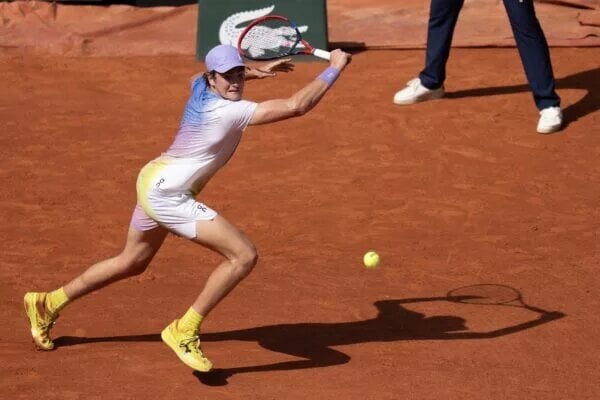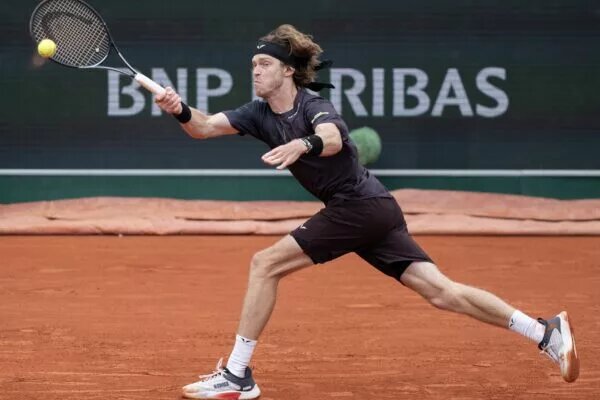



Daniil Medvedev is joint first among the ATP top 100 for most 0-6 set losses in 2026, tied with Daniel Altmaier.
On the surface, that is a strange sentence to write about a player whose entire identity is built around refusing to go away. Medvedev is the sport’s most famous sponge, a player who has spent his career absorbing pace, extending rallies, and frustrating opponents into beating themselves. He is not supposed to be a bagel merchant’s favourite victim. He is supposed to be the guy who turns a routine set into a 40-minute war of attrition that leaves the other player questioning their career choices.
And yet here we are. In April, wildcard Matteo Berrettini bagelled him twice in the same match at Monte Carlo, 6-0 6-0, in 49 minutes, the first time in Medvedev’s career he had lost a professional match without winning a single game. Medvedev responded to the second set slipping away by smashing his racket into the clay seven times in a row.
At the same time, the crowd chanted along with each swing, which is either the funniest tantrum of the tennis season or a very literal demonstration of a player’s game and temperament unraveling at the same moment.
Why Has Medvedev Suffered the Most Bagels on Tour?
Why the Wall Has a Crack in It
The explanation is not bad luck. It is baked into the mechanics that make Medvedev so good in the first place.
His signature is a return position set unusually far behind the baseline, sometimes two or three metres back, which buys him extra time to read the ball and neutralise big serves by blocking them back deep. It is a brilliant piece of engineering against players who need time to construct their offence. It is a genuine liability against players who take time away entirely.
Flat, first-strike hitters like Berrettini who serve big and follow it with an even bigger next shot before Medvedev’s extra half-second of reaction time can be put to any use. When that happens, the deep return position stops being a weapon and becomes a spectator’s spot.
There is also a strange mechanical detail underneath his return that rarely gets discussed outside of serious tactical breakdowns. Medvedev uses an unusual grip transition between his forehand and backhand, effectively flipping the racket. Hence, the same side of the strings works for both wings, which means neither hand can simply sit and wait in a fixed, ready position the way most returners do.
It is a technique that requires exceptional advanced timing to execute cleanly. Against a cold start, an unfamiliar surface, or an opponent serving with pace and placement he has not seen in a while, that grip flip becomes a guessing game rather than a read. One wrong guess tends to produce the next, and then the next, because the technique offers no natural recovery point mid-rally the way a simpler continental grip would.
Here is the part that makes the whole thing genuinely funny rather than just clinically explicable. Medvedev’s game has almost no built-in Plan B. Grinders who fall behind normally have a fallback, a drop shot, a change of pace, a heavier second serve, something to interrupt the bleeding. Medvedev’s entire method is patience and depth.
When patience and depth are being actively denied to him, there is no toolbox underneath it. There is just Daniil, several metres behind the baseline, watching the same problem repeat itself game after game, growing visibly more incandescent with each one, until the racket becomes the only opponent left he can actually beat.
The Emotional Amplifier
The final ingredient is temperament, and this is where the bagel epidemic stops being purely tactical and starts being genuinely entertaining. Medvedev is not a stoic griever of lost points. He is one of the most theatrically frustrated players on tour, prone to muttering at his box, arguing with chair umpires, and, on the evidence from Monte Carlo, systematically destroying tennis equipment in front of a delighted crowd.
For most players, that kind of eruption is a release valve. For Medvedev, whose game depends entirely on staying mentally locked into a slow, repetitive, high-patience rhythm, an emotional detonation mid-match is close to the worst possible thing that can happen, because it removes the one ingredient his style cannot survive without. A grinder who loses his composure is not a grinder anymore. He is just a very tall man standing a long way behind the baseline, increasingly upset, waiting for balls that keep arriving too fast to do anything meaningful with.
A Funny Problem, Not a Fatal One
None of this means Medvedev is in genuine decline. He remains a multiple Masters 1000 champion this season and a player capable of beating anyone on tour when his rhythm is intact. His opponent lets him dictate the terms of engagement. But the specific, recurring, total collapse is a real pattern with a real explanation. His game is built for a fight that unfolds slowly.
When an opponent refuses to let that fight start on his terms, Medvedev does not lose the way a grinder is supposed to lose. He loses the way a sandcastle loses to a wave that arrives before the tide was supposed to be in: all at once and with a racket or two left in the wreckage as evidence of exactly how it felt from the inside.
Main Photo Credit: Mike Frey – USA TODAY Sports