
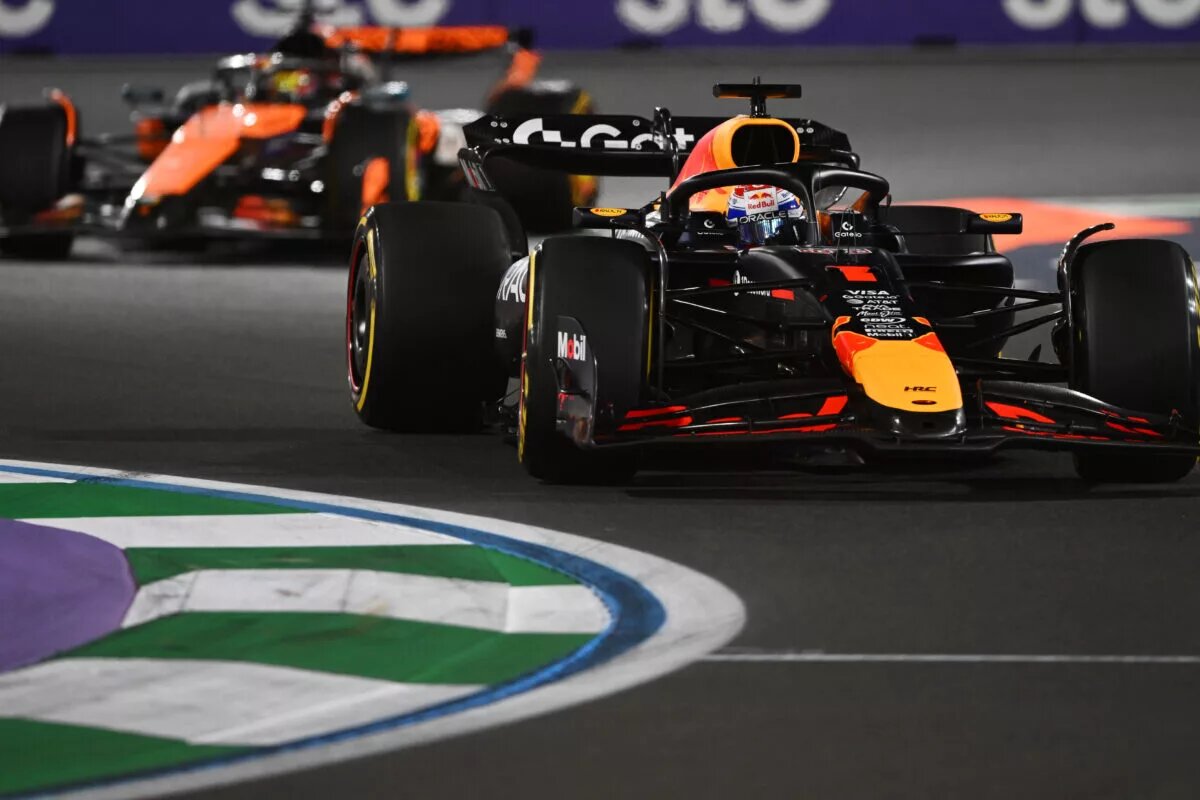

Despite missing out on victory in Jeddah, Max Verstappen can take many positives from last weekend.
On both sides of the Red Bull garage, the RB21 was competitive and more compliant than prior events.
Primarily, the Saudi Arabia GP confirmed that Red Bull’s RB21 can be very competitive at high-speed circuits.
The Milton Keynes challenger capable of being both aerodynamically efficient whilst avoiding drag.
Regarding the RB21’s persistent weaknesses, upgrades in the pipeline that Red Bull will bring in the coming weeks.
Red Bull slowly improving their operating window
Over the last twelve months, the unpredictable nature of Red Bull’s F1 cars has become a massive talking point.
Max Verstappen has been vocal about the problems with his latest challengers, as McLaren comprehensively out-developed Christian Horner’s team last year.
This year’s RB21 was particularly tricky in the opening rounds, which was best exemplified by Liam Lawson’s nightmare results.
After round two in China, the consensus was that Red Bull lacked the performance to consistently challenge McLaren.
Piastri and Norris secured a relatively comfortable 1-2 finish, even with the British driver suffering a brake issue.
During the last triple-header, however, Red Bull have unlocked some performance in the RB21.
At high-speed circuits, which reward aerodynamic efficiency over pure traction, the Austrian team are very competitive.
Verstappen’s pace in both Japan and Jeddah are confirmation that Red Bull can challenge McLaren at certain layouts.
Red Bull have admitted their simulator correlation is relatively inaccurate, which has compromised their baseline set-ups in several weekends.
With that said, their trackside engineers have consistently found ways to widen the RB21’s operating window.
This is perhaps best evidenced by Yuki Tsunoda’s trajectory, with the Japanese driver already showing glimpses of impressive pace.
Assuming he can have a clean weekend, the 24-year-old should build on his consecutive Q3 appearances and begin scoring solid points.
Tsunoda has commented the RB21 is obviously a tricky car, but emphasises that putting everything together is not impossible.
Considering his pace without a single pre-season, more mileage in the coming weeks should allow him to cement his position within the team.
Upgrades due in Imola
As previously outlined, Red Bull can bring the fight to McLaren at certain circuits – but the MCL39 still reigns supreme overall.
The Woking-produced machine has no weaknesses, making McLaren favourites going into every race weekend.
Traction zones and low-speed corners are where Oscar Piastri and Lando Norris enjoy the largest advantage. China and Bahrain have both exemplified this.
It will be these areas that Red Bull will aim to address with their next upgrade package – due at the first European event of the season in Imola.
A significant set of updates is expected, with Helmut Marko explaining in after the Australian GP that improvements were incoming.
Christian Horner has previously signalled the team’s willingness to delay 2026 development to try and gain an advantage in this year’s title race.
In the context of Red Bull’s 2026 engines, it is understandable that this season will be prioritise.
Horner’s squad also believe that new flexi-wing directives (to be implemented at the Spanish GP) could hurt McLaren.
With the RB21 fluctuating at around 1-3 tenths behind the MCL39, Red Bull anticipate a combination of effective updates and a new Technical Directive could boost their title chances.