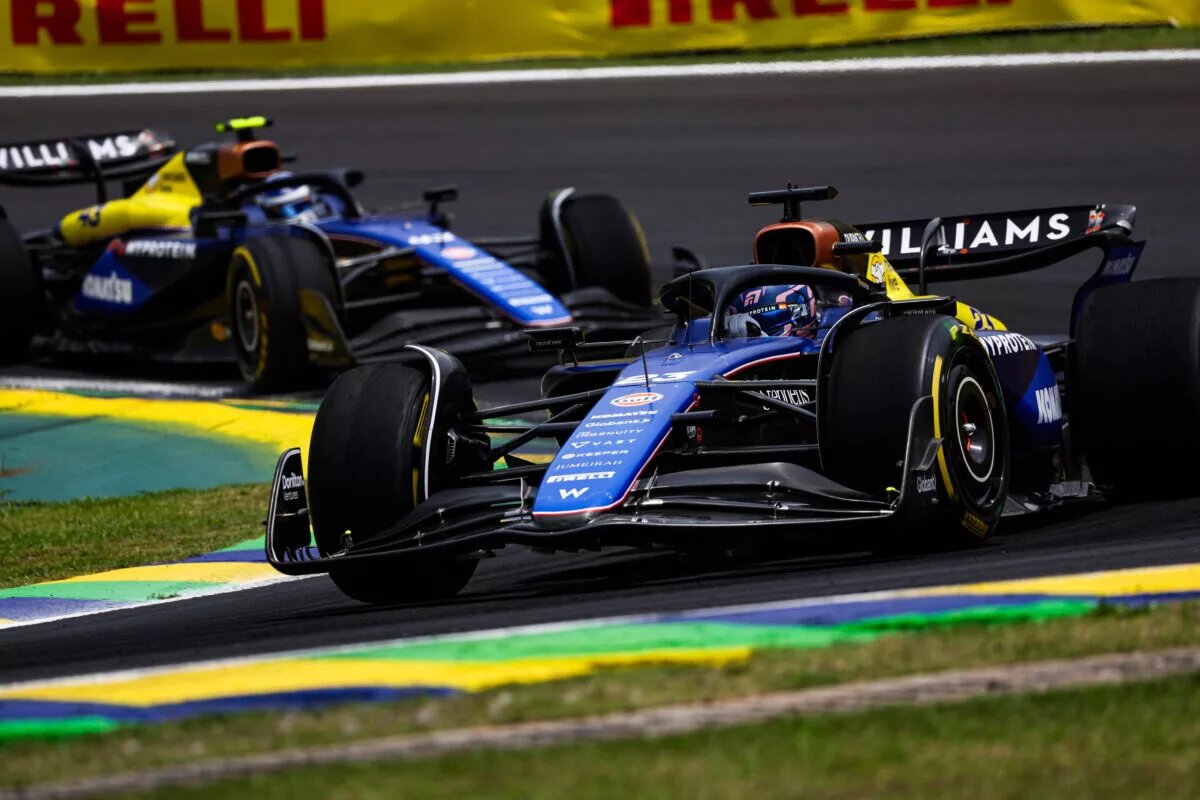
Williams have suffered from an immense number of crashes over the last twelve months. Team principal James Vowles explains how next year’s car will be impacted – as preparation continues on the 2026 regulations.
James Vowles: No team could anticipate 17 incidents in one year
Since joining Williams at the beginning of 2023, James Vowles has made no secret of his ambitions for the team.
The former Mercedes engineer wants to rebuild Williams into a title-contending force, capable of competing consistently at the very front.
To achieve this, Vowles is willing to make short-term sacrifices for the sake of long-term progress.
Even before the team’s repair bill sky-rocketed, focusing on the 2026 regulations was a prevalent theme in Vowles’ media statements.
After the conclusion of this year’s campaign, this sentiment was as strong as ever.
READ MORE: Why Yuki Tsunoda is at a dead end with Red Bull
The 2026 regulations are the key
Following the crashes Franco Colapinto and Alex Albon have suffered, the factory in Grove have been forced into adjustments.
James Vowles outlined the team’s position in ‘The Vowles Verdict’.
“The impact on ’24 and ’25, is you can choose where to deploy your aerodynamic resource.
“Do you want to put it all in the ’24 car early on, or do you want to change your ’25 car?
“Which in our case, has some different layout at the rear of the car – certainly some different solutions we’ve come up with.
“So our investment was in 2025 fairly early on,” the Williams team principal explained.
“And the reason being, that it gives us a good method to invest in 2026 early as well.
“Which is really what our intention is, just forward load these all years to give us the best run possible for 2026.
“The biggest impact on ’25 has been the amount of attrition, the amount of accidents we’ve had over these last Grand Prix.
“We’ve been managing it as best as possible. It’s fair to say we haven’t been building new [parts].
“We’ve been trying to keep back stock that we can maximise our opportunity into 2025.”
Williams take a calculated risk
In some ways, Williams can take positives from their performances at the end of 2024.
For several rounds, the FW46 was being fitted with older specifications that were still in the team’s stockpile – since producing new parts would be too costly.
Despite this, the Grove-based outfit were still relatively competitive at the season finale in Abu Dhabi.
Alex Albon narrowly missed out on points with an audacious one-stop strategy, climbing the field after being forced to take a grid penalty.
Even before the final triple-header, Williams were already on the backfoot.
The car they brought to track in Bahrain – due to several reasons – was a more basic version of the FW46 than they wanted.
However, as mentioned previously, James Vowles continues to emphasise the importance of future growth.
This is why Williams spent the winter break working on their foundations and overall design and manufacturing process.
The result of this was an overweight car to start 2024, in addition to a relatively lack lustre development programme.
With this context in mind, the British squad were relatively competitive amidst a variety of limiting factors.
For 2025, Williams’ main objective will be to tread water before putting all their cards on the table for the 2026 regulations.