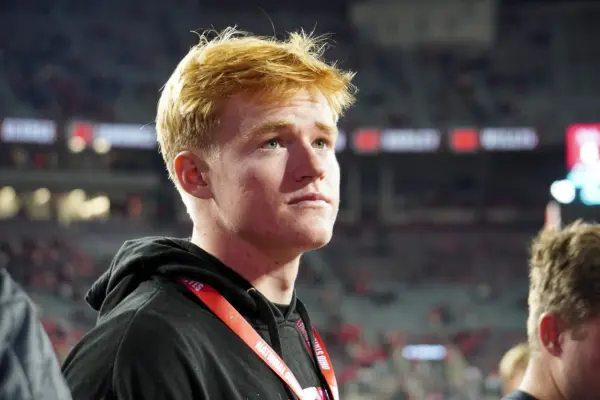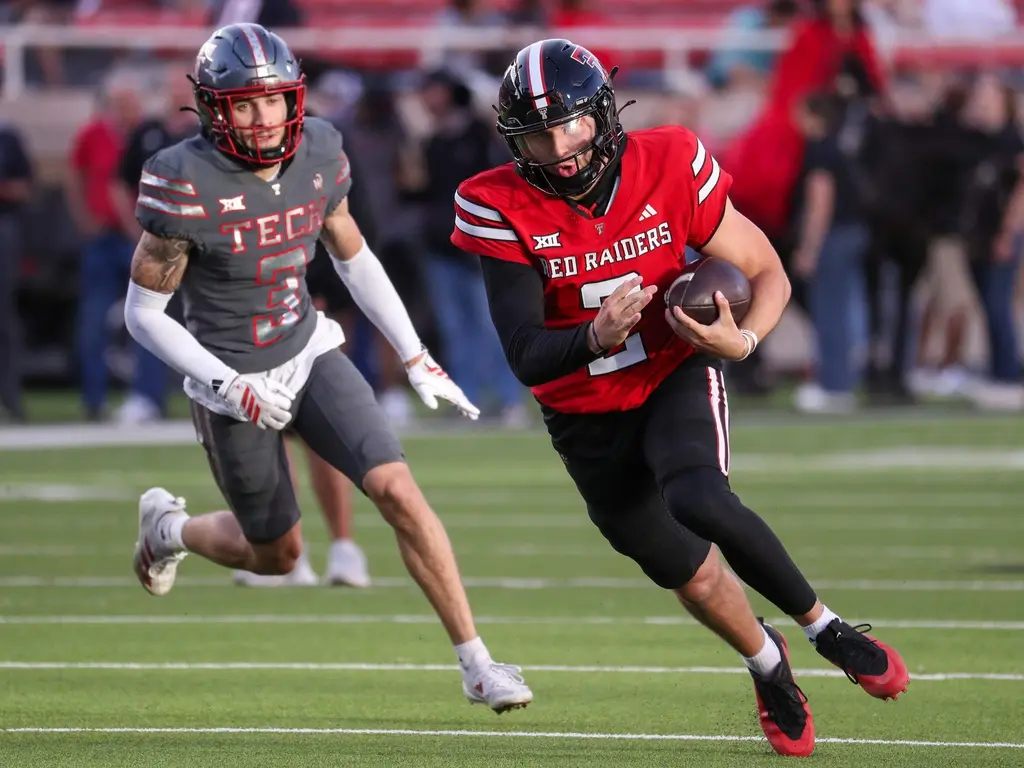
EDITORIAL: Texas Tech quarterback Brendan Sorsby checked himself into a rehab facility in the last few days for an addiction to gambling. With it comes the jokes on social media about his life choices, as well as additional scrutiny going forward for the foreseeable future. But should that future include being banished from college football?
Will the NCAA Hypocrisy Get To Brendan Sorsby?
The Sorsby Story
The 2026 season would have been Sorsby’s fifth and final season of eligibility, especially with the NCAA’s Five for Five plan likely to go forward. He spent two years at Indiana, redshirting in 2022. He was at Cincinnati in 2024 and 2025, before entering the portal and landing at Texas Tech for the 2026 season. Sorsby was considered by some to be the best quarterback available in the 2026 transfer portal class.
He was slated to get millions in proper revenue-sharing money. That is in addition to millions more from the Cody Campbell friends and family program that allows Tech to circumvent revenue-sharing cap rules.
But now all of that is likely gone. Sorsby has violated NCAA rules on gambling. He has admitted to using digital media gambling services to place bets on Indiana football in 2022, his redshirt year. It is a sidenote that he was under the legal gambling age at the time. But that is not a Texas Tech or NCAA problem to fix. That is an age-verification flaw in the gambling app. Sorsby appeared in just one game for the Hoosiers in 2022, going three for six passing for eight yards. He clearly was not betting on his performances but was betting on games involving his team. That exacerbates the NCAA scrutiny he faces. He played in 10 games for Indiana in 2023, throwing for more than 1,500 yards, and the numbers suggest he was still placing bets.
There are newly unearthed rumors that he also gambled on Cincinnati football while he played with the Bearcats. There has been no comment from Sorsby or his representatives on that, and there has yet to be any proof to back that up.
A Precedent
The NCAA has not yet met with Sorsby or his people, and they probably will not until he has spent more time at the rehab facility. But there is precedent for a season-long suspension. In 2023, Iowa defensive lineman Noah Shannon was suspended for the season for gambling on non-football Iowa athletics. Shannon’s college career was over. He went undrafted by the NFL the following Spring. He spent a few months with the Raiders under an undrafted free agent contract but was cut before the season started.
Does Sorsby deserve the same punishment? It depends. Is the NCAA and the college sports community ready to answer for its rampant hypocrisy? NCAA televised events are filled with ads for digital gambling sites. Fan Duel, Draft Kings, Bet MGM, and others spend a not-so-small fortune on commercials with financial inducements for using their site.
The NCAA and each of the Power Four conferences get tens of millions of dollars in rights fees from ESPN and Fox. Those networks get millions in advertising revenue from gambling sites. And those sites advertise on the networks’ college sports broadcasts. So, college sports live in a “Do as we say, not as we do” world. And it is those people living on Hypocrisy Lane who will determine Sorsby’s college future.
The New Gambling World
Gambling on sports used to be a lot more black and white. There were two teams, a point spread, and an over/under on the point total for the game. Watch the full game to keep up on your bet, or check in later. It didn’t matter much. But with the advent of proposition, or prop, bets, and live in-game prop bets, the entire activity has changed.
Now you have the ability to, during a game, place a bet on something that might or might not happen later on during the game. It certainly compels one to stick around throughout the contest, following every down, every score, every carry by a running back or tackle by a linebacker. And it encourages ongoing gambling activity throughout the game. Sorsby took the bait and got caught on the hook. Millions do every year. They “only” have to face their friends or family with their addiction. Sorsby has to face all of college football.
These Are Not the Old Days
There have clearly been issues with gamblers causing games to be fixed by players. There have been famous point shaving scandals at places like CCNY, Boston College, and Arizona State. But those were all basketball scandals. It is easy to throw a game in basketball with some missed free throws or some well-placed turnovers. It can be controlled by one person. It’s much harder in football with numbers on the field on every play.
The NFL went scorched Earth in the early 1960s with a gambling scandal involving stars Paul Hornung and Alex Karras. For decades, the league perpetuated the myth that gambling was a non-issue, all while the NFL on CBS pregame show was airing point spread predictions by Jimmy “The Greek.”
As the years went on, Fan Duel, Draft Kings, and other gambling sites showed up on the backdrops behind coaches as they did their post-game press conferences.
The System Invites the Problem
College programs have not yet gone that far. But they now mirror the NFL in another element. Every FBS conference requires its schools to submit an injury report to the league offices 48 hours before a conference game. The NFL has been doing that since the 1940s.
And what is the point of the injury report? Legitimately, nothing. It is not about fair play or transparency, so the opposition knows who they will or will not be facing next week. Coaches are preparing for anyone and everyone to play. So, we ask again. What purpose does the “Thursday” injury report serve? Well, it certainly aids the bookmakers in setting odds for games and managing potential in-game prop bets. Really, the odds makers are the ones primarily benefiting from the rule. Well, they and the habitual gamblers who are getting a preview of their weekend activity.
Look, what Sorsby did was bad, and he broke a litany of rules. But this isn’t the 1950s, 60s, 70, etc., where the point shaving and gambling scandals were brought about by athletes having ties to the Mob. We aren’t looking at the Gambino crime family covering its gambling activity by paying players to alter games.
What To Do With Sorsby
We are looking at a young man, 17 at the time he first had an online account, finding a way to gamble, presumably with his own money, and getting hooked, by one of the NCAA’s indirect business partners. He clearly has a problem. Reports, including some by his own admission, indicate there were periods where he was placing as many as 20 bets per day.
Make sure he gets through his rehab. Insist on verification. Suspend for three to six games. Mandate that he continue outpatient treatment for his addiction and get verification. Make him do community service work. Make it a one-strike case. Any other misstep and he is gone for good. But he was patronizing the friends of the networks that are paying the NCAA and conference’s bills. That’s as much on you as it is on him.
Main Image: Nathan Giese/Avalanche-Journal / USA TODAY NETWORK via Imagn Images