

The Protect College Sports Act could see its time for a full vote by the US Senate as early as Thursday of this week, according to multiple reports.
The Protect College Sports Act
This Week
The bill, which passed the Senate Commerce Committee by a 19-9 vote last month, continues to undergo alterations prior to the vote. Committee member Eric Schmitt (R-MO) said yesterday that he believes the bill has the votes needed to pass the full Senate. The timing of the vote matters because the Senate is scheduled to go on its Summer recess in two weeks, so the calendar is in play. That break will be about a month, so any momentum the bill currently has is at stake.
The bill needs 60 yea votes in the Senate to pass and move on to the House of Representatives for final passage.
Revisions
The legislation has gone through some changes since its committee passage. But a current version has yet to be made public, so all of the alterations are not yet available.
One of the changes we do know about involves a prohibition on super leagues. The original proposal targeted the SEC and Big 10 with language that prevented further mergers designed to get college sports down to just the two primary conferences. SEC commissioner Greg Sankey and Big 10 commissioner Tony Petitti took umbrage at their conferences being the target of the language. The bill that came out of committee was changed to include the ACC and the Big 12.
Conferences
But there has been another change since then. To allow Group of Six schools to move up to the Power Conference level, a specific number would be imposed as a cap on membership for the conferences. The membership limit would be 19 schools for any conference. The SEC currently has 16 schools; the Big 10 has 18 members; the Big 12 has 16 schools; and the ACC has 17 schools, plus Notre Dame, which is a member for all sports except football.
The definitive number would allow the P4 conferences to take schools from the smaller conferences. They could poach from other P4 conferences, but the bill mandates that any current Power Four school that leaves it current conference must exist as an independent for five years before joining the new conference. That would likely put up financial roadblocks to those moves. There has been the anticipation of a wave of realignment as television contracts come up for renewal in the next three years.
The Television Market Issue
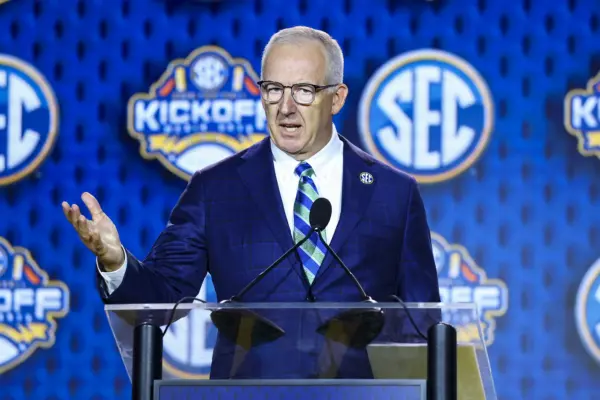
Sankey talked about the TV issues in the legislation during his opening comments at SEC Media Days in Tampa, FL on Monday. He has opposed the portion of the bill that incentivizes conferences to go to the marketplace as one for the television contracts. The SEC and the Big 10 have significant revenue advantages over the rest of college sports when it comes to their media deals.
Anything that takes away the individual conference negotiations and moves them to a unified effort would close that gap between the Big 10/SEC and the ACC/Big 12. Clearly, ACC commissioner Jim Phillips and Big 12 commissioner Brett Yormark do not oppose the concept of a unified TV deal. It does not appear that there have been changes to the structure of what a unified negotiation would look like. The proposed legislation says that in order for there to be a unified television negotiation with the networks, there must be 70% participation among all FBS schools. If every school in the Big 10 and SEC opposed the idea, it would still surpass the 70% threshold by seven votes. Conferences that oppose it could still be on their own to find their own television deals.
Commissioners Remaining Involved
Sankey said he continues to talk with the bill’s originating authors, Ted Cruz (R-TX) and Maria Cantwell (D-WA), about changes to the bill he thinks are important. During his speech Monday, he called for a singular framework for college athletics that would supersede the variety of state laws currently in existence. He said the SEC seeks “National standards through federal legislation.” He said that with athletes and schools using individual state laws to move their agenda forward, congressional intervention “provides a needed path for long-term stability.”
Last week, at ACC Kickoff in Charlotte, Phillips said he was in daily communication with lawmakers and their staffs. The week prior to that, Yormark said he would be returning to Washington DC for further lobbying efforts before a final vote on the bill.
Main Image: USA TODAY Network via Reuters Connect