
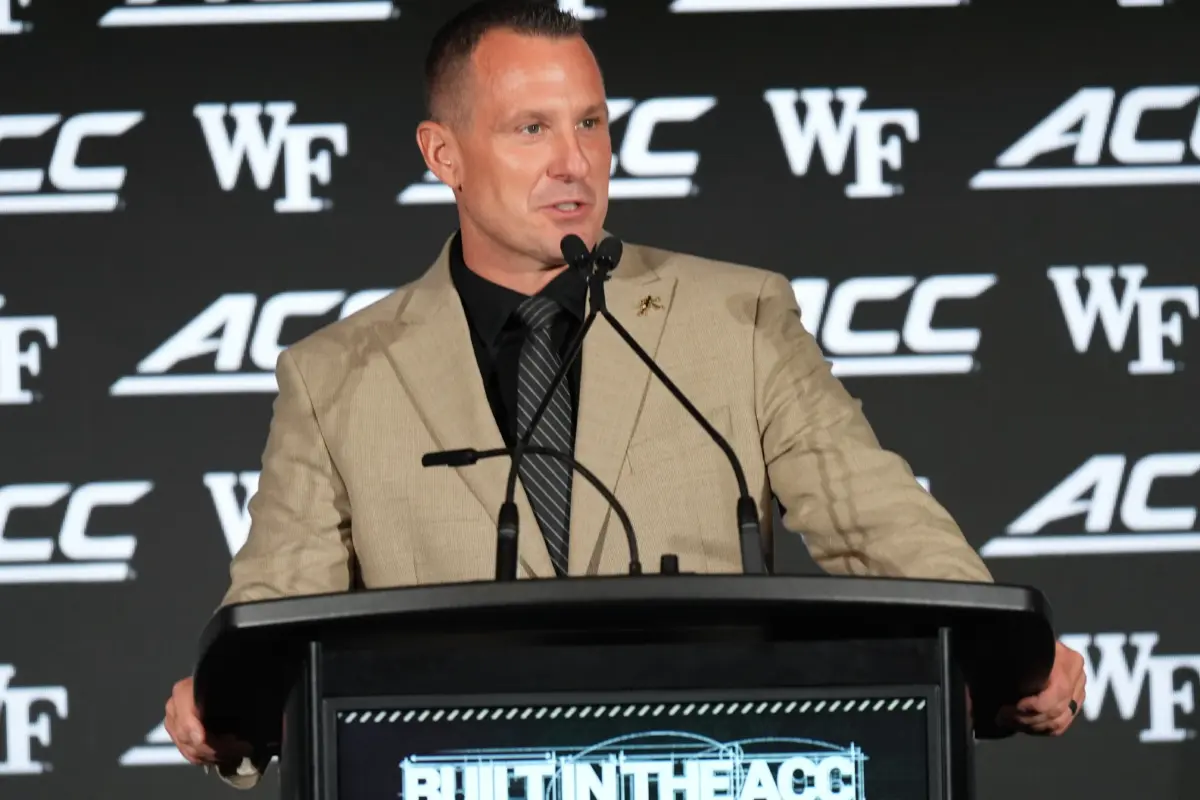

Jake Dickert’s second act as the Wake Forest head coach comes under two categories. The first is what all coaches go through. “What have you done for me lately?” The second category is far more complicated because it has to do with resources. Or in this case, the lack of them.
Jake Dickert’s Second Act at Wake Forest Has a Pretty Big Obstacle
The Haves and Have-Nots
College sports were never a completely equitable playground for competition. But now they are less so than ever before. The House v. NCAA settlement last Summer put a revenue-sharing cap of $20.5 million on each athletic department across the country. That was supposed to be all the money any school spent on its athletes. The compliance is few and far between. There are exaggerated reports of schools spending anywhere from $10 million to $30 million above that. Athletes are selling the ownership of their NIL rights back to the school for additional payroll.
And then there are those schools that are not wildly over the revenue-sharing cap. Welcome to season two of the Jake Dickert era at Wake Forest football, an era that has the program spending less instead of more.
To the Cap and Beyond
The $20.5 million cap is for each school to spend on payroll for athletes as it wishes. Some schools never get to the $20.5 million cap.
Most schools spend the bulk of the money on football since it also returns the lion’s share of the revenue. The rest is spread out over basketball and other sports at the school’s discretion. At Wake, the money spent (which will never be fully transparent since it is a private school and the athlete contracts are private) is viably spread out over four to five sports.
But that gets us back to football. Jake Dickert turned in the best season for a first-year head coach in school history. Wake was 4-8 in each of the last two seasons of the Dave Clawson era. Dickert came in from Pullman, WA, and turned in a 9-4 season, including a win over Mississippi State in the Duke’s Mayo Bowl.
What Have You Done for Us Lately?
You know what that got him in year two? Increased expectations with a smaller budget. Yes, Dickert got the old business bromide of “We’re just going to have to do more with less.” Credible media reports and sourcing for Last Word confirm that athletic director John Currie gave Dickert $2-$3 million less to work with for 2026. That means less money for the transfer portal, less money for current roster players, and a lot of financial juggling for football general manager Rob Schlaeger. Congrats on the successful first season, Coach Dickert.
We Asked the Questions
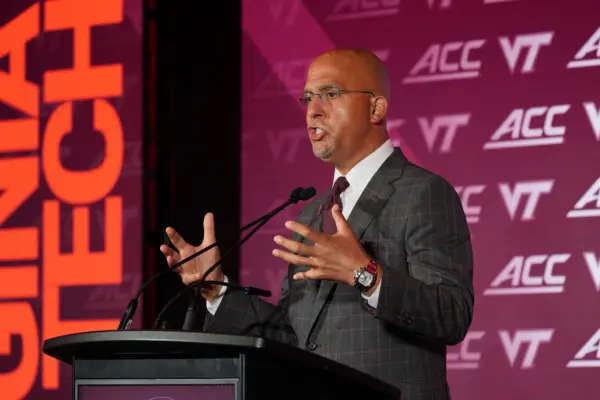
Going into his second season, Dickert looks around the country and certainly up and down the ACC and can see teams spending money he simply won’t be given. He addressed our questions at ACC Kickoff this week about what the landscape looks like when you are not given the same financial resources as others, but are still expected to compete with them.
“I think you’ve got to control your mindset with it,” he said in response to our question about how to compete with the schools that spend. “One of my pet peeves with our game is that there are so many excuses. So if we’re not good, next year I just get to come up here with a free excuse that we don’t have this and that.”
Dickert is no stranger to working with financial smoke and mirrors. He was, after all, an assistant coach at many much smaller schools. From the main stage in the press conference room, he addressed that topic.
What Wake Forest Can Do for You
“Well, at D3 I sold raffle tickets to get into fall camp, so I don’t know if that’s what you’re referring to. Every level of college football, every place has challenges, right?” He added, “The big thing that I think at Wake Forest we know where we are. There’s this corporation of football going on, but, you know, if we think and act like Miami, we’re not going to be successful, right? If we believe in action that we’re going to be Clemson and their roster-building, it’s just not going to be successful.”
He described the environment at his current coaching stop: “There’s a perfect lane of Wake Forest football. We need to push. We need to advance. We need to realize that football is a tremendous investment, and we’re always going to do it a certain way. I think that’s the role that I accept,” he said. “Once again, there are no excuses. I think that’s really important. That’s our mindset.”
The Three Tiers of the ACC
That gets us back to our Q&A with him on that topic. Dickert has acknowledged to us in the past that he sees three tiers of spending schools in the ACC, and he believes Wake Forest is in the third of the three tiers. He said on Friday that he just has to learn to work with the realities.
“We’re a developmental program. There’s a disadvantage to doing it that way in today’s world,” he said. We don’t get to just pull and plug players. But we’ve got to believe and be convicted in who we are more than ever.”
He said he still has the belief that continued success with the program can bring investment that could get Wake Forest into the second of the three tiers. “We have a plan to go do that, and I think our people are more energized than ever to go do it.”
He did plant a flag in the ground about the impact of the money and his coaching colleagues. He said, “We’re going to see who’s the good coaches and who just has the biggest payroll.”
We will have more coverage of Wake Forest from ACC media days.