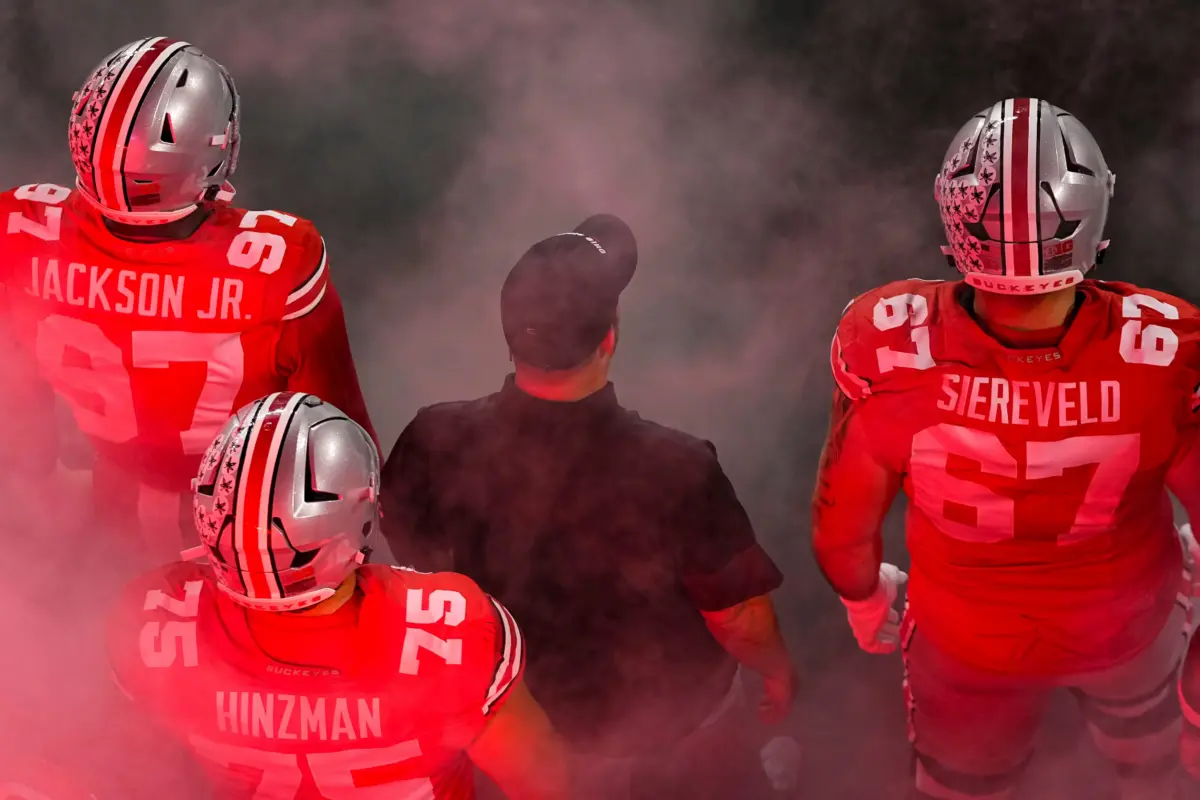

Over the years, the Ohio State trenches have been home to plenty of All-American and early NFL Draft talent. Since the 2013 NFL Draft (ie, since Urban Meyer took over and through the Ryan Day era), Ohio State has had 45 draft picks from the offensive and defensive lines, and 10 consensus All-Americans (six of which were unanimous). Last year saw no trench players go in the first round, with Kayden McDonald’s selection with the 36th pick as the highest. The year prior, three trench players went in the first with Donovan Jackson, Tyleik Williams, and Josh Simmons.
With how last year ended, there were concerns on both sides of the ball. The offensive line was great against teams that did not play in the national championship. The defensive line was alright, but nobody stood out as most fans are used to.
This offseason, the Buckeyes lost one starter on the offensive line to the transfer portal, along with four more depth pieces. Ethan Onianwa was drafted, but he only played 96 snaps. If you count C.J. Hicks as an EDGE, Ohio State lost six defensive linemen to the portal and two to the NFL. Losing McDonald and Caden Curry to the NFL hurts, but losing potential in Jarquez Carter and Dominic Kirks really stings.
As a result, the Buckeyes were active in the portal on the defensive side, all while returning four starters on offense. Despite how the season ended on offense, plus the turnover and concerns on defense, certain experts are incredibly bullish on the Buckeyes.
Why Are Expectations High for the Ohio State Trenches?
What Was Lost
Let’s start with the departures. On the offensive line, Tegra Tshabola hit the portal and landed at Kentucky. While he was widely considered the weakest link on the offensive line, he logged 607 snaps and started 12 games last year. He was one of the few returning members of the starting five from the national championship season, in which he played 781 snaps and started all 16 games.
However, while Kentucky is thrilled with the pickup, it could be addition by subtraction for Ohio State. If PFF is your thing, he was graded with a 56.5 mark for the year. Heading into the CFP, out of 493 qualified guards at the FBS level, Tshabola was 321st in run blocking, 349th in pass blocking, and 392nd overall. Of course, PFF only charged him with one sack over the last two seasons, so to each their own.
The depth lost was not as concerning. In total, Ohio State lost Justin Terry (57 snaps), Isaiah Kema (31 snaps), Jayvon McFadden (15 snaps), and Devontae Armstrong (no snaps). The guys battling to replace Tshabola (and maybe another incumbent starter) are expected to be much better.
Defensively, as we said in the lead-up, the Buckeyes lost NFL talent and plenty of potential. Carter looked to be the next man up with McDonald off to the NFL. While Hicks never truly lived up to his five-star billing, the athleticism was always intriguing.
All in all, despite all of this, Phil Steele, in his annual preview magazine that is well worth it, listed the Ohio State trenches highly. On offense, Steele considers the Buckeyes’ line to be second only to Notre Dame’s. On defense? Steele expects the Buckeyes to be The™ best.
THE Best?
If you polled the casual observer of college football to name a single player on the Ohio State defensive line, many would come up empty. The Buckeyes lack a household name that they had with Joey Bosa, Nick Bosa, or Chase Young. Curry was good, but he wasn’t on the level of those three.
This year, the known commodities are Kenyatta Jackson Jr. and Eddrick Houston. Both have played significant snaps in scarlet and gray, and both are expected to be the leaders in the room. However, neither has been the guy whom offenses have to game plan around. They could be, but they haven’t been.
Ohio State went out and signed Qua Russaw, James Smith, and John Walker to help out. Smith and Walker are considered interior defenders, while Russaw is expected to add to the EDGE room.
The thing about this unit is that, on paper, sure, it could be the best. However, college football is a “what have you done for me lately” sport. None of those players has done much to this point.
Steele’s section on the Buckeyes is optimistic: “It’s always next man up at OSU, especially along the DL. They allowed 85 rush (2.8 per attempt) yards per game last year despite returning no starters. This is a more experienced and deeper group that adds 2 Alabama VHTs (very highly touted) and a UCF star to vets Kenyatta Jackson and Eddrick Houston.”
We know what Matt Patricia did with a defense that had to replace eight NFL Draft picks. He turned it into the best defense in the nation and produced three top-11 picks. Sure, Caleb Downs would have been a top pick even if he went to Ohio University, but we digress.
Steele is banking on better depth and a natural progression from the Buckeyes’ defensive line. It’s a very optimistic outlook, that’s for sure. However, with Patricia and Larry Johnson coaching the unit up, anything is possible.
With a schedule boasting as many NFL-bound talents on offense, this defensive line will have to be the best in the country to make sure the Buckeyes aren’t overwhelmed for the first time in 15 years.
Betting on Vets
The selection of the Ohio State offensive line as number two is, rightfully, eyebrow-raising. Struggling against the best and second-best teams in the nation is not the end of the world. When you looked at the monsters on that Miami front, it made sense. However, at Ohio State, you’re expected to hold up against the best of the best.
Heading into 2026, Ohio State is returning four starters. Between Austin Siereveld, Luke Montgomery, Carson Hinzman, and Phillip Daniels, the unit played 3,249 snaps and started a combined 55 games last year (Daniels missed one game).
Why are they considered one of the best despite struggling late? It’s honestly pretty easy. Steele is betting on the veteran leadership.
In his blurb, Steele says, “Last year, the OLine opened holes for 163 (4.7 ypc) rush[ing yards per game] with just 9 sacks despite returning only 2 starters. This year, they have 4 starters back and 89 career starts, and it figures to be their best OLine in a couple of years.”
Ohio State actually allowed 18 sacks and averaged 170 yards per game (4.64 yards per carry) from its running backs. Regardless, Siereveld, Montgomery, and Hinzman all played a part in the national championship run. All three came off the bench due to late-season injuries to Simmons, Seth McLaughlin, and Zen Michalski. Hinzman actually battled his way out of the dog house, considering he was the starting center before his benching before the Cotton Bowl loss to Missouri.
There were plenty of issues with last year’s unit, but some could be attributed to what it was working with. The run game struggled…until Bo Jackson took over. Jackson averaged 83.9 yards per game and 6.1 yards per carry. He and his fellow true freshman, Isaiah West, provided a spark that the rest of the running back room lacked. Heading into 2026, those two are the lead backs, resulting in plenty of hype.
At the same time, Julian Sayin did not run the ball much or well. Having a quarterback with at least a threat of movement causes the defense to think twice. They didn’t have to with Sayin, but if all reports coming out of Spring are accurate, they will this year.
Ohio State’s offensive line will be much better in 2026. Will it be the second-best unit in the nation, as Steele says? Massive, if so.
To continue to support Last Word on College Football’s coverage of The Ohio State Buckeyes, visit our team page. On Twitter, give us a follow at @LastWordOnCFB and @LastWordOSU.