
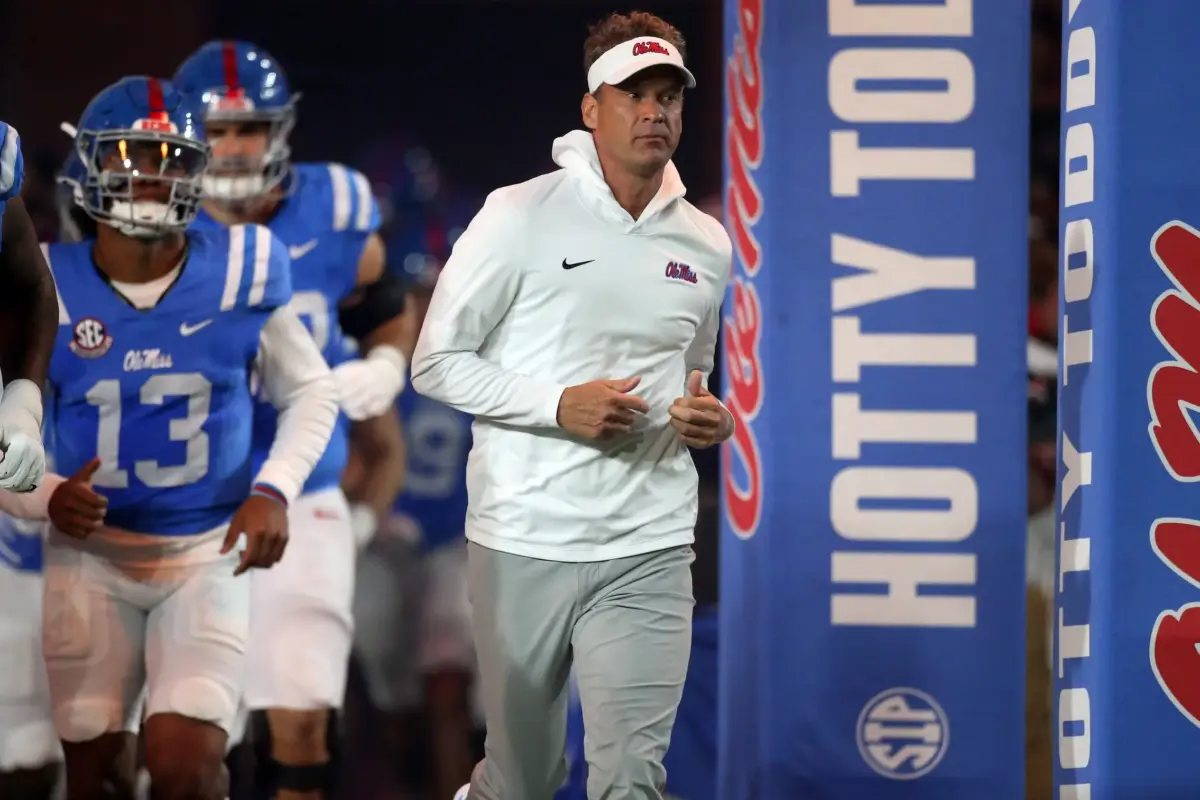

At this point, we’ve likely all seen Lane Kiffin’s recent comments surrounding race and the Ole Miss recruiting history. In an interview with Vanity Fair that was released this week, the former Rebel head coach took aim at the state’s checkered past to explain some of the recruiting struggles he had while at the helm in Oxford. However, a deeper look at Ole Miss’s recruiting history raises questions as to the validity of Kiffin’s comments. So were the comments based on truth, perception, or was it potentially Kiffin just running his mouth to stir up more drama? After all, that is something he is known to do.
First, let’s look at the comment that finds itself as the main source of the controversy. According to the article, Kiffin said that he had recruits who would tell him, “Hey coach, we really like you, but my grandparents aren’t letting me move to Oxford, Mississippi.” He then continued, “That doesn’t come up when you say Baton Rouge, Louisiana. Parents were sitting here this weekend saying the campus’s diversity feels so great: ‘It feels like there’s no segregation…” As Chris Smith, the author of the article, says, it’s clearly Kiffin indirectly bringing up “Ole Miss’s struggle to distance itself from symbols like the Confederate flag, Colonel Rebel, and the nickname Ole Miss itself.”
That being said, how much of these comments are based on fact?
A Closer Look at Ole Miss’s Recruiting History
The State of Mississippi’s Checkered Past
Let’s be honest, there’s just about no one out there denying that the state of Mississippi has a horrible history regarding race relations. From the Civil War to the Civil Rights Movement, to James Meredith’s enrollment saga at Ole Miss in 1962, the state and university have been front and center for a ton of noteworthy stories when it comes to race relations.
That being said, there’s also arguably not a state or university in the country that has done more to attempt to distance itself from its history than Mississippi, and Ole Miss has. The state of Mississippi officially changed its state flag in 2021, removing the Confederate flag that had been on the previous state flag. As for Ole Miss, they essentially banned the Confederate flag from campus, starting in 1997. They’ve removed Colonel Reb, a clear depiction of a plantation owner, as the school’s mascot, and on all official merchandise.
Diving deeper, all first-year students at the university take EDHE 105: First Year Experience. EDHE 105 is a course that, from personal experience, spends a lot of time tackling this troublesome past and attempts to continue to usher in a new atmosphere at the school.
So while there’s no denying the past, it is a past that the university is trying at great length to distance itself from.
The Early Days of the Ole Miss Recruiting History
And now this is where we tie back to Kiffin’s comments. In those comments, he tries to invoke the past in struggles regarding current football recruiting. But do the numbers back up those comments?
Starting back during the Civil Rights era, Ole Miss consistently had one of the better teams in the country. This includes claiming national titles in 1959, 1960, and 1962, all under head coach John Vaught. But obviously, that was a much different time, and a much different sport.
Then, following the retirement of Vaught in 1970, they essentially fell into irrelevance for the better part of 30 seasons. Could the university’s past have had something to do with the football program’s struggles during that time? Quite possibly.
Those struggles continued until 2003, when the Rebels picked up their first 10-win season since 1971. Eli Manning was the focal point of that 2003 team, led by head coach David Cutcliffe. They then once again stumbled along, with only a few good seasons over the next decade.
And then came Hugh Freeze.
The Hugh Freeze Era
While it took time to get adjusted to the SEC, under Freeze, the Rebels won eight, nine, and 10 games respectively, from 2013 to 2015. That includes signing top-15 recruiting classes in both 2013 and 2014. The following year, they fell just outside the top-15, at number 17. In 2016, the Rebels signed their best class to date, coming in at number five.
Then came Freeze’s unceremonious firing. The drama surrounding his firing and subsequent investigations into NCAA violations led to a postseason ban and loss of scholarships. And while it’s easy to chalk up Freeze’s recruiting success to the NCAA violations, the numbers don’t bear that out. The impermissible benefits aspect of the violations equated to only roughly $37,000 in cash payments, with other violations surrounding transportation, meals, and lodging. In modern college football, even before the NIL era, you’re likely going to have a hard time convincing most people that $37,000, split amongst a variety of prospects, was the deciding factor in their eventual decision.
So while they weren’t recruiting at a blue blood level, the struggles to recruit seemed to fade away quite a bit under Freeze.
Kiffin Takes Ole Miss Recruiting to New Heights?
Following Freeze’s firing, Ole Miss turned to Matt Luke, a hometown guy who was hired to restore order to the program. However, largely due to recruiting restrictions from the NCAA investigation, Luke struggled to recruit and failed to have success, leading to his termination following the 2019 season.
This led to Kiffin’s hiring. And then, in 2021, NIL took over the industry. The transfer portal, mixed with NIL, ultimately changed the sport as a whole, and Kiffin took advantage. Beginning in 2022, 247Sports started keeping track of transfer rankings. Since then, the Rebels, led by Kiffin, finished second in 2022 and 2023, first in 2024, fourth in 2025, and now second in this year’s transfer rankings, under new coach Pete Golding.
But despite the transfer rankings, Kiffin only signed one overall top-15 class in his time in Oxford. It stands to reason that his high school recruiting classes were less than stellar. While he did land a few stars directly out of high school, Quinshon Judkins comes to mind; nearly every star Kiffin brought to Oxford was through the portal.
Using a Broad Brush to Paint a Prettier Picture
Maybe Kiffin’s comments are based on fact. But his transfer classes would imply that it only becomes a struggle with high schoolers. That seems to make his argument almost illogical.
The fact is likely more along the lines of what we’ve known all along. And that is the fact that Kiffin can, at times, be lazy when it comes to high school recruiting. He wants proven guys that he can bring in via the portal, who are ready to contribute immediately. And there’s nothing wrong with that. It’s clearly worked for him up to this point. However, using a broad brush to essentially continue to tarnish an entire state’s image, solely to alleviate himself from blame for his laziness, seems problematic.
So yes, there’s a real possibility that Ole Miss has lost out on a recruit here or there because of the university’s history. But given the source of the comments and Kiffin’s known love affair with himself, his statements should likely be taken with a grain of salt.
Main Image: Petre Thomas-Imagn Images