
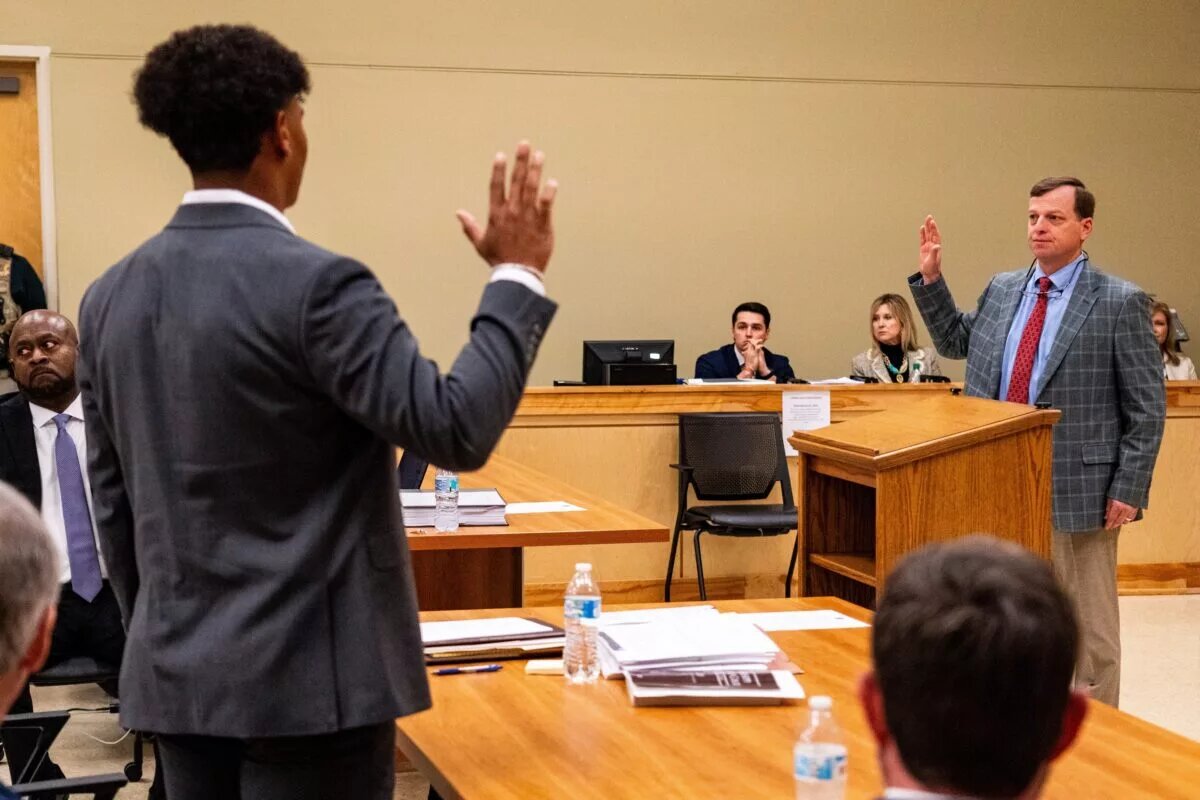

After months of questions and speculation, we finally seem to have an answer as to who is set to be Ole Miss’ quarterback for next season. This all comes in response to the drama surrounding Trinidad Chambliss and his eligibility. Chambliss has been seeking a waiver from the NCAA that would grant him a sixth year, allowing him to play next season. However, the NCAA had denied that request numerous times. But Thursday, a state judge in Mississippi granted an injunction, which, for now, grants Chambliss the sixth season he was looking for.
So how did we get here, and what comes next for Chambliss, Ole Miss, and the NCAA?
The Trinidad Chambliss Drama
How It All Started?
Put simply, none of this would be a conversation if Austin Simmons hadn’t gotten injured for Ole Miss. But an early-season injury allowed Chambliss to take over, and he made the most of the opportunity. The transfer quarterback from Division II Ferris State ultimately led the Rebels to the College Football Playoff semifinals.
Along the way, questions arose about his potential eligibility for next season. This is due to the fact that in 2022, his second year at Ferris State, he didn’t play a single snap. He also didn’t dress for games that season. Chambliss and his representatives have argued that the reason for that is respiratory issues stemming from the removal of his tonsils. After already burning his redshirt in 2021, he was led to believe that he would receive a medical redshirt for the 2022 season. However, despite documents showing that Chambliss was having medical issues, it appears that Ferris State never filed the proper documentation for him to receive the medical redshirt. This led to Chambliss and Ole Miss seeking a retroactive redshirt. Naturally, the NCAA was reluctant. All of that ultimately led us to today.
The Road to the Injunction
Fearing the impact it could have on future cases, the NCAA denied Chambliss’ requests for a waiver every step of the way. This led to Chambliss and Ole Miss filing a lawsuit in state court, seeking an injunction to the NCAA’s ruling. Given the fact that it was in state court, and who the judge presiding over the case was, the decision never really seemed to be in doubt. Judge Robert Whitwell is an alum of the Ole Miss School of Law, graduating in 1972. Understandably, this led many to believe there would be a bias in the courtroom.
And at times, it likely appeared there was.
The hearing itself took on a bit of a circus feel at times. Direct spats between Chambliss’s attorneys and the defense. Animated arguments between the defense attorneys and the judge. Seemingly simple questions asked by the judge toward Chambliss when he took the stand. And what looked like bizarre ineptitude by the NCAA’s attorneys.
Throughout the day, the NCAA’s representatives decided not to call any witnesses to further push their case. They also then left the courtroom before the ruling was announced. Even in a situation where the verdict seemed almost predetermined, it was an odd decision. It was also a decision taken note of by Judge Whitwell, who announced that he would potentially look into holding the attorneys in contempt of court for the move.
What Comes Next for Everyone Involved?
As for what comes next, the answer for Chambliss is simple. The injunction gives him the green light to begin preparing for the 2026 season as the Rebels’ starting quarterback. Similarly, for Ole Miss, it means they can now begin preparing for the season with the expectation that Chambliss will be leading the team next season.
The real question comes from the NCAA’s perspective. One option they have is to simply live with the verdict from Thursday’s hearing. That would almost certainly pave the way for Chambliss to be the Ole Miss starter in 2026, as the next steps likely wouldn’t take place until after the season.
Or, the NCAA could decide to appeal the verdict from Judge Whitwell. This would be the messier option, and it’s one that seems likely to fail anyway. Due to this, the decision to appeal seems unlikely. That is, at least as things currently stand.
Why the Intense Focus on the Chambliss Case?
If you ask Ole Miss fans, this is likely the most infuriating aspect of the whole ordeal. The NCAA is well-known for being arbitrary in its rulings. There’s never any real consistency. There never seems to be any rhyme or reason behind the decisions they make. For instance, mere days before the Chambliss hearing, Montana linebacker Solomon Tuliaupupu was granted a ninth year of eligibility. TJ Finley was recently given a seventh season. And while those cases may not be identical to the Chambliss case, there are similarities.
So why is the media focus solely on Chambliss? Why is the NCAA fighting tooth and nail to prevent him from playing another season?
From the media standpoint, the answer is clearly built around talent level. We’re talking about a potential Heisman candidate next season if he plays. That is naturally going to be a big story.
But from the NCAA, it’s tougher to understand. Obviously, it potentially opens the door for other similar cases moving forward. However, if Ferris State had filed the paperwork in 2022, none of this would’ve ever come up. Chambliss would have almost certainly been granted the medical redshirt. Essentially punishing a student athlete for the failures of a university is always going to leave a bad taste in many peoples mouths.
However, regardless of the what-ifs or the whys, Chambliss is set to be the Ole Miss starting quarterback in 2026.
At least for now.
Main Image: Ayrton Breckenridge/Clarion Ledger / USA TODAY NETWORK via Imagn Images