
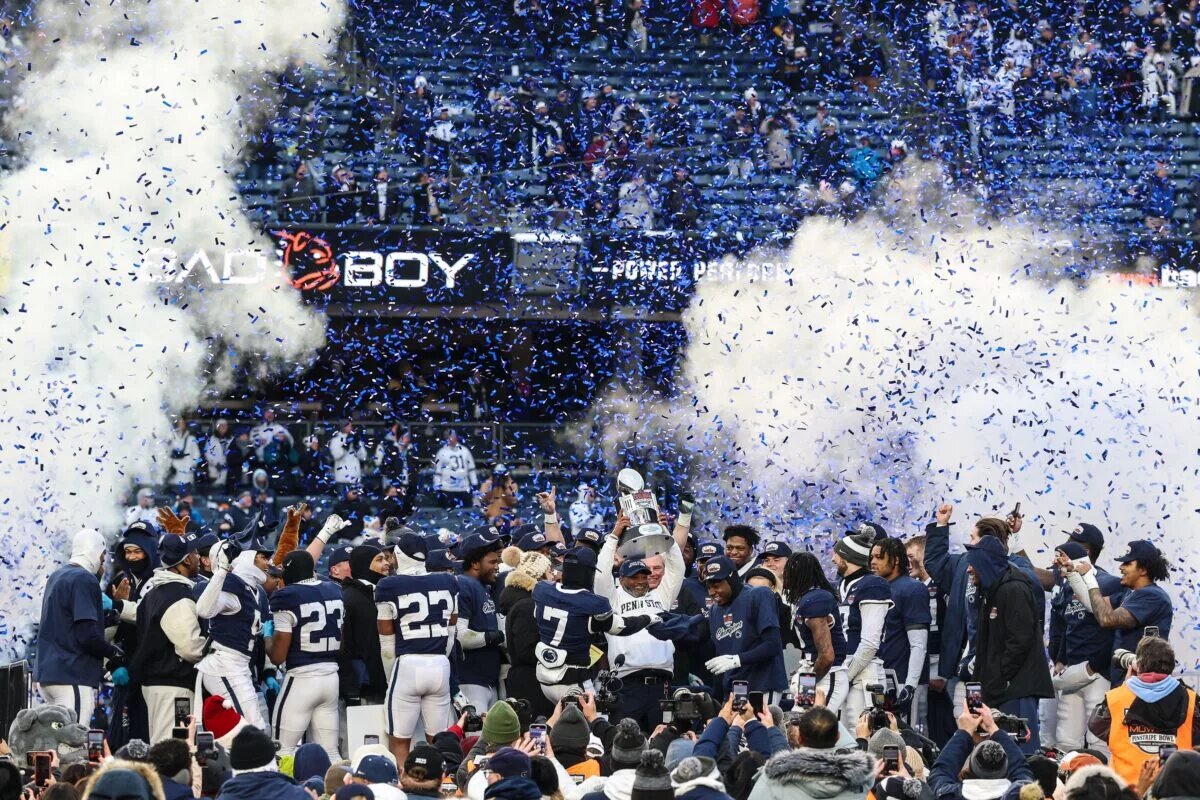

The Pinstripe Bowl did not reward comfort or familiarity for Penn State or Clemson. It rewarded toughness, adaptability, and the ability to grow in real time.
On a cold afternoon at Yankee Stadium, Penn State and Clemson played a game shaped by weather, youth, and roster turnover. Offense was hard to find early. Clean possessions were rarer still. What emerged instead was a revealing snapshot of Penn State’s future, one built on young skill players, an aggressive defensive identity, and a quarterback who looked increasingly comfortable carrying responsibility. Penn State passed the test with a 22-10 win over the Clemson Tigers.
A Game That Forced the Depth Chart Forward
First Half Defined by Discomfort and Discovery
From the opening drives, the weather dictated the tone. Both quarterbacks struggled to find consistency, and both offenses leaned heavily on short throws and cautious sequencing. Completion percentages stayed low, not because of conservative play calling, but because execution was difficult with altered personnel and slick conditions.
Penn State, however, showed a clear willingness to push the ball vertically. Redshirt freshman Ethan Grunkemeyer took several downfield shots, some overthrown, some dropped, but the intent mattered. The offense wasn’t hiding its quarterback. It was one testing limits in an environment that rarely rewards experimentation.
The run game offered little relief early. Penn State’s reshuffled offensive line struggled to create push, and most carries ended quickly. Quinton Martin, though, stood out. While yards were scarce across the board, Martin consistently found more space than anyone else, showing patience, balance, and burst that separated him from the pack. His efficiency hinted at why this game felt like a personal audition. There have been rumblings that Martin could hit the transfer portal.
Grunkemeyer leaned heavily on tight end Andrew Rappleyea, who quickly emerged as the most reliable target on the field. He was a featured weapon, flexed wide, worked into seams, and trusted on key downs. In a game where timing routes struggled, the Grunkemeyer–Rappleyea connection stabilized Penn State’s offense.
Defensively, Penn State controlled the first half. Cade Klubnik was rarely comfortable, repeatedly flushed from the pocket, and forced into off-platform throws. Anthony Poindexter, calling plays in Jim Knowles’ absence, mixed pressure from the middle, frequently sending Amare Campbell downhill. Dani Dennis-Sutton set the tone on the edge, including a sack where Klubnik failed to simply throw the ball away, a costly decision in a game where possessions mattered.
The Breakthrough Came With Confidence
The third quarter looked much like the first two. Penn State’s defense swarmed. The offense continued to search for a breakthrough while leaning on misdirection runs and Rappleyea’s versatility. When Penn State faced a fourth-and-six early in the fourth quarter, interim coach Terry Smith chose points. The field goal pushed the lead to 9–3 and reflected the reality of the afternoon. Then, the game finally cracked open on a single throw.
On third-and-eight with just over 13 minutes remaining, Grunkemeyer stood tall and delivered an absolute strike to Trebor Peña on a skinny post. Peña split coverage and raced 73 yards for the touchdown, the most electric play of the game by a wide margin. Penn State went for two and missed, but the message was clear. When given time and trust, Grunkemeyer could make the throw that changed everything.
From there, Penn State grew into itself. Grunkemeyer showed poise under pressure, including a flat throw to Devonte Ross with a rusher in his face and another clean dart to Ross moments later. The young offensive line, shaky early, gave him time in the passing game as the afternoon wore on. Then came the defining sequence.
With 4:56 left, Grunkemeyer hit Rappleyea on a quick seam for a touchdown. It was a simple concept executed cleanly. Two or three steps, ball out, trust rewarded. Penn State suddenly led 22–10, and the game tilted decisively.
A Defense That Finished the Job
Penn State’s defense never let Clemson recover. The secondary, composed largely of young contributors, played with an edge absent earlier in the season. Daryus Dixson was outstanding, finishing with three pass breakups and tight coverage all afternoon. Dejuan Lane and Vaboue Toure flew downhill, especially in the fourth quarter, filling gaps and delivering physical hits in the run game.
Clemson’s lone touchdown came after a questionable offensive pass interference call negated a stop, setting up a short field for Adam Randall’s rushing score. Outside of that drive, the Tigers’ offense stalled repeatedly, undone by drops and pressure. Dennis-Sutton added his second sack late, a fitting punctuation for a player headed to the draft who chose to play anyway. Moments later, Toure delivered the final blow, sacking Klubnik on fourth-and-11 with 2:29 left to effectively end the game.
A Moment Bigger Than the Bowl
This was not a game about trophies. It was about opportunity, and Penn State seized it. The Lions found real answers in Grunkemeyer’s poise under pressure, Rappleyea’s steady presence as a mismatch target, Martin’s emergence as a physical runner, and a young secondary that played with confidence and edge from the opening snap. In difficult conditions, with unfamiliar lineups and little margin for error, Penn State did not flinch.
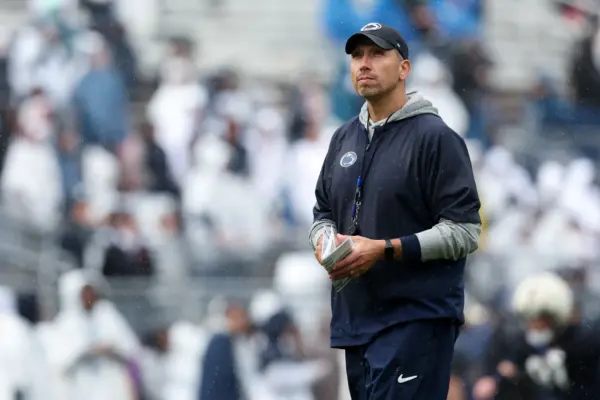
After the game, interim head coach Smith spoke through tears, framing the win as something far more personal than a bowl result. “It means everything,” Smith said. “We lived on this model of sharpen the pencil, write your own script. We dictated the terms the last four games. I can’t be more proud of these guys. They played their hearts out.”
Smith emphasized resilience more than outcome. “They could have laid down and quit,” he said. “They didn’t have to show up here, but they did. They played really hard. That’s a testament to Penn State and the character it builds.” When asked what the moment meant to him, Smith did not separate himself from the program or the locker room. “This is the greatest moment of my life,” he said. “I love Penn State. I love football. I’m just thankful.”
Penn State did more than close a season. It showed what remains when structure changes, when names disappear, and when belief has to come from within. In the cold, with a roster full of questions, the Lions found answers. And in doing so, they showed who they might become next.
Main Image: Vincent Carchietta-Imagn Images