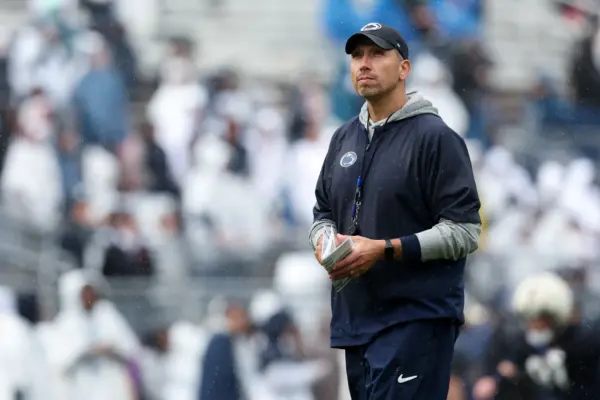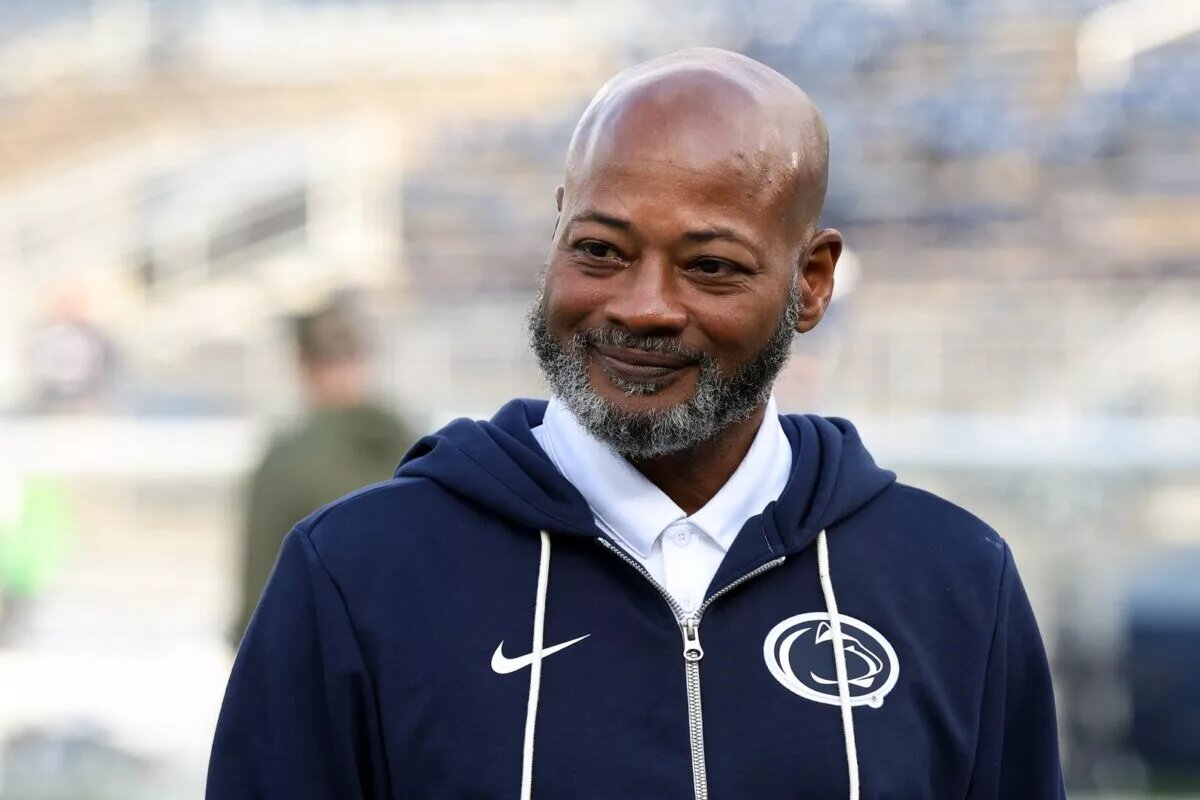

Penn State’s season ends on Saturday at Rutgers, but ultimately, the most important outcome will not be written on a scoreboard. Instead, it will be written in Pat Kraft’s office, where Penn State’s athletic director is closing in on a hire that will define his tenure and potentially either stabilize or fracture the direction of the program. Terry Smith enters the weekend with his résumé on full display. We have seen three weeks of revived energy, a reconnected locker room, and a vocal surge from the alumni base, unlike anything Penn State has seen in years.
The Final Stages of a Long Coaching Search
Smith has re-centered the program around accountability, clarity, and identity. He said this week that the team now has “a true identity. Period.” That simplicity has translated to sharper football. The offense rediscovered its vertical element. The run game regained its purpose. Jim Knowles’ defense looks faster, cleaner, and more disciplined. Players have repeated the same theme. The building feels lighter, and Saturdays feel fun again.
Fans have echoed it with “Hire Terry Smith” signs, and the alumni voice has grown even louder. On the broadcast during the Nebraska game, Michael Robinson said he had spoken with “hundreds” of former players and that “every single one of them” endorsed Smith to be the next head coach. Afterwards, Smith acknowledged the weight of that support while describing the experience of walking into the stadium with his granddaughter while fans chanted his name. “How would you feel?” he said. “It’s amazing.”
That emotional surge matters, but it cannot be the reason Kraft hires him. The case lies in how this team plays. They are faster to the ball, sharper in their assignments, and more confident in who they are. Those are coaching traits, not just feel-good storylines.
Where Brian Hartline, Bob Chesney, Brian Daboll, Kalen DeBoer, and Kalani Sitake Fit
The coaching landscape has shifted fast. Eli Drinkwitz and Clark Lea, once loosely connected to the search, have both signed extensions in the last twenty-four hours. As a result, that narrows the field behind the remaining serious names: Smith, Brian Hartline, Bob Chesney, Brian Daboll, Kalen DeBoer, and Kalani Sitake. All carry different levels of momentum, and Sitake in particular has seen a surge in speculation in the last forty-eight hours, driven in part by growing action on Kalshi, where his odds have climbed more than any other newly mentioned candidate.
Hartline remains the headline grabber. He is not a coordinator fallback option. He is a legitimate head coaching candidate. Hartline has national recruiting horsepower, a magnetic personality, and a proven ability to run an elite offense. If Kraft were to hire him, Penn State would need to keep Terry Smith as Associate Head Coach with a raise and real authority. Hartline would bring scheme, energy, and splash. Smith would bring culture, roster retention, the Pennsylvania talent pipeline, and the internal leadership structure that Hartline has yet to build on his own. Together, they could form a complementary core. Hartline as the offensive visionary and brand driver, Smith as the on-the-ground CEO voice organizing the staff, stabilizing the locker room, and anchoring daily accountability.
Chesney is the program builder whose trajectory mirrors the rise of Curt Cignetti. A grinder who has elevated every stop, turned Holy Cross into a disciplined winner, and built a reputation for culture-setting leadership. Sitake brings power conference poise and the credibility that comes from steadying BYU through one of the most difficult transitions in college football, guiding the program through staff overhauls, roster turnover, and the jump into the Big 12 without losing the locker room. That stability under pressure is a major reason his name has suddenly accelerated through industry chatter.
Every name has questions. Every name has risk, but Smith is the only one who currently holds the trust of the players and the community. However, that does not automatically make him the coach who can carry Penn State to the pinnacle it has chased and fallen short of. Smith has earned serious consideration, but ultimately, the bar is higher than momentum.
The Risks, Rewards, and Pressure on Kraft
The transfer portal and NIL era have raised the stakes. Kraft has watched James Franklin exploit Penn State’s instability from afar. He has already flipped major Penn State commits to Virginia Tech, including Messiah Mickens, Pierce Petersohn, Marlen Bright, and Roseby Lubintus. That exodus underscores why Kraft cannot afford a near miss. A failed hire in 2025 would set the program back years.
Hiring Smith comes with obvious questions. He has never built a college staff from scratch, and he is not an offensive architect. There is a real chance the surge is emotional rather than structural. However, the rewards are clear. The team culture has seemingly been reinvigorated, and the current roster believes in him. Pennsylvania recruiting, which slipped under Franklin, would realign behind an in-state figurehead, players, and families’ trust.
Kraft will ask himself what kind of leader fits Penn State’s identity. Smith said this week that under him, the program would be “blue collar,” rooted in unconditional love and daily competitiveness. That message mirrors what Penn State fans say they want the program to be. However, matching identity and execution of a program building plan is the true test.
Rutgers is Smith’s final audition. The evidence is there and growing, but Kraft now must decide whether it is enough.
Main Image: Matthew O’Haren-Imagn Images