
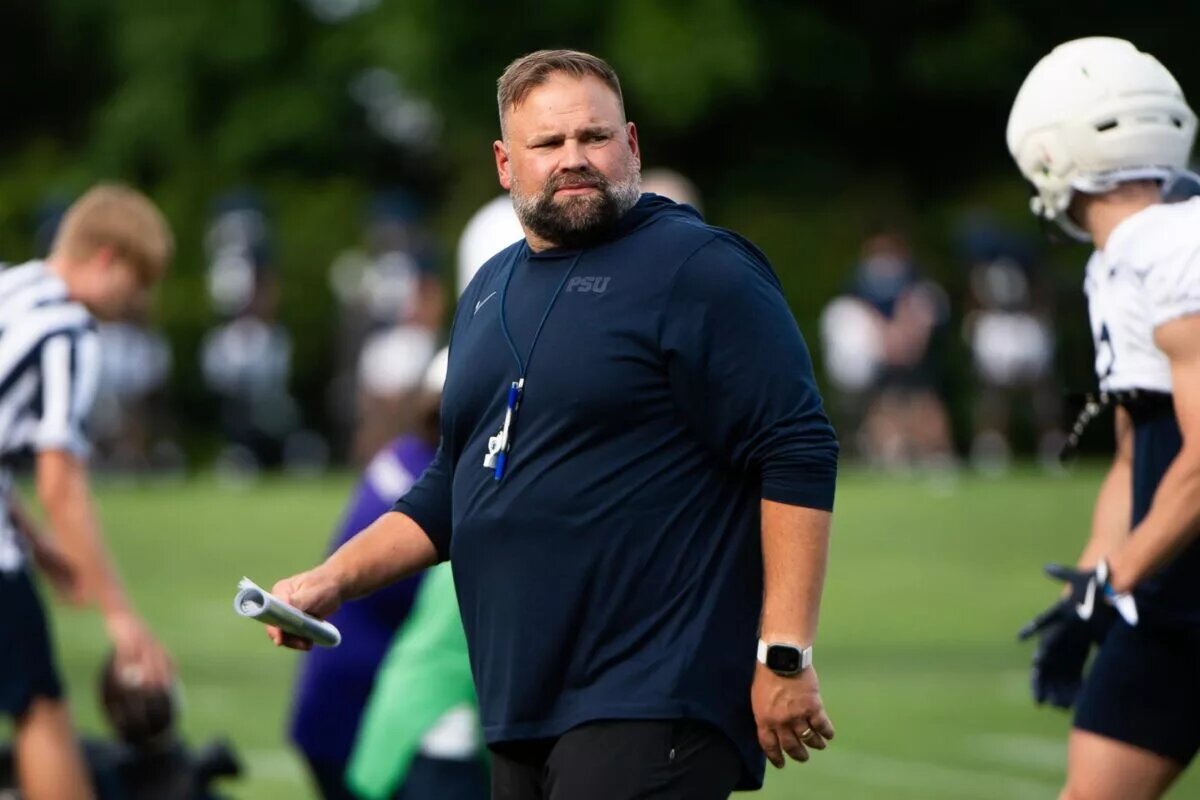

Penn State football has reached a point where effort and talent are not the issue. The problem sits on the headsets. After watching every snap this season, it is clear the coordinators have drained the program of energy and direction. Andy Kotelnicki’s offense is predictable, Jim Knowles’ defense is overcomplicated, and former head coach James Franklin let it all happen by standing still.
Lack of leadership fueled the decline
Kotelnicki’s Offense Is Predictable and Ineffective
Kotelnicki’s offense has lost its edge. His system once thrived on pre-snap motion and misdirection, but opponents now expect every wrinkle. Against Northwestern, the Lions produced only 274 total yards and 13 first downs. They managed 137 passing yards and one touchdown. Every drive looked rehearsed and slow.
Then came the Iowa game, where Kotelnicki made an even worse decision. He rotated quarterbacks Ethan Grunkemeyer and Jaxon Smolik even though Grunkemeyer was making his first real start. The offense never found rhythm. Grunkemeyer completed 15 of 28 passes for 93 yards and two interceptions. The run game totaled 173 yards but collapsed in key moments. The two-quarterback idea was reckless. Instead of building confidence, it created chaos. Defenses sat on the short routes and ignored the window dressing. Iowa’s linebackers barely moved on pre-snap motion because they knew it meant nothing. The scheme has become a shell of itself.
The wide receivers have not helped. The group under coach Marques Hagans rarely creates separation or wins deep. Quarterbacks coach Danny O’Brien has not developed consistent pocket rhythm or decision-making. His quarterbacks show sloppy footwork, uneven throwing mechanics, and poor pocket presence. Too often, they drift under pressure instead of resetting their base and delivering on time. That falls on both coaching and play calling, but O’Brien’s group has not shown the technical growth needed to execute at this level. Kotelnicki calls plays like a coordinator who is guessing rather than leading. It is a system without soul or identity.
Knowles’ Defense Is Too Complex to Succeed
Knowles’ defense has been just as damaging. His system promises aggression, but players look hesitant and confused. Even Knowles admitted his scheme might be too complicated. What shows on tape confirms that.
The defense reacts instead of attacking. Pass-rushers stop mid-stride, linebackers overrun plays, and safeties stare into the backfield. In the Iowa game, the defense surrendered 245 rushing yards and three touchdowns. A 67-yard quarterback run summed it up. Players hesitated, misread motion, and opened a wide lane. This defense no longer dictates tempo. It allows it. Opponents complete more than 70 percent of their passes in Penn State’s losses. The sack totals have also dropped far below expectations. When players spend more time thinking than reacting, the results are predictable.
Penn State once built its identity on physical, decisive defense. Under Knowles, it has turned into a classroom on the field. The scheme may look impressive on a whiteboard, but it falls apart in real time. Simplicity wins in the Big Ten, and this defense is anything but simple.
Franklin’s Complacency Let It All Happen
Franklin carries his share of the blame. His biggest mistake was comfort. He stopped adjusting when the warning signs appeared. The same offensive breakdowns repeated weekly, and he allowed it. The same defensive confusion resurfaced, and he said little publicly.
Good leaders confront problems before they become habits. Franklin did not. He kept doing the same things, expecting a different result. That approach bred a culture of acceptance. When coordinators struggle, the head coach must either guide or replace them. Franklin did neither. His inaction turned Penn State from a contender into a repeat of its worst habits. Complacency at the top created comfort for mediocrity below. The team looks like it practices hard but plays cautiously. That reflects leadership that stopped evolving.
Time for a Full Reset
Kotelnicki’s offense and Knowles’ defense are mismatched with the roster. The players are capable of more, but the staff is out of ideas. Hagans has not elevated the receivers, and O’Brien has not improved the quarterbacks. Together, they form a group that feels stagnant. This program needs urgency, not excuses. If Penn State misses a bowl game, it might be a blessing. The university could reset without hesitation and build a new identity around accountability and speed.
Until the coordinators simplify their schemes and a head coach demands real change, Penn State will remain stuck. The tape shows a team waiting for answers that are not coming from its current staff.
Main Image: Dan Rainville / USA TODAY NETWORK via Imagn Images