
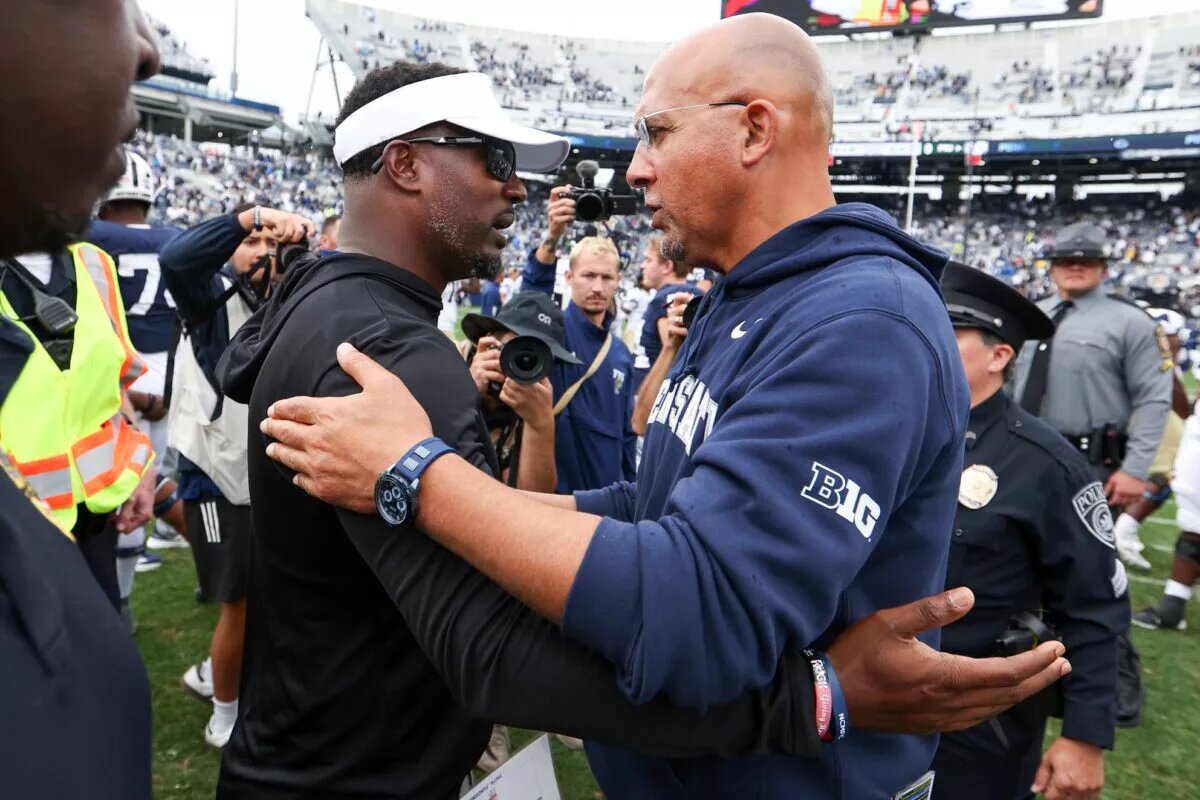

Penn State shut out FIU 34–0 on Saturday, but the film will reveal more offensive problems than positives. The Nittany Lions’ defense carried the day, while the offense exposed glaring issues up front, hesitation in the backfield, and play-calling tendencies that will need fixing before Big Ten play.
Offensive Line Breakdown
Penn State’s defense pitched a shutout in the 34–0 win over Florida International, but the offense looked anything but dominant. The most glaring issue was the offensive line’s inability to handle basic stunts, pressure, and short-yardage situations.
On multiple first-half series, the interior trio of linemen Vega Ioane and Anthony Donkoh, along with center Nick Dawkins, failed to pick up twist/stunt defenders. One late-second-quarter sack came when a tackle-nose stunt went untouched, allowing a free rusher to hit Drew Allar. These breakdowns are the type of execution lapses that top defensive lines will punish in Big Ten play.
In short-yardage situations, the interior failed to generate vertical push on inside zone. Kaytron Allen was stuffed on a 4th-and-2 in the first quarter, and Nick Singleton and Allen found little daylight on zone read runs on the interior and perimeter. As James Franklin admitted postgame, the run game was not consistent enough to establish control. Until Penn State’s offensive line cleans up its footwork and communication inside, the offense will continue to stall in critical moments.
Running Back Hesitancy
Penn State’s talented backfield of Allen and Singleton eventually produced numbers, but both backs showed hesitation early. Singleton in particular appeared tentative, chopping his feet behind blockers rather than planting and accelerating. On several outside runs, he missed cutback lanes that could have turned minimal gains into explosive plays.
Allen later provided a reminder of his decisiveness, finishing with a career-high 144 yards on 16 carries. He ran with north-south intent, while Singleton looked unsure of his reads for much of the game. The duo combined for 220 yards and two touchdowns, but the inconsistency early highlighted a broader issue. Without consistent blocking, Penn State needs its backs to trust their vision and hit lanes with authority.
Allar’s Inconsistency
Allar’s performance told two stories. On one hand, he showed flashes of his elite arm talent, firing darts to Kyron Hudson and Trebor Peña over the middle. On the other hand, his deep-ball accuracy remained a concern.
Allar underthrew Devonte Ross badly on one early deep shot, forcing the receiver to come back and draw a pass interference penalty. Still, his first-half numbers (9 of 17 for 68 yards) reflected a lack of rhythm in the passing game. Penn State failed to establish a consistent run game, which put the offense in difficult down-and-distance situations. Without balance, the rhythm of the game plan never materialized, and Allar struggled to settle in as the passing game stalled. “I think we made it harder than we needed to be,” Franklin said, noting the uneven execution. For Allar, the challenge is consistency. Syncing footwork with routes, staying decisive under pressure, and avoiding early-game lulls that stall drives.
Kotelnicki’s Play-Calling
Second-year offensive coordinator Andy Kotelnicki leaned heavily on zone reads, swing passes, and quick hitters to the flats against FIU, but the scheme did not play to Penn State’s strengths. The Panthers repeatedly clogged the perimeter, and the Lions failed to adjust until late. Many of these plays were zone reads, and there were times when Allar had clear lanes to pull the ball and take it himself, but he consistently handed it off. Franklin admitted the team “was not running the ball as consistently as we could” and that more throws were needed to loosen the defense.
Future opponents will key on tendencies quickly. To keep defenses honest, Kotelnicki must diversify his approach by incorporating more quick-hitting runs between the tackles and rhythm throws that allow Allar to settle in early.
Defensive Tweaks Show Potential
While the offense struggled, defensive coordinator Jim Knowles experimented with creative fronts in game two. Dani Dennis-Sutton saw snaps inside, giving Penn State a mismatch against FIU’s guards. True freshman Chaz Coleman also emerged as a disruptive force, recording a strip-sack, recovery, and multiple pressures.
Knowles mixed more man coverage in the second half, tightening windows and forcing FIU into checkdowns. The result was a defense that not only shut out the Panthers but also produced takeaways for the second straight week. The contrast was clear, as the defense adapted quickly while the offense remained predictable for far too long.
National Context and Next Steps
The concerns from Saturday are less about the final score and more about what the tape reveals. Penn State’s offensive line problems cannot continue if this team hopes to contend in the Big Ten. The lack of short-yardage execution, red-zone inefficiency, and deep-ball inconsistency will be exploited by stronger defenses.
Poll voters will notice, too. While the Lions remain in the top five, another lackluster showing could fuel national skepticism. Georgia also struggled in a 28–6 win over Austin Peay, so where both teams land in the updated rankings remains to be seen.
Oregon, meanwhile, absolutely dominated Oklahoma State 69–3, holding the Cowboys to just 211 total yards. Based on that performance, the Sept. 27 White Out in Beaver Stadium looks like a daunting test for Penn State, and at this stage, the matchup appears to favor the Ducks.