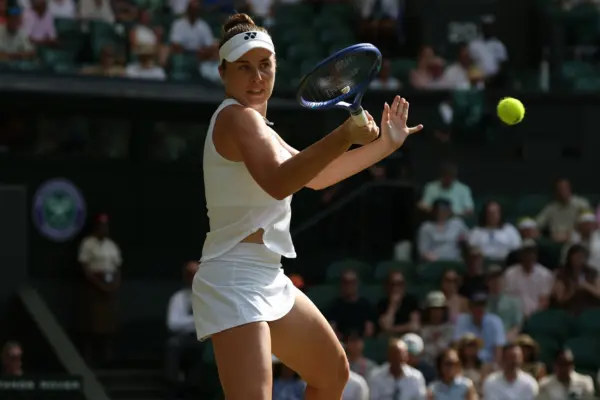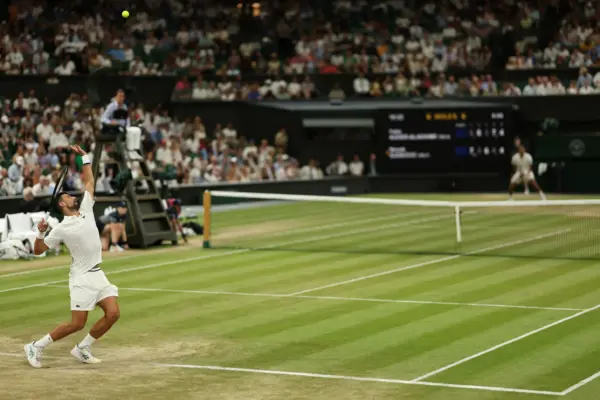

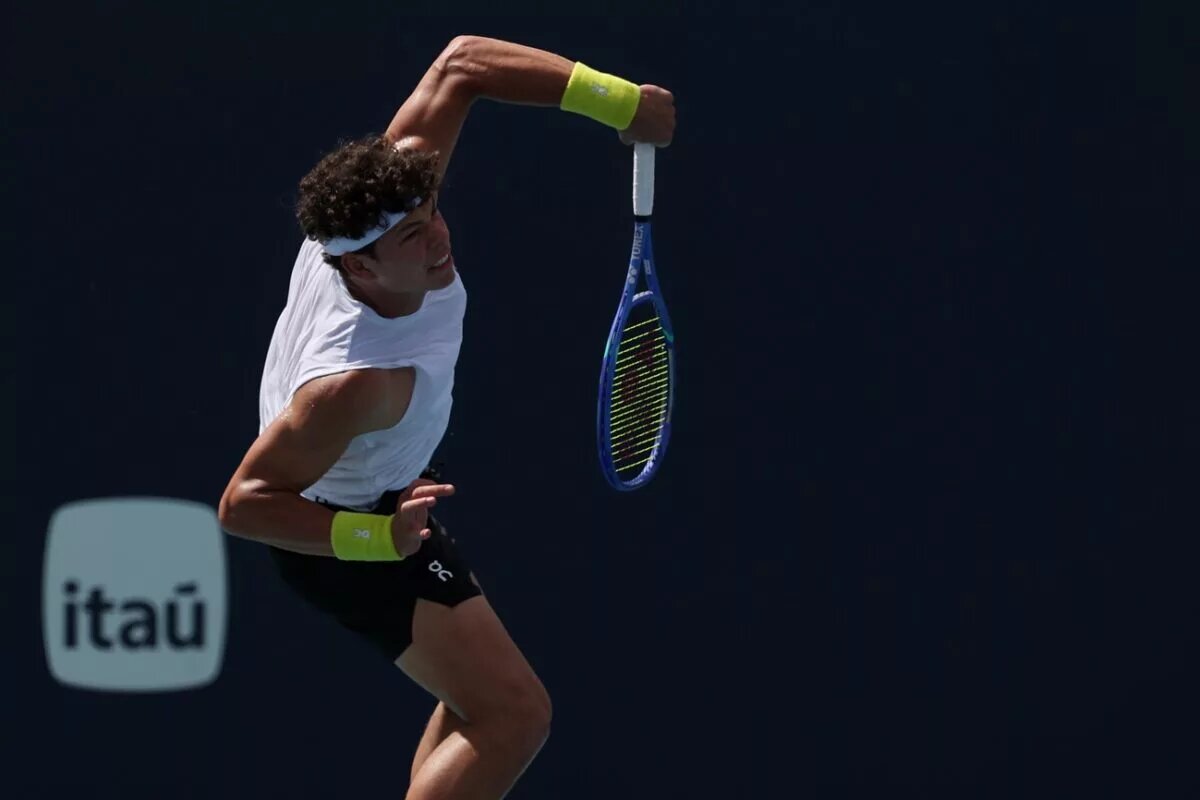

Ben Shelton won his first grass-court title in Stuttgart on June 14, beating Taylor Fritz 6-4 2-6 6-4 in the final, completing a trio of titles across all three surfaces in 2026 after hard-court success in Dallas and clay-court success in Munich. He then arrived at Halle and kept the run going. He beat Lorenzo Sonego 7-5, 6-3 in the first round, extending his grass-court winning streak to five matches. He then edged Ethan Quinn 6-4 5-7 6-4 to reach the Halle quarterfinals, with the streak now at six.
Ben Shelton heading into Wimbledon with six consecutive grass-court wins, a title on the surface, and a serve that makes strong men nervous is a different proposition to the Ben Shelton who showed up at the All England Club for the first time three years ago and barely knew where to put his feet. The question of whether he is a genuine threat at SW19 deserves a proper answer so let’s do it.
Is Ben Shelton a dark horse at Wimbledon?
Ben Shelton in SW19
His Wimbledon record tells a clean story. Shelton went out in the second round in his first appearance in 2023, reached the fourth round in 2024, and made the quarterfinals in 2025. Three editions, three progressively deeper runs, each one built on what the previous year taught him about the surface and the tournament. In reaching the quarterfinal in 2025, he became the second youngest American man to reach that stage since Andy Roddick in 2004. The trajectory is clear.
Now add a grass title and six straight wins on the surface and the numbers behind those wins become relevant. Across 14 grass-court matches in the last 52 weeks, Ben Shelton holds a 10-4 record. He is holding serve at 92 percent. He is breaking 14 percent of the time. He is aceing on 13 percent of rally points. He is winning 70 percent of serve points and 34 percent of return points. Those are not rookie numbers anymore.
The serve is the headline figure and deserves to be. Holding at 92 percent across 14 matches means opponents are essentially playing the match on his terms. If Ben Shelton does not give you a look at his serve, you need to break him from the baseline, and his serve is precise enough and varied enough on grass that doing so consistently is a problem for the vast majority of the draw. He can win a lot of matches at Wimbledon through that mechanism alone, against opponents who simply cannot find a way onto the board.
Ben Shelton vs Novak Djokovic on Grass
Bringing Novak Djokovic’s grass statistics into the conversation is not to suggest Ben Shelton is Djokovic. It is to calibrate where his numbers sit on a broader scale. Djokovic across his career on grass holds an 89 percent serve hold rate, breaks 26 percent of the time, aces to win 9 percent of rallies on serve, wins 70 percent of serve points, and 39 percent of return points. He produced those numbers across 147 matches against the deepest competition the sport has ever produced.
The comparison is striking not because the numbers are identical but because Ben Shelton’s serve numbers are actually higher than Djokovic’s career grass averages. He is holding at 92 percent to Djokovic’s 89, and winning 70 percent of serve points, matching the Serbian exactly. The gap opens on the return side, where Djokovic’s 39 percent return points won dwarfs Shelton’s 34 percent, and in the break rate, where Djokovic at 26 percent is nearly double Shelton’s 14. Those are not small differences and they represent the distance between a player who can scam wins through his serve and a player who can win any match on grass regardless of circumstance.
The context around Djokovic’s numbers matters enormously. He built them in 147 matches across a Wimbledon career that includes multiple titles and multiple finals against Federer, Nadal, and the best players of two generations. Ben Shelton has played 14 grass matches in the last 52 weeks. Placing them alongside each other is a calibration exercise, not a comparison of players. What it shows is that Ben Shelton’s numbers on grass are already sitting in elite territory. What it also shows is that the return and break numbers have a long way to travel before he becomes a complete grass-court force.
Conclusion
Ben Shelton is not yet a genuine Wimbledon threat in the sense that matters most, which is the ability to beat the best players over five sets in the second week. The return game, at 34 percent of return points won and a 14 percent break rate, is not good enough to trouble the elite. Sinner, Alcaraz, and whoever else populates the top of the draw will hold serve at a high rate against him and make him win the match almost entirely through his own delivery, which is not a reliable formula across seven rounds at a Grand Slam.
Against non-elite opposition, however, he is a nightmare. A 92 percent hold rate with that serve in a best-of-five format means he will accumulate wins. Anyone ranked outside the top twenty who draws him in the first week faces a match where the structural advantage lies entirely with Shelton from the first point. He will reach the second week. He may well reach the quarterfinal again.
What comes after that depends on a part of his game he has not yet developed. The serve will get him far. It will not get him to the final. If Ben Shelton can improve his return numbers to the point where he can put pressure on the best servers in the draw, this conversation changes completely. The progression from second round to fourth round to quarterfinal at Wimbledon over three consecutive years suggests the development is happening. It is just not there yet.
Main photo credit: