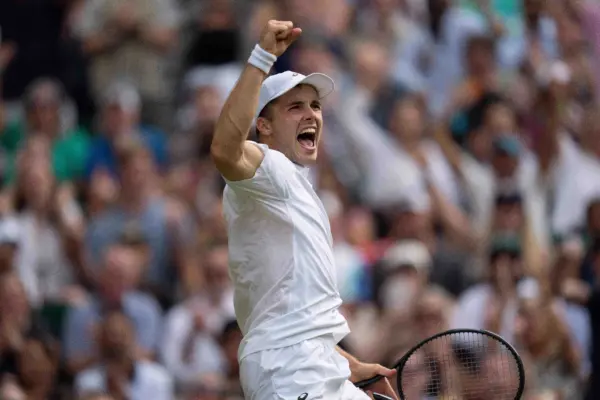
Carlos Alcaraz deploys a drop shot in roughly 16 percent of all rallies he plays and wins around 63 percent of those points. Both figures are the highest ever recorded at the elite level of professional tennis per Tennis Abstract. The comparison pool is not limited to current players. This is across the history of the sport for which reliable data exists, and nothing approaches it.
The nearest historical parallel in terms of effectiveness is Roger Federer, who used the drop shot in approximately 8 percent of rallies and won around 60 percent of those points. Those numbers are exceptional by any normal standard. Carlos Alcaraz doubles the usage rate while maintaining a higher win percentage. Jannik Sinner and Rafael Nadal have both peaked at around 60 percent on the win rate, which puts them in the same ballpark as Federer for effectiveness, but they deploy it only around 4 percent of the time. The shot is a weapon in their hands. In the hands of Carlos Alcaraz it is practically a cheat code.
The contrast with Alexander Bublik is perhaps the most instructive data point available. Bublik uses a drop shot in roughly 12 percent of rallies, which makes him the second-most frequent user on the ATP Tour behind only Alcaraz. His win rate on those points sits around 48 percent. He is losing one in every two drop shots he plays. Carlos Alcaraz is using the shot at a higher rate than Bublik and winning at a rate fifteen percentage points higher. So why is it so effective?
Does Carlos Alcaraz have the best drop shot of all time?
Why It Actually Works
The mechanics of the Alcaraz drop shot are not what most people assume when they watch it. It is not primarily a slice or a backspin shot. It uses an open face to take pace completely off the ball, producing what is best described as dead weight. The ball does not rotate through the air in the way a conventional drop shot does. Instead, it dies.
The result is that Alcaraz can execute a drop shot off a high, loopy, heavily-spun groundstroke of the kind that Tsitsipas might send him from deep behind the baseline. Most players on tour cannot do this. The standard drop shot requires a degree of pace to work with. Alcaraz generates his own, from nothing, on contact.
The margin for error in this technique is almost absurdly small. Two percent too much acceleration into the shot and the ball carries past the service line, turning a potential winner into an easy put-away for the opponent. Two percent too little and it dies into the bottom of the net. Elite players practicing this shot with consistent, low-spin feeds from a hitting partner struggle to land it reliably. Alcaraz does it in live match conditions, off heavy pace, at critical moments, and wins 63 percent of the time. The touch required to execute this at that consistency is not something that can be coached into a player who does not already possess it at a neurological level.
But the mechanics of the drop shot itself are only half the explanation. The other half is what happens after it. Carlos Alcaraz is not simply hitting a drop shot and hoping. He is hitting a drop shot and immediately reading the situation, anticipating the return, and positioning himself for the next ball.
His reaction speed and court coverage are elite even by the standards of a top-five player, which means that when an opponent does get to the drop shot and flicks it back, Alcaraz is already moving into position to respond. He wins points off the second and third ball in that sequence that most players would concede by default. The drop shot becomes a trap, not a one-shot gamble, because the player setting it has the speed and touch to close out whatever comes back.
What It Does to the Players Who Face Him
The statistical impact of the drop shot on how opponents play Carlos Alcaraz is significant and measurable. Opponents who face him regularly shift their positioning forward during rallies to protect against the short ball, which in turn exposes them to his passing shots and his ability to pin them with topspin to the corners. He is simultaneously pulling players in and pushing them back with the same weapon, and the threat of the drop shot at any point in a rally forces opponents to make a positioning compromise that they would not otherwise have to make against anyone else on tour.
This is what makes Carlos Alcaraz a uniquely difficult player to construct a game plan against, particularly on clay and grass where the drop shot is most lethal. On clay, where opponents are deeper behind the baseline and the court is slower, the drop shot drops in before a defending player can close the distance. On grass, where pace and surface skid make it harder to read, it is equally disruptive because it contradicts everything the surface is supposed to reward. The opponent who positions forward to defend the drop is exposed to the passing shot. The opponent who stays back is handing Alcaraz the point. There is no clean answer.
Players at the very top of the sport, Sinner included, handle this better than the rest of the field because their footspeed and anticipation are good enough to reach the drop shot and create something from it. But even they must account for it throughout a match in a way that no other player demands. The cognitive load of preparing for a shot that can come at any moment, off any ball, at any point in a rally, is a tax that Carlos Alcaraz collects continuously across a match. The 63 percent win rate on the shot itself does not capture that cost. The full value of the weapon is higher than any single number can express.
The drop shot has existed in professional tennis for as long as the sport has been played at a high level. No player has ever made it do what Carlos Alcaraz makes it do. The data says so plainly, and the data does not have a comparison to offer.
Main photo credit: Susan Mullane-Imagn Images