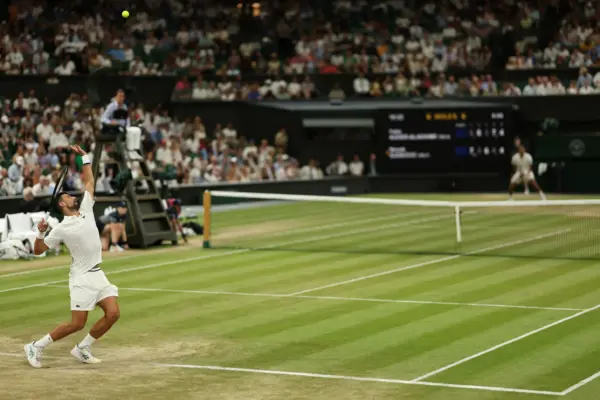


For nearly two decades, men’s tennis was governed by a simple truth: if you possessed a dominant serve, you controlled the match. The likes of Pete Sampras, John Isner, and Ivo Karlovic reinforced the idea that first-strike tennis began with the toss. Aces, unreturned serves, and one-two combinations shortened points and protected service games with ruthless efficiency.
That assumption no longer holds.
Since roughly 2018, a measurable shift has occurred at the elite level. Return quality has improved at a faster rate than serve dominance. The evidence is visible in the numbers and unmistakable on court: more serves are coming back, more rallies are extending beyond the third shot, and even the biggest servers are being dragged into baseline exchanges they once avoided.
The transformation begins with positioning. Daniil Medvedev has normalised a return stance four to six metres behind the baseline on hard courts. What once looked passive is now understood as geometric optimisation. By increasing reaction time against 210–230 km/h deliveries, he converts sheer pace into a controllable, neutral ball. Hawk-Eye tracking from recent hard-court seasons shows Medvedev contacting returns later but with higher control, immediately resetting the rally to neutral rather than conceding the point.
Contrast that with return positions from the 2005–2015 period, when players stood closer to the baseline and prioritised blocking the ball low. The modern returner is no longer trying merely to survive the serve. He is trying to start the rally on equal terms.
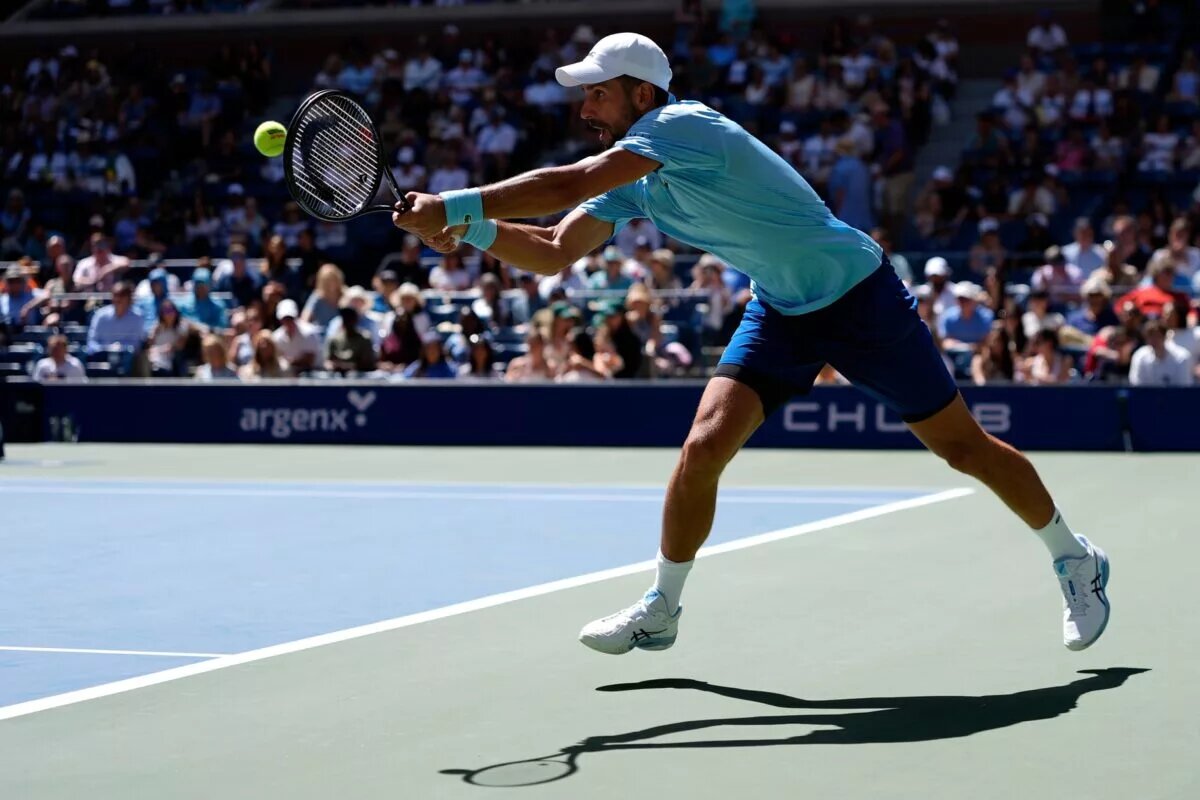
No player embodies this evolution better than Novak Djokovic. At his peak, Roger Federer won roughly 77–79% of first-serve points in his best seasons. Djokovic’s return numbers against comparable servers have consistently reduced that figure several percentage points below historical norms. Across the past five seasons on hard courts, Djokovic has hovered around or above 33% return points won against first serves from top-20 opponents, an exceptional figure in an era of faster courts and heavier racquets.
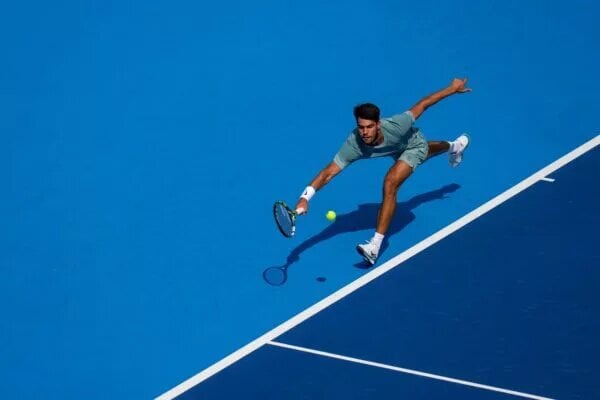
The next generation has pushed this further. Between 2023 and 2025, both Carlos Alcaraz and Jannik Sinner have ranked near the top of the ATP leaderboard in return games won. Their numbers rival prime Djokovic seasons. They do not chip returns; they strike them intentionally. Slow-motion analysis shows both players taking abbreviated backswings, meeting the ball early, and using modern polyester strings to generate immediate control and depth.
This is where equipment enters the conversation. Polyester strings and faster racquet-head acceleration have changed the physics of the return. In Sampras’ era, a 200 km/h serve often produced a defensive chip because gut strings and heavier frames demanded longer preparation. Today’s frames and strings allow compact swings to redirect pace with surprising penetration. The return is no longer a defensive block. It is a controlled counterpunch.
The statistical pattern confirms the eye test. Aces per match among the tour’s biggest servers have trended downward compared to the 2005–2015 window. At the same time, return points won percentages among the top returners have climbed. Grand Slam match data shows a higher proportion of points extending beyond three shots, even when first serves land. First-serve points won percentages, once comfortably above 80% for elite servers at majors, are now frequently several points lower when facing the modern return elite.
What has changed is not the service quality but the anticipation. Players and coaches now use granular serve-pattern analytics. Tendencies by score, side, and pressure moment are mapped and rehearsed. Returners are no longer guessing; they are reading probabilities. The return position is set not just by instinct but by data.
Watch Alcaraz on break point. He often cheats slightly to the ad-court wide serve because scouting reports tell him the percentage play. Watch Sinner leaning subtly into the body serve in deuce court because patterns have been decoded. These are marginal gains, but at 220 km/h, a fraction of a second is decisive.
Rally length after serve tells the broader story. The serve was formerly the shortest route to a point. Now it is frequently the first exchange in a rally that both players expect to contest. Servers who cannot back up their delivery with baseline resilience are increasingly exposed.
This is why pure serve specialists are less threatening in the deep positions of majors than they were 15 years ago. It is also why players with elite return games are dominating the sport’s biggest titles. The serve remains a weapon, but it is no longer untouchable.
The modern returner has turned defence into offence. By repositioning deeper, shortening swings, exploiting equipment advances, and applying data-driven anticipation, today’s elite players have quietly dismantled one of tennis’s longest-standing advantages.
The toss still begins the point. It just no longer decides it.
Main photo credit: Robert Deutsch-Imagn Images