
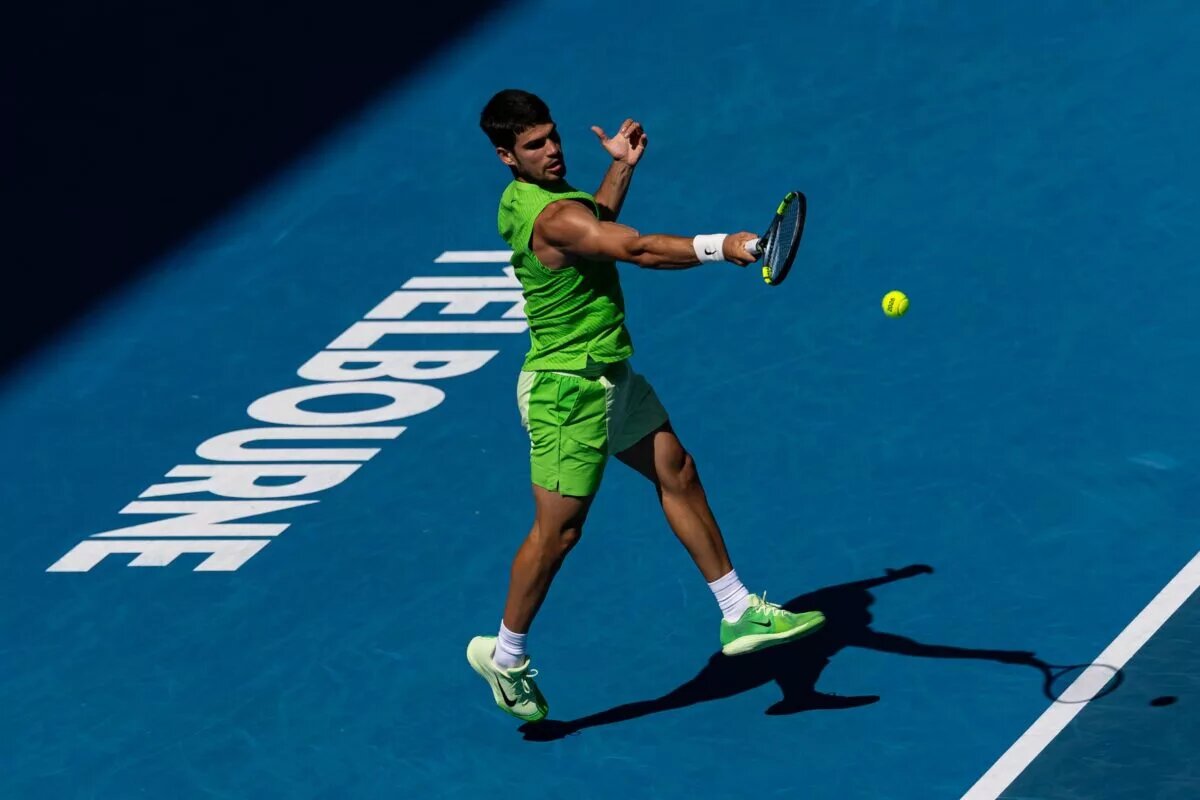

Carlos Alcaraz did to Novak Djokovic in Sunday’s Australian Open final what Djokovic has done to opponents for over a decade.
It may not have been as clean and clinical as it often was with Djokovic in his prime, but the essence was identical. Alcaraz found a way to win when his best tennis wasn’t available, grinding through the moments that separate champions from very good players.
The match demonstrated just how much Alcaraz has matured as a complete player. That maturity means he’s added a layer of pragmatic, even ugly, tennis to his naturally spectacular game. It’s still beautiful to watch because Alcaraz is inherently a spectacular player, but that gritty, adaptable edge was necessary to give his game the stability required to win matches like this.
How Alcaraz Made History in Melbourne
The Numbers Tell the Story
Alcaraz made 27 unforced errors across four sets. That’s not remarkably low in absolute terms, but it’s exceptionally low for him, particularly in a final against Djokovic with the career Grand Slam on the line. It doesn’t mean he was blasting winners relentlessly. It means he went into defensive lockdown mode from the baseline when the situation demanded it. He read the match correctly, recognizing that Djokovic began to struggle physically after the first set and consciously chose to deepen that struggle.
There was genuine risk in that approach. He might have become too passive, allowing Djokovic to dictate without consequence. But that didn’t happen. He did lose some control toward the end of the fourth set when Djokovic became more aggressive, but with a measure of fortune, he stayed in the set and eventually created his opportunity. Did Djokovic help him? Absolutely. Quite substantially, in fact.
After the opening set, Djokovic experienced a dramatic drop in level. It was obvious he was struggling physically, and his forehand betrayed him repeatedly in crucial moments. Djokovic made 24 unforced errors on the forehand alone. There were more errors overall, but the forehand failures came at the worst possible times. He made one on his only break point in the second set at two all for Alcaraz, then another at four-two, putting himself down a double break.
He made another forehand unforced error on his only break point in the fourth set. Those were his only two break points across the final three sets. Djokovic was in an excellent position on many of those forehands, but it didn’t work out. The match ended with Djokovic losing serve after making yet another unforced forehand error on match point.
Adaptation as the Ultimate Weapon
Why did those errors happen? We can attribute them to Djokovic clearly being exhausted and arriving fractionally late to the ball, but Alcaraz deserves enormous credit for the tactical work he did. He already covers the court brilliantly, but on Sunday, he sensed that Djokovic needed to be worn down through baseline consistency. That approach pushed Djokovic into taking extra risks on the forehand, risks that increasingly didn’t pay off.
Djokovic has legitimate reasons for regret because he started the match almost flawlessly. It felt like Alcaraz could be in serious trouble very quickly. Djokovic built his advantage primarily through a fantastic serve that gave him confidence and freedom on return as well. He even dominated the longer rallies, winning them seven to one in points, lasting nine shots or more.
He also adapted much more quickly to the slow conditions at Rod Laver Arena. Taking the first set in just 33 minutes was an excellent sign for him. He looked confident, radiating that champion’s presence, and it seemed Alcaraz might begin to panic. Then the match’s entire dynamic flipped at the start of the second set.
Djokovic suffered a sharp drop in intensity. His serve began to struggle first. He landed only 58% of first serves in that set, stopped hitting the lines consistently, and his serve speed dropped from an average of 190 kilometers per hour in the first set to 183. While 36% of his serves in the opening set weren’t returned by Alcaraz, that number plummeted to just 14% in the second and third sets.
Another crucial adjustment came in the third game of the second set when Alcaraz changed his return position on second serves. He eliminated Djokovic’s ability to take risks and grab easy points off the second serve, and he maintained that position for the remainder of the match. It wasn’t that he destroyed the second serve outright. Djokovic still won a respectable 53% of those points, though only 38% in the final set. But Alcaraz forced him to work considerably harder for every single point.
From there, Alcaraz began playing more conservatively, mixing his patterns more effectively from the baseline. In the third set, he became even more cautious on the backhand. While in the first two sets, 53% of his backhands went crosscourt, that rose to 74%, which helps explain why he made only seven unforced errors on that wing in the entire match.
In a remarkably short period, he managed to turn the match completely in his favor. It was genuinely concerning for Djokovic that after just 90 minutes, he already looked on the edge of physical collapse.
The Fourth Set Test
It was inevitable that Djokovic would stabilize at some point, and he did in the fourth set when he rediscovered his serving rhythm. In that set, Djokovic won 20 points on his serve within the first four shots, either aces, winners, or forced errors from Alcaraz. The match was finally being played at a tempo that suited him. Quick points, minimal physical drain. The crowd became involved as well, which Djokovic himself encouraged after a long stretch of seeming almost too subdued.
It was obvious then that Alcaraz was under substantial pressure, and Djokovic received his opportunity at four all. It was only his second break point in the last three sets, and as mentioned, he squandered it unusually easily. It didn’t help that in the very next point, Alcaraz struck a winner off a mishit forehand.
You could even argue the Spaniard enjoyed a bit of fortune in those moments. Djokovic landed 71% of first serves in that set, but that percentage collapsed in the final game when he made just one of five first serves. That game also featured a grueling 25-shot rally that Alcaraz won.
Immediately after that exhausting point, where Alcaraz was mostly defending but carefully avoiding excessive risk, Djokovic made two more unforced forehand errors. The second came on match point.
That extended rally was perhaps the clearest sign of the mature Alcaraz, who has integrated that ugly, pragmatic dimension into his game.
Winning Without Perfection
Alcaraz didn’t win yesterday by playing his flowing tennis at the edge of perfection. He won because he’s added that gritty, adaptable element to his arsenal. He was patient. He was tactically disciplined. And at times, naturally, he was brilliant. That combination was sufficient.
He may have enjoyed a bit of luck late in the fourth set, and Djokovic didn’t push him to the absolute limit. But this is also a 38-year-old Djokovic who now has to take additional risks in matches of this magnitude and can’t rely as heavily on movement anymore, particularly after the physical war with Jannik Sinner just days earlier.
In the end, Alcaraz remained steady and composed for the vast majority of a match with enormous historical stakes. With that performance, he has already entered tennis legend. He became the youngest player ever to win all four Grand Slams and once again demonstrated that his ceiling is genuinely limitless.
Because now, on a tennis court, he truly can do everything. He can play breathtaking tennis on the edge of perfection. And he can win ugly when that’s what the situation demands.
That versatility and that completeness are what separate the all-time greats from everyone else. Alcaraz has joined that conversation, and he’s only just getting started.
Main Photo Credit: Mike Frey – Imagn Images