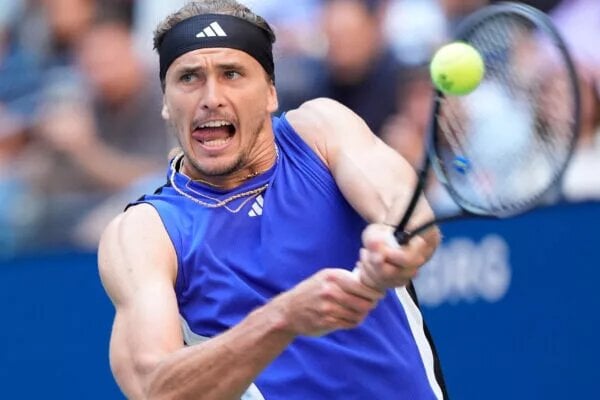



Alexander Zverev recently described himself as a diesel engine. Unlike Sinner and Alcaraz, who can elevate their game at any moment, the German needs time to get going before he can play his best tennis.
The self-awareness is admirable, but it’s also a luxury he can no longer afford. Time is finite, and his is running out.
Zverev Still Hunting For the Elusive Grand Slam
There was a period when Zverev was considered an up-and-coming player with years ahead of him to figure things out. That period has passed. At 28, he’s in what should be his prime years as a tennis player. What he does over the next few seasons will ultimately define his legacy in the sport.
Right now, that legacy doesn’t look as impressive as it should be.
He’s a good player, ranked No. 3 in the world by most metrics, but that’s simply not good enough anymore. He can’t be a diesel engine. He needs to transform himself into a different kind of player; one who seizes control of matches from his opponents and dictates terms from the opening point.
He’s aware of this. He’s been aware for a while. Some incremental improvements have been made, but he remained largely passive even last year. He doesn’t show enough aggression, certainly not compared to players like Sinner and Alcaraz, and he needs to. There’s no other way to compete in this era of tennis if you want to win at the highest level.
Perhaps there was a brief window when his style could work against these players, but at their current level, it simply doesn’t anymore. Neither does taking things slow.
What does being a diesel engine even mean in practice? That he needs a few weeks to find his rhythm? That won’t work in tennis, where you have to be ready immediately.
A Troubling Admission
The more concerning aspect of Zverev’s comments is what they reveal about his mindset.
Saying something like that ahead of such a pivotal season doesn’t suggest a player who believes things need to change dramatically. Perhaps it suggests a player who knows things can’t change as much as they need to.
We can’t know for certain. We can only judge what happens on the court. Based on his first match of 2026, things aren’t looking too bad. He faced Tallon Griekspoor at the United Cup and dismantled him 7-5, 6-0 in just 70 minutes. The result itself is significant, but the approach matters more.
We saw an aggressive Zverev, one willing to take risks and attack. Breaking Griekspoor is no easy task. He’s a solid player who typically makes matches competitive. Zverev created four break chances and converted all of them. He won 37 percent of points when returning Griekspoor’s first serve, which is impressive.
What’s even more striking is that he won 77 percent of points on Griekspoor’s second serve. That’s elite, and where the aggression showed itself most clearly. Numbers like these would have been impossible just a few years ago because he simply wouldn’t have played aggressively enough.
The Path Forward
So what do we make of all this? It’s complicated.
He said something that suggests he’s falling back into old habits, but the product on the court suggested otherwise. What’s certain is that for Zverev, the only path forward is to become an aggressive tennis player, regardless of how unnatural or uncomfortable it might feel. Anything less won’t be enough to create the legacy he wants to leave behind.
Main Photo Credit: Robert Deutsch – Imagn Images