
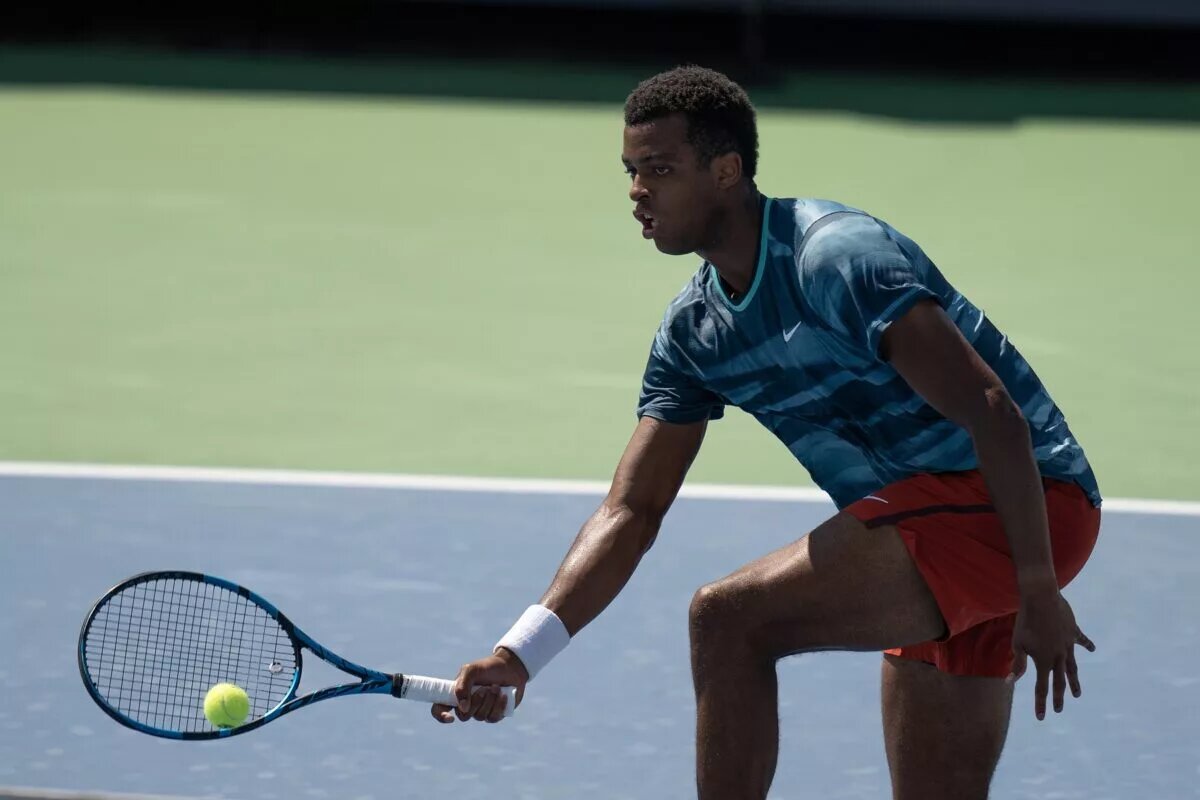

Watching Giovanni Mpetshi Perricard play tennis is simultaneously mesmerising and maddening. At 6 feet 8 inches with a serve that routinely touches 145 mph, he possesses the kind of weapon that can make even elite players look helpless. When it’s working, he is bordering on unplayable. When it’s not, it looks almost comically ineffective.
Here’s the puzzle: this is a player who finished 2024 ranked 31st in the world, fresh off a stunning title run in Basel where he dismantled quality opponents with ease. Yet he concluded 2025 at 59th, having spent much of the year struggling to win consecutive matches.
So what happened? Did he regress, or has the Tour simply figured him out? Perhaps unsurprisingly, the answer is more complicated.
The Promise of 2024
Let’s establish what made Mpetshi Perricard special in the first place. He won 48 matches in 2024, and contrary to popular belief, they weren’t all accumulated on the Challenger Tour. Yes, many came at that level, but he also announced himself with a fourth-round run at Wimbledon and that remarkable Basel triumph.
That Basel week looked like a breakthrough. He defended his serve like a brick wall, fired forehand winners from impossible positions, and suddenly looked like a player ready to establish himself among the game’s elite. Finishing at 31st in the rankings felt like just the beginning. The hype was real. Here was a young Frenchman with a game tailor-made for the modern era: massive serve, aggressive forehand, and the confidence to go for broke on big points.
The 2025 Reality Check
This season was always going to test whether Mpetshi Perricard could sustain success against top-level competition week after week. The answer, unfortunately, was a resounding no. The year began promisingly enough with a semifinal run in Brisbane. The fast courts suited him perfectly, his serve was clicking, and it felt like 2024’s momentum might carry forward. It didn’t.
What followed was a brutal stretch of inconsistency. From February through April, he couldn’t string together consecutive victories. Three months. He’d win a match here or there, then immediately lose the next one. He couldn’t build any rhythm or any confidence and seemingly didn’t have any answers either.
The clay season was predictably difficult. Movement has never been his strength, and on a surface that demands constant adjustment and defensive skill, his limitations were brutally exposed. But clay-court struggles were expected to be expected for a player with his profile.
Grass, however, was supposed to offer salvation. Big servers traditionally thrive on the surface but Mpetshi Perricard won just one of four matches. The low bounce that makes grass unique also makes it treacherous for extremely tall players who struggle to get down to balls and generate topspin over the net. He looked uncomfortable, almost awkward at times.
By mid-season, a pattern had emerged. Better players were neutralizing his serve by standing farther back, taking time away, and forcing him into extended rallies where his technical deficiencies became glaring. His forehand, while powerful, lacked consistency. His backhand was a liability. And his return game? Almost non-existent.
The second half brought mild improvement. He won a few matches during the US Open stretch and in China, showing flashes of the player who’d conquered Basel. But these were flashes, nothing more.
The indoor season represented his last chance to salvage something from the year. Indoors is where big servers thrive. No wind, no sun, perfect conditions for bombing serves and dictating with the forehand. Brussels delivered a semifinal, and for a moment, it seemed like he’d rediscovered his form.
Then came the collapse. Three straight first-round exits in Basel, Paris, and Metz to close the season. The Basel loss particularly stung since he was the defending champion. By the time the dust settled, he’d tumbled to 59th.
The Fundamental Problem
Here’s the uncomfortable truth: Mpetshi Perricard’s game, as currently constructed, has a ceiling. And he’s probably close to it.
He doesn’t break serve often enough, which means he’s constantly forced into tiebreaks. Tiebreaks are cruel coin flips at the highest level. One poor point, one lucky net cord from your opponent, and you’re staring at a break point you can’t afford. When your entire strategy revolves around holding serve and stealing a tiebreak, you’re playing tennis on a razor’s edge.
His serve is legitimately world-class. But world-class players have learned to handle world-class serves. They stand back, they block returns deep, they make you play. And when Mpetshi Perricard is forced to construct points beyond serve plus one, his game deteriorates rapidly. The forehand is a genuine weapon when he’s stepping into it, but it sprays errors when he’s rushed or stretched. His backhand is purely functional. His movement is laboured.
The margin for error is microscopic. Everything needs to work perfectly or the whole structure collapses.
What Comes Next?
Mpetshi Perricard is 22 years old. He’s young, he’s athletic, and by all accounts, he works hard. The raw materials are there. The question is whether he can build something more complete.
He needs to develop a return game. It doesn’t have to be an elite one, just something competent enough to apply occasional pressure and force opponents to think twice about their second serves. He needs to improve his movement, particularly his lateral mobility. He needs to add variety to change pace and rhythm.
These aren’t minor adjustments. They’re fundamental additions that require retooling large portions of his game. Some players manage it. Many don’t.
If he can evolve, the French player has the tools to become a legitimate top 20 regular, maybe even push for the top 10 on his best surfaces. If he can’t, he’ll remain exactly what he is now: a dangerous floater ranked between 40 and 70 who can beat anyone on a hot serving day but will never sustain success over a full season.
The talent is undeniable. The serve alone ensures he’ll always be dangerous. But tennis at the highest level demands more than one weapon, no matter how devastating that weapon might be. Giovanni Mpetshi Perricard spent 2025 learning that lesson the hard way.
Main photo credit: Susan Mullane-USA TODAY Sports