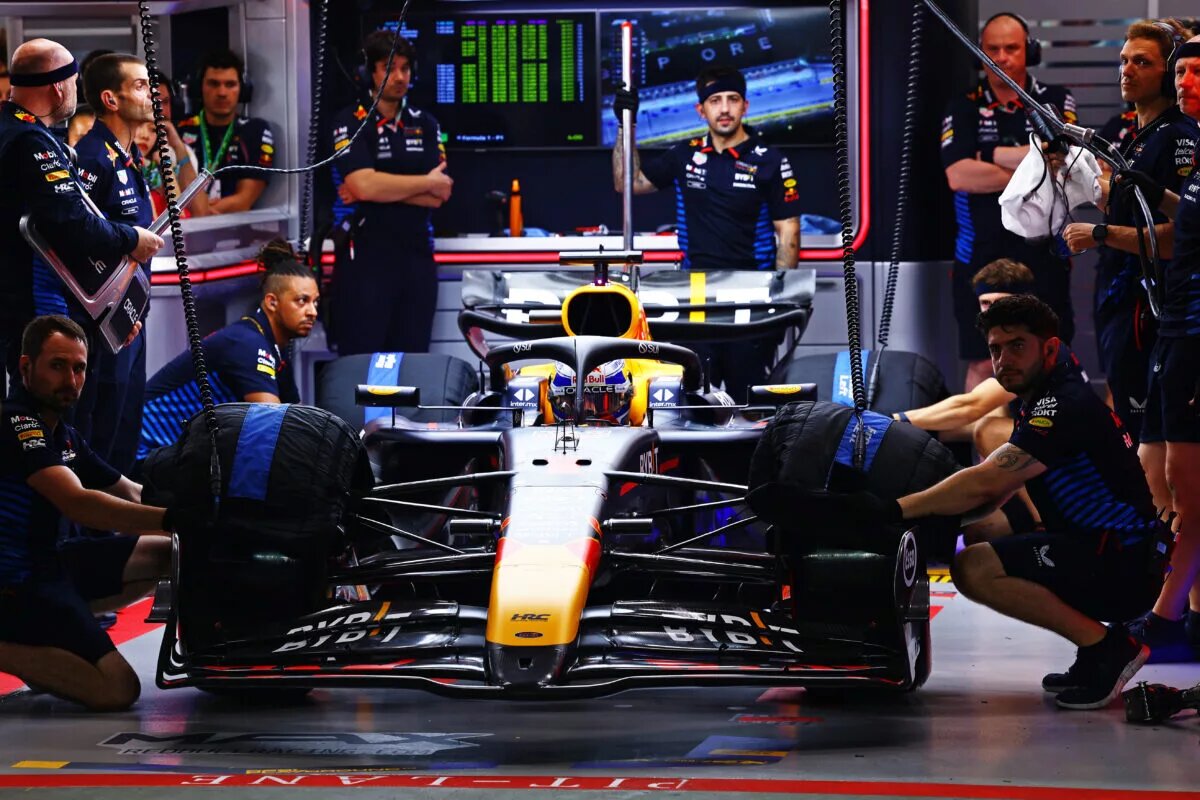
After dominating the opening rounds of the season, Red Bull’s 2024 campaign slowly ground to a halt. Upgrades to the RB20 consistently failed to deliver performance, complicating life for Max Verstappen in his Championship defence. Technical Director Pierre Wache explains why Red Bull struggled to unlock more lap-time.
Red Bull encounter major limitation
For the majority of the current regulatory cycle, which comes to an end in 2025, Red Bull have enjoyed very strong mid-season development.
Max Verstappen’s title triumph in 2022, for example, only came after the Milton Keynes squad compensated for a slow start and gradually outpaced Ferrari in the development race.
The following season was even more dominant for Christian Horner’s team, with Verstappen practically in a league of his own.
However, the opposite was true last season. After making reasonable progress with their Japanese GP package (introduced in April), Red Bull went the majority of the year without improving.
Upgrades did not work as expected, with the team’s perfect harmony between the simulator and the track suddenly disrupted. Pierre Wache has elaborated on this issue:
“The car had some different characteristics than what we expected in terms of aero,” Red Bull’s Technical Director told Autosport.
“Another aspect is that we didn’t expect some elements would affect the car performance as much as they did. They were not there by desire, but maybe we didn’t focus enough on them.
“Those elements were still there at the end of the season and we have to fix them for 2025.
“We had a loss of downforce in some areas of the map, and therefore we didn’t perform on track as we thought we could based on the wind tunnel, so there were some holes.
“That is a correlation issue and in terms of delivery on track it was mainly a balance issue.”
No room for error
Unlike last year, Red Bull cannot rely on Max Verstappen’s brilliance to make up for poor development. Ferrari and McLaren were objectively faster than the Austrian team at the conclusion of 2024.
McLaren’s development was particularly bulletproof last year, sustaining an upward trajectory from round 1 to round 24.
Meanwhile, despite stumbling mid-season, Ferrari corrected their mistakes and became contenders for the constructors title.
READ MORE: Fred Vasseur “not worried” about Hamilton and Leclerc competition
Mercedes are also a threat heading into 2025, especially if James Allison’s technical team can make the W16 less susceptible to changes in temperature and wind conditions.
Christian Horner admitted that Red Bull were approaching a ‘ceiling’ with their concept towards the end of last year. Considering the progress of their rivals, the Austrian team must find a way to overcome their recent slump.
There is also the issue of Max Verstappen’s next teammate, Liam Lawson, and to what extent he will contribute. With just 11 races under his belt, the Kiwi driver will find himself battling with hardened veterans and World Champions.
With this in mind, Red Bull must – at the bare minimum – close the gap to Ferrari and McLaren over the winter. Helmut Marko has spoken with optimism about the team’s capabilities in this regard.
Then again, as evidenced on numerous occasions in recent years, this generation of F1 cars are very unpredictable. Only time will tell if the factory in Milton Keynes has the remedy to its latest troubles.