
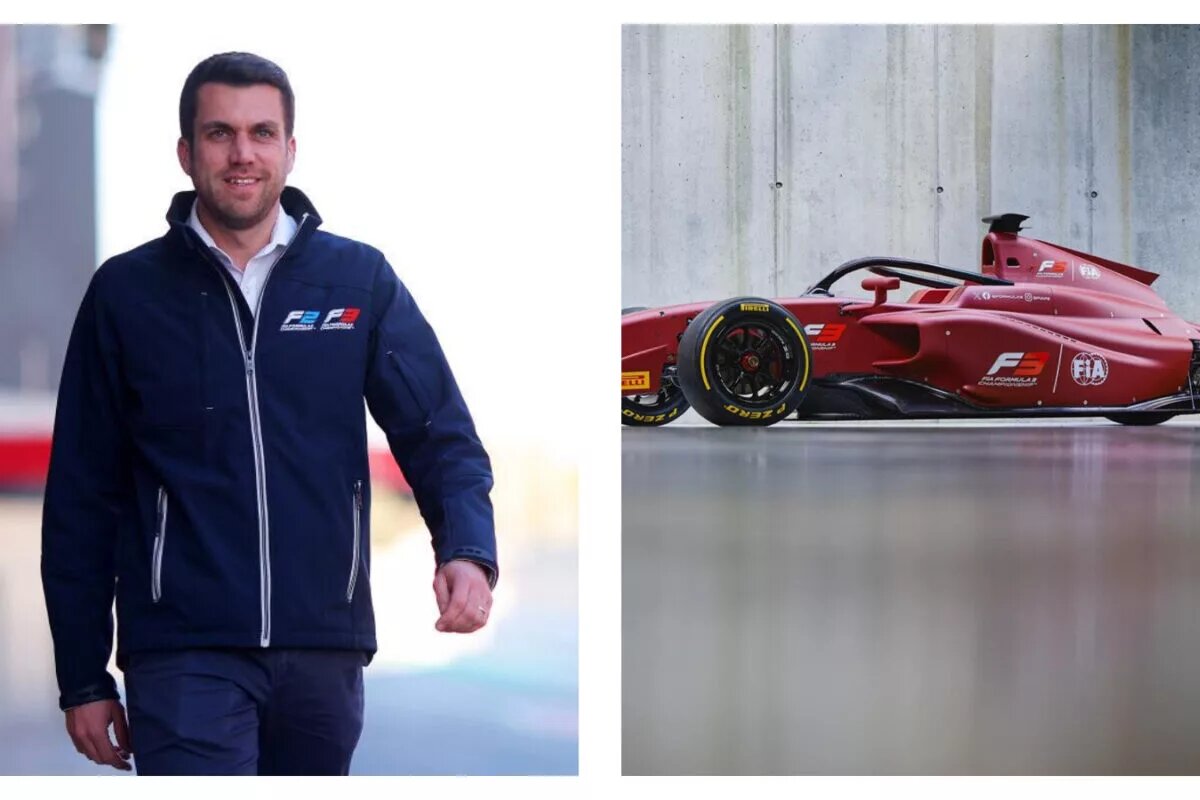

Ahead of the 2025 FIA Formula 3 season, Last Word on Sport (LWOS) spoke to FIA Formula 2 and FIA Formula 3 Technical Director, Pierre-Alain Michot about the Dallara F3 2025 car.
Last Word on Sports’ Exclusive Interview with Formula 2/Formula 3 Technical Director Pierre-Alain Michot
As motorsport continues to evolve, the balance between high-performance engineering and environmental responsibility has become a driving force for innovation.
With the 2025 Formula 3 season on the horizon, the latest F3 car promises to push the boundaries of technology and sustainability.
To learn more about this exciting development, we sat down with Pierre-Alain Michot, FIA Formula 2 and FIA Formula 3 Technical Director, the man behind the car’s development.
The 2025 season marks an exciting step forward for Formula 3. The new F3 car boasts advancements aimed at enhancing performance, safety, and sustainability.
We asked Michot about the most significant upgrades compared to the previous model.
What are the most notable improvements or innovations in the 2025 F3 car compared to its predecessor?
“The new car is a big step forward compared to the previous generation; we have made several changes, and it is also in line with the latest safety standards from the FIA.
“There was a lot of modification on the safety structure – chassis, front and rear crash box, so as to adapt to the latest regulations.
“Also, we wanted to take a step forward on the tyre size. We wanted to go closer to what we have in F2 and what they have in F1 as well, so we went from 13 inches to 16 inches.
“The most important step has been to work on the engine to accommodate the latest Aramco advanced fuel which we will have for this season, which will be a 100% sustainable fuel.
“That’s the biggest step and biggest improvement we made for this new car.
“We also wanted to go forward with some recycled carbon on the car, so as to all move forward in the same direction and make sure that we are more sustainable in the future.”
IN CASE YOU MISSED IT: Key Takeaways from FIA F3 Pre-Season Testing in Barcelona
Based on simulations and early feedback from teams, what impact do you anticipate sustainable fuels will have on performance and reliability?
“On performance and reliability, we shouldn’t notice anything. That was the main target because we know that this kind of fuel can be tricky to handle in terms of performance, reliability and for other components of the car.
“But we proved successfully during the development phase of the F3 car last summer that we didn’t have any issue with it. We even had some improvements compared to the previous generations of fuel. That’s a good step forward.
“We will need a bit more feedback from the teams, but we should also have a consumption reduction by a few percent.”
What unique challenges has this early adaptation brought for the teams so far?
“The first challenge was to find ‘good’ fuel because fuel is a chemical formula. You need to find a good blend and good chemistry to make sure that whatever you put in the engine is giving good performance, and the power and reliability that you expect.
“So we had to test several fuels before choosing this one. There were a lot of dyno tests at Mechacrome, and a lot of work from Aramco in the background to make sure that we can have this fuel available for the teams in early 2025.
“In the end, the final product might feel like, ‘Okay, no change’ but it was after a lot of work to make it happen. That was the main target.”
Balancing performance and sustainability is a growing challenge in motorsport. How does the 2025 F3 car manage this balance?
“To go back to what I said earlier with recycled carbon – the more recycled carbon you put on the car, sometimes the more weight you have to add, because this recycled carbon doesn’t have the same characteristics as let’s say the normal carbon fibre that we know.
“So, if we want to go more sustainable on one side we might have to add more weight on the other side. More weight, equates to more fuel consumption and more tyre consumption.
“In the end, we need to balance both when we are in the design phase. At this stage, there are a few parts of the car that, due to their induvial construction and make-up, means it’s feasible to produce in recycled carbon.
“So, the engine cover, the front-end plate, and the seats are all in recycled carbon. In the end it’s just over 10% of the carbon non-structural parts which will be recycled carbon.”
YOU MAY ALSO LIKE: Key Takeaways from F2 Pre-Season Testing in Barcelona
Can you share any behind-the-scenes efforts to reduce emissions or waste during production and race weekends?
“That’s something that we are working hard on in the background but for now, we are monitoring and calculating what we currently produce.
“We still do not have all the final results so we cannot disclose any numbers, but for sure the final target is to reduce all our CO2 emissions. So for example, for the fuel, it’s on a production side. Production and the way that the material is produced – that’s where we’ll reduce the emission.
“And the final product might have a little bit less consumption as well by a few percent, and this is how we aim to reduce the CO2 emission.
“But as we know it’s a long monitoring process, and it needs some assessment over several years to make sure that we are going in a good direction.”
Sustainability is a journey rather than a destination. We asked Michot for his perspective on how F3 cars might evolve further in the coming years to become even more environmentally friendly.
Looking ahead, how do you see F3 cars evolving further in terms of sustainability?
“We aim to continue development with Aramco on the fuel. We want to go to synthetic fuel because for now it’s bio-sourced material, but we will go to synthetic material.
“In the end, we will work a lot on this side of sustainability, as well we aim to keep working on our material sourcing like the recycled carbon or some other products on the car in order to transition to more green sourcing material.
“But it’s a long process and a longer development phase. We are working a lot with Dallara to make it happen.”
Do you think fully electric or hybrid technology will eventually make its way into the F3 category?
“In the near future, no. In the further future, we’ll see.
“In the near future we wanted to put, I’d say, all our eggs in the 100% sustainable fuels basket, because it made more sense for us in terms of technology and costs for the teams to go and stay in that route.
“As a quick example, if you go to a hybrid system you add a lot of weight to the car.
“Adding a lot of weight might result in some consumption as well, so we need to balance it properly and, in the end, we preferred staying in the fully combustion engine camp.”
Designing a race car is a complex and challenging task. We wrapped up the interview by asking Michot what he is most proud of in the new 2025 F3 car.
As an engineer, what are you most proud of in the new F3 car?
“Just making it happen was a big challenge.
“When you see the car on track for the first time, even though I’ve been doing it for nearly 20 years now, it’s still emotional – to make sure that the engine goes on and the car gets out of the garage on its own, and then comes back on its own and doesn’t stop on track.
“I would say that it can be easy to go out of the garage, but to come back on its own after a few kilometres sometimes it is not that easy.
“Seeing it on track and being able to see the smiles on all the teams’ faces who worked hard on the project, seeing it on track is really something that makes me proud of the final product.”
READ NEXT: Key Takeaways from 2025 F1 Pre-Season Testing in Bahrain
Main Photo: Formula Motorsport Limited