

After almost two years of uninspiring development, Aston Martin have fallen down the pecking order. Andy Cowell, who recently became team principal, believes the team must aim for a 90% upgrade success rate. The former Mercedes engineer explains how to achieve this.
Aston Martin enter critical phase
There are many reasons for Aston Martin to be excited about the future. Investment into a new wind tunnel, simulator and factor campuses put the Silverstone at the front of Formula 1 in terms of facilities.
Lawrence Stroll’s drive to succeed has translated into infrastructure that most teams across the paddock would be envious of.
Ultimately, it was the tools available to Aston Martin that helped convinced Adrian Newey to sign on the dotted line and join the team.
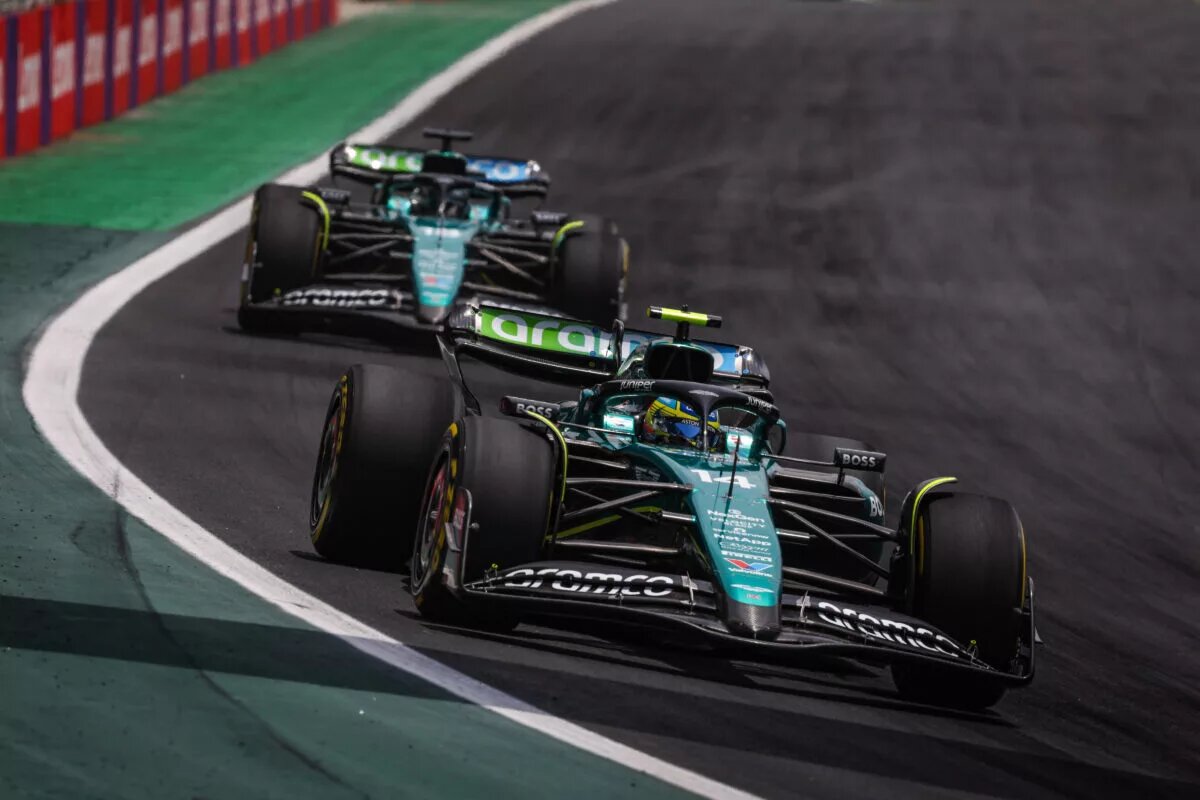
Of course, off-track improvements do not immediately translate to results. Last year’s campaign is good evidence of this, with Aston’s AMR24 being relegated to a midfield car after Imola.
The Italian circuit, not for the first time in recent years, saw Aston Martin’s upgrades derail their progress.
Although correlation issues are not unique to Aston, nowhere else in the paddock has development been so stagnant since mid-2023.
READ MORE: Mercedes Tipped to Deliver “Best Engine” for 2026 regulations
Changes for 2025 and beyond
For all the focus on Adrian Newey, several other high-profile figures joined the British team last year. Among them is Andy Cowell, who became CEO of the team just over three months ago.
Responsible for much of Mercedes’ success during the hybrid era, Cowell understands the inner workings of a Championship-winning team.
Partly because of this, he ushered in a series of changes to Aston’ technical structure.
Most notably, Mike Krack was moved from team principal to Chief Trackside Officer – with Cowell taking the Luxembourger’s previous post.
In order to propel Aston Martin into title-contention, Cowell explains that resources must be used more effectively.
“We definitely won the World Championship for the most updates in 2024. But those updates didn’t deliver the laptime – and what everybody wants in this business is to deliver laptime.
“That’s not to say we must get it right every time. I’ve seen statistics that show that in true research and development environments, a 20% success rate is high.
“If we can get a 20% success rate then that’s good.
“But the difference is that this needs to happen at the AMR Technology Campus and not at the track.”
Cowell believes that for Aston Martin to become a top team, their development programme must dramatically improve:
“We need to make sure that all our tools and processes… are working well enough to ensure that whenever we take an update to the circuit, we are at least 90% certain that it’s going to work on the track and.”
“There will always be the risk of data not quite matching up with what we find on the circuit.
“But our simulations can give us a robust steer and I’m confident we can get to the point where we’re right 90 per cent of the time.
“That’s the level that World Championship-winning teams are operating at so that needs to be our aim at a minimum.”
To some extent, the 2025 season will be an early indication of the team’s progress in this department.
Having failed to make any notable progress in last year’s campaign, unlocking performance over the winter break is imperative for Aston Martin.
With that said, the big opportunity to progress is obviously in 2026 – when all eyes will be firmly on the British squad.