

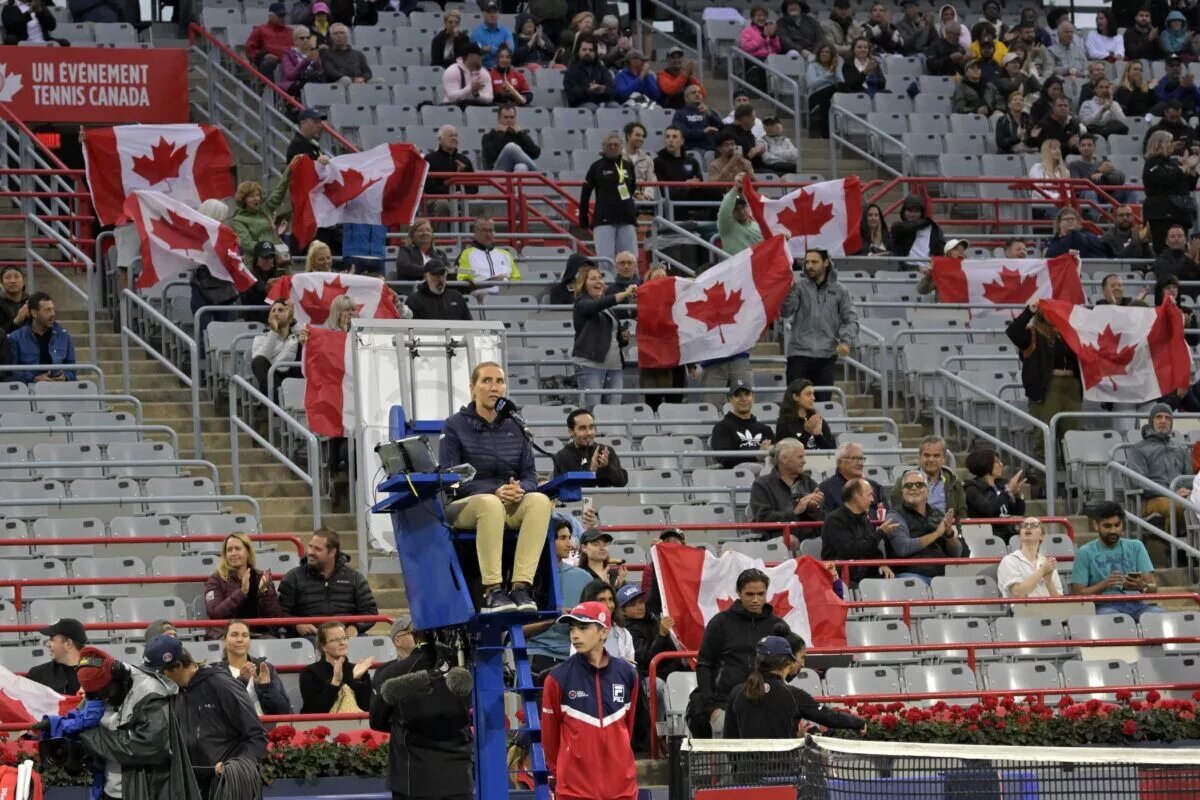
The Canadian Open is a truly unique tennis tournament, because it is staged in two different cities (Montreal and Toronto) simultaneously. Consequently, it is a more truly national tournament – rather than just one host city – than any other comparable national championship, such as the French Open or Italian Open, which are invariably staged in that country’s capital city.
Recently, the scheduling of the Canadian Open has come under pressure from multiple sources, including last year’s Olympic Games in Paris, which has led to the bizarre situation where, for the time being at least, the finals are no longer held at a weekend but in the middle of the week. Nevertheless, as a key staging-post on the way to the US Open, the last Major of the year, the Canadian Open remains a very significant event. Here is a brief history of the Canadian Open.
The Second Oldest Tennis Tournament in the World
The Canadian Open, or Canadian Championship as it was called before the Open era, is the second oldest continuous tennis tournament in the world after Wimbledon. Wimbledon began in 1877 (and so will celebrate its 150th anniversary in two years’ time) at the All England Lawn Tennis and Croquet Club. And in 1881, just four years later, the first Canadian Championship was held at the Toronto Lawn Tennis Club, with the first official women’s event being held 10 years later in 1891.
However, although both Wimbledon and the Canadian Championship began on grass, the Canadian Championship did not remain on grass for long. The Toronto club switched surface when it switched location in 1913, with red clay courts replacing grass courts for the Canadian Championship, even though the club itself continues to be called a lawn tennis club to this day.
Fascinatingly, given its proximity to the US Open or US Championship (the first edition of which was held just a month after the first Canadian Championship), the Canadian Open remained on clay for much of the entire 20th century, only switching to hardcourt in 1979. Although this may seem paradoxical, given that the Canadian Championship soon established itself as a major warm-up event for what would become the bigger and more prestigious US Championships, it is worth remembering that the US Open itself was briefly played on clay between 1975 and 1977. However, after the US Open switched permanently to hardcourt in 1978, the Canadian Open followed suit in 1979 and thereafter the two premier north American tournaments have both been played on the same surface.
That consolidated Canada’s position alongside Cincinnati as one of the two main north American events in the run-up to the US Open. That status was formalised in 2004, when the Canadian Open became part of the US Open Series of events in the approach to the US Open itself. And although Canada and Cincinnati may lack the obvious glamour of, say, Monte Carlo and Rome, the two premier European clay-court events in the run-up to Roland Garros, alongside the US Open they still constitute a north American “Triple Crown” of sorts. And the difficulty of winning all three in the same year is proven by the fact that since 2004 only Rafael Nadal, in 2013, has won all three events in the same year, to complete what was called “The Summer Slam” or “North American Slam”.
Home Prospects In 2025
Just as the US Open has generally towered over the Canadian Open, so US tennis has generally towered over Canadian tennis, to the extent that, remarkable as it sounds, only one Canadian tennis player has ever won a Major title in singles (the ‘Great White North’ has been rather better represented in doubles).
That was Bianca Andreescu in 2019, when she defeated Serena Williams in the US Open final just a few weeks after she had also beaten Williams in the Canadian Open final. That final in Toronto only lasted for a total of four games before Williams retired injured after her back began to spasm. However, if Williams thought that retiring from the Canadian Open final would boost her chances at the US Open, she was ultimately proved wrong, as the same opponent beat her fairly and squarely in New York in straight sets, 6-3 7-5.
Other than Andreescu, who of course has suffered from innumerable injuries since that historic triumph in 2019, no other Canadian has won a Major and precious few have even won their home championship. Andreescu was the first Canadian woman to win the Canadian Championship or Canadian Open since Faye Urban in 1969, precisely half a century earlier. And the last Canadian man to win the Canadian Championship or Canadian Open was Robert Bédard, who won the third and last of his Canadian titles in 1958.
It is fair to say that it is unlikely that there will be a home winner in either Montreal or Toronto in 2025, though Milos Raonic, Felix Auger-Aliassime and Denis Shapovalov have all briefly threatened to establish themselves at the top of the game before fading. Indeed, the most noteworthy Canadian participant this year is probably Eugenie Bouchard, who announced before the tournament that it will be her last ever event as a professional tennis player. And given that Bouchard, who reached the 2014 Wimbledon Singles final but was thrashed in it by Petra Kvitova 6-3 6-0, has seemingly played more pickleball than actual tennis in recent years, some people may be surprised to learn that she has not already retired from professional tennis.
An Event As Unique As Canada Itself
Nevertheless, despite the scheduling issues and the relative lack of strength among home players both on the men’s and women’s side, the Canadian Open remains an event as unique as Canada itself. Just as Canada is often described as having the best of both worlds, or at least the best of British (with its sense of history and its English-style understatement) and the best of America (with its general optimism and high-tech economy), so the Canadian Open is one tournament with two sides, or more accurately two sites, with the women playing in Montreal this year and the men in Toronto.
And in a year when Donald Trump, the US President, has persistently threatened not only to impose high tariffs on Canada but to make it a part of the United States of America, it is worth remembering the entirely more benign assessment of Canada by another American, the late and truly great Robin Williams: “You are the kindest country in the world. You are like a really nice apartment over a meth lab.” And to an extent, that is as true of the Canadian Open as it is true of Canada itself.
Main photo credit: Eric Bolte-Imagn Images