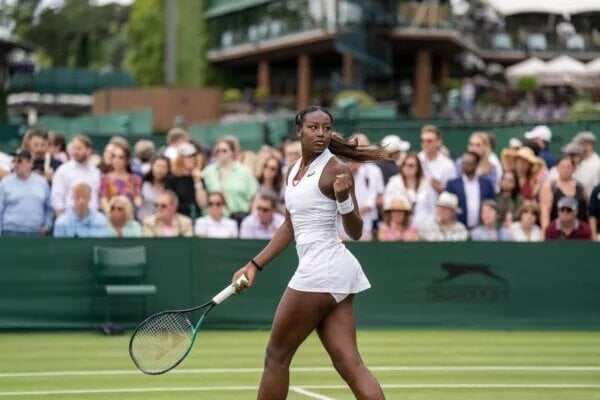



Emma Raducanu withdrew from Wimbledon on Sunday night after a final scan confirmed that the niggle she had been managing had developed into a stress fracture in her right lower leg. She had been scheduled to open play on Court 1 on Monday against Antonia Ruzic. She had told reporters earlier that same day that she planned to play. By Sunday evening she was posting on Instagram that she could not believe she was saying this again.
She did not need to explain the again. Everyone who has followed Raducanu’s career since 2021 understood it immediately. She had been managing the injury since her run to the Queen’s Club final two weeks ago, played the final heavily strapped, and withdrew from Nottingham citing a scheduling change rather than injury. She arrived at SW19 in a protective boot, missed multiple practice sessions, rescheduled her press conference without explanation, came through a Sunday morning session that looked positive enough to raise hope, and then was gone by evening. The sequence of events is almost too on-brand to process.
This is the Raducanu cycle, in real time, completing another rotation. Promising run, injury, withdrawal, absence. Same wheel, different month, different body part.
The Emma Raducanu Hamster Wheel
Let us be precise about what the past five years have actually looked like, because the general impression of Raducanu as an injury-prone underachiever is accurate and somehow still understated by the isolated narrative of each individual setback.
In 2022, she reached the second round at Wimbledon and lost in straight sets to Caroline Garcia. She made quarterfinals at Stuttgart and Washington, a semifinal at Seoul, and won zero titles. In 2023, surgeries on both wrists and an ankle in May ruled her out for the remainder of the year. She missed Wimbledon entirely. Returning in January 2024, she lost in the second round at Auckland, played the Australian Open on a protected ranking, and managed semifinal runs at Nottingham and quarterfinals at Stuttgart, Eastbourne, Washington, and Seoul. Progress, undeniably. Titles, zero. Her first career Top 10 wins, over Jessica Pegula and Maria Sakkari, finally arrived that year, meaning it took her three years after the US Open to beat a player ranked inside the top ten. She ended her 2025 season early in mid-October with physical issues in China, retired against Ann Li in the Wuhan heat, and withdrew from off-season exhibitions in December. Her 2026 preparations were derailed by a bone injury in her foot, then a post-viral illness following Indian Wells that sidelined her for over two months. She returned, reached the Queen’s final, picked up the stress fracture in her lower right leg, played the final strapped, and has now withdrawn from her home Grand Slam for the second time in four years.
She had said she was willing to risk potentially making the problem worse to play Wimbledon. Ultimately, that did not prove possible. It never does. That is the part of this story that has stopped feeling like bad luck and started feeling like a pattern with its own internal logic.
The frustrating aspect of covering Raducanu is that the good weeks are genuinely good. The Queen’s run was real. The wins were clean. The level she produced in those early rounds was exactly the level people have spent years waiting to see consistently. Every good week resets the narrative, producing a wave of coverage about turned corners and new chapters, and every good week is followed, with remarkable reliability, by the kind of Sunday night Instagram post nobody wanted to read.
The hype machine around Raducanu has always been generous beyond what the record justifies, and this is largely because the 2021 US Open casts an impossibly long shadow over everything that followed. Winning a Grand Slam at 18, as a qualifier–without dropping a set–is a legitimate and extraordinary achievement. It is also the only title she has won in five years of professional tennis. Her WTA profile lists one singles title. Since that triumph, her next best results are two WTA 125 final appearances. For a player who was seeded 30th at Wimbledon and relentlessly framed by British media as a generational talent, that is a surreally sparse return.
Her coaching carousel has not helped. She has cycled through a sequence of coaches since 2021 that would be remarkable for a player twice her age, each appointment heralded by optimistic framing about fresh starts and new directions. She recently reunited with Andrew Richardson, who guided her to the 2021 US Open title. Returning to the coach behind her sole career title is either inspired or the clearest possible admission that nothing else has worked. It is likely both.
What Has to Change and Why It Probably Won’t
The honest assessment of Raducanu at 23 is that this cycle will continue until something fundamental changes in how she approaches the physical demands of professional tennis. The pattern of building form, sustaining injury, taking extended time off, and returning undertrained is the predictable output of a body not adequately prepared for the load a full season places on it. She revealed on Sunday that she had been battling the stress fracture since before Queen’s Club, meaning she played an entire grass-court final on a broken leg.
The solution is not complicated in theory. It is extraordinarily difficult in practice: sustained, unglamorous physical conditioning across months where no tournaments are played, no ranking points are earned, and no headlines are generated. The players who avoid this cycle invest heavily in the physical that allows them to compete forty or fifty times a year without breaking down. Raducanu has not yet demonstrated the ability to sustain that investment, and at this point its absence is the primary limiting factor on her career.
She wrote in her Instagram Story that playing at Wimbledon in front of a home crowd means everything to her and that this is really difficult to process. That is true, and it deserves sympathy in the way that all genuine disappointment does. The problem is that the disappointment is no longer surprising. The crowd that would have filled Court One on Monday to watch her had been warned, quietly, by five years of this exact sequence, that the night before her opening match was when the news would come.
The cycle will not break until Raducanu decides that consistent tennis is more important than occasional brilliance. That decision is entirely hers. The evidence of the last five years suggests she has not made it yet, and a stress fracture on the eve of Wimbledon is the most unambiguous signal the body can send that the current approach is not working.
She will be back; she always comes back. The question that has never been answered is whether the next return will be any different from all the ones that came before it.
Main Photo Credit: Geoff Burke-Imagn Images