
Every Major provides an opportunity to take stock of the whole sport of tennis and the 2026 French Open was no different. From first-week infernos to final-weekend drama, here are five things we learned.
Five things we learned from the 2026 French Open
1. Tennis (Like Everything Else) Is Struggling To Adapt To The Heat
Major fortnights are so long and so intense that by the time you reach the end of one, it can be easy to forget what happened at the start. However, the first week of the 2026 French Open was genuinely unforgettable – and not in a good way.
Springtime in Paris has never been so hot, as a heatwave engulfed Roland Garros in the opening week of the 2026 tournament. There were numerous examples of players struggling in the extreme conditions, but perhaps the most memorable was Jakub Mensik, who collapsed at the end of his second-round win over Mariano Navone and eventually had to leave the court in a wheelchair.
It is a testament to Mensik’s fitness and conditioning that he was able to recover from what looked like a very serious incident of heatstroke or similar to reach the semifinals. Nevertheless, the suspicion will always remain that the almost literal hell that he went through finally caught up with him, because he was nowhere near his best in that semifinal against Alexander Zverev.
Tennis has to adapt to global warming. If it does not, it faces an existential crisis, because ultimately the jewel of the sport, five-set tennis – which elevates tennis not just into the realms of great sport but great art, becoming comparable to a Shakespeare play or a Dickens novel – might not survive the age of climate change.
-
Women’s Tennis Just Gets More and More Competitive
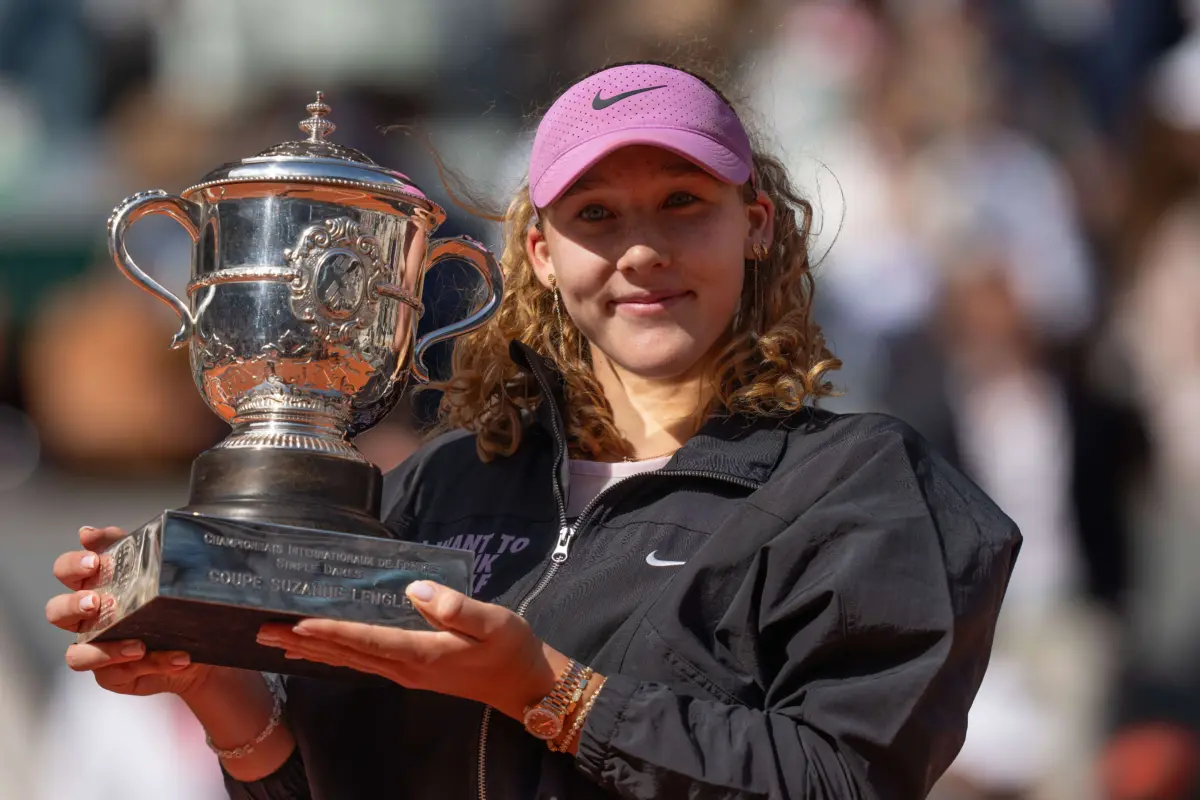
Miira Andreeva has become the latest female Major-winner, only adding to the ultra-competitiveness at the top of the women’s game. In stark contrast to the “Sincaraz” duopoly in men’s tennis in recent years, there have been numerous different women’s champions at the Slams. In fact, it has now been more than five years since any woman won back-to-back Majors. Naomi Osaka was the last woman to do so, when she immediately followed up her 2020 Covid US Open triumph by winning the 2021 Australian Open.
Andreeva’s ascent into the Major-winning category only adds to the incredible competitiveness and indeed flux at the top of the women’s game. The dominant woman on the WTA Tour, Aryna Sabalenka, has now won only one of the last six Majors she has competed in, losing three Major finals in that time and not even reaching the final in Paris (more on that below).
When Osaka briefly bestrode the women’s game like a colossus after that 2021 Australian Open win (her fourth Major victory in less than three years), I speculated that she might become the next dominant Women’s world #1, such that she could be identified globally just by her first name, as “Martina”, “Chrissy”, “Steffi” and “Serena” all were before her.
In fact, nothing could have been further from the truth. Osaka has fallen back into the pack and may never win another Major again. And women’s tennis has probably never been more competitive than it is now.
-
Alexander Zverev Showed He Can Cope With Unbelievable Pressure
Winning your first big title in any sport is the hardest title to win and things becomes even harder when you have come close to winning and failed. That is what makes those sporting champions who can come back from regular defeat and even regular humiliation extra-special. They might not have the greatest skill-set or the greatest style, but ultimately they prove that they have the greatest tenacity.
Only last month, Arsenal manager Mikel Arteta finally won the Premier League after coming second for three years in a row. The pressure on him was so enormous that he went into the final few games of the English domestic season knowing that at the end of it he would either lose his job (if not immediately, then eventually) or write his name indelibly into the club’s history books.
A comparison can be made between Arteta and Alexander Zverev, who finally won his first Major at the 2026 French Open after losing his three previous Major finals. Zverev had been under enormous pressure to win a Major and it only increased after the events of the first week at Roland Garros, which left him as the highest remaining seed in the men’s draw. To have gone on to win the title under so much scrutiny and expectation is truly impressive, regardless of the manner or style in which he played.
Rightly, much has been written about Zverev’s off-court life and especially about the domestic abuse claims that he has faced from two women in recent years, including the fact that he effectively reached an out-of-court settlement with one of them, the mother of his child. That must not be forgotten in the wake of this weekend. But on the court, he has finally proven himself to be a champion, and one who could operate under the most intense pressure imaginable.
-
Cobolli Shows He Has a Way to Go To Win a Major
When Flavio Cobolli reached the 2026 French Open final, it looked as if he might be the latest male tennis player to translate Davis Cup heroics into Major-winning triumph shortly afterwards, thereby following in the illustrious footsteps of Novak Djokovic and Jannik Sinner, to name but two. Unfortunately for him, he ultimately fell short, as he finally succumbed to Alexander Zverev in the fifth set of the final, when cramping and the general fatigue of a two-week Major tournament (especially one played out in extreme heat at the start) eventually caught up with him.
Like anyone who loses a Major final, Cobolli will have regrets, especially because he knew he had a uniquely golden opportunity to win a Slam in the absence during the second week in Paris of Carlos Alcaraz, Jannik Sinner and Novak Djokovic. Nevertheless, he can take great pride in the huge strides he has made over the last year, beginning at Wimbledon 2025 (where he made the quarterfinals), continuing in Bologna last November at the Davis Cup Finals, and culminating in Roland Garros over the last two weeks.
Now, in the wake of losing his first Major final, he must recover, reflect and really consider how he can elevate his game further so that he can challenge for a Major even when Alcaraz, Sinner and Djokovic are still in the tournament. His forehand is mighty, but his backhand needs improving; his serve, though potent, still has a long way to go to match the improvements that Alcaraz and Sinner have made in recent years; and above all he has to improve his stamina, so that he can compete in a Major final right to the end and not just for the first four sets.
-
No Tennis Match Is Ever Over Until It’s Over
Perhaps the most enduring lesson from the 2026 French Open is a reminder of one of the most enduring truths about tennis as a sport, namely that unlike a game in every other major sport a tennis match is never over until it is finally over. There is no time-limit in tennis, such that a player or team can simply build up a big lead and then sit on it until the clock runs out. In tennis, you have never won a match until you have actually won it.
At the 2026 French Open, both the World No.1s, Jannik Sinner and Aryna Sabalenka, lost from seemingly impregnable positions: Sinner was two sets and 5-1 up in the third set before his physical collapse against Juan-Manuel Cerundolo; and Sabalenka was a set and 4-1 up in the second set before similarly crumbling against Diana Schnaider.
Those two truly astonishing results will give renewed hope to every tennis player alive that however far behind they are in a match, they still have a chance to come back and win. And that is perhaps the most magical lesson that any tennis tournament, Major or non-Major, can provide us with.
Main photo credit: Susan Mullane-Imagn Images