
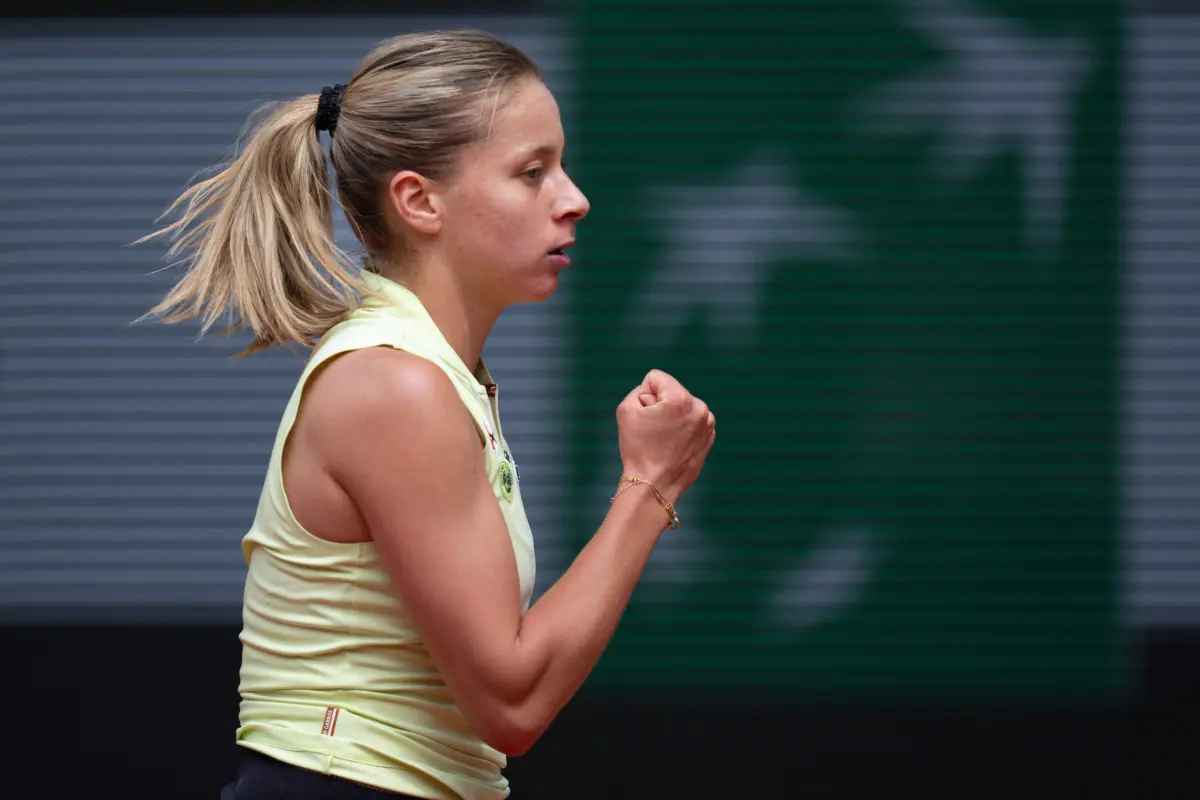
There is a particular kind of audacity that belongs to players who arrive at a Grand Slam through the back door and refuse to leave quietly. On Thursday at Roland Garros, Maja Chwalinska slammed that door wide open. The 24-year-old Polish left-hander, who entered the 2026 French Open ranked 114th in the world and had to fight through qualifying just to earn a spot in the main draw, has done what no qualifier in the Open Era, male or female, had ever done before: reached a Grand Slam final.
She did it the hard way, and she did it with style.
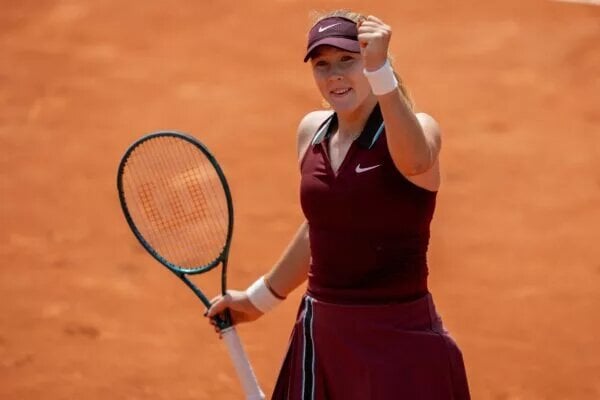
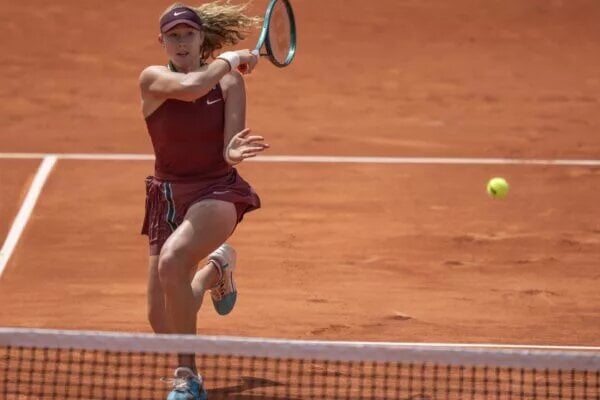
Maja Chwalinska at the 2026 French Open
Chwalinska’s path through the qualifying draw read like a punishment handed out to the rest of the field. She overpowered Alice Rame 6-0 6-3 then dismissed Carole Monnet 6-0 6-1 before grinding past Suzan Lamens in a testing 7-6 7-5 encounter. The upsets grew bigger from there as she progressed into the main draw–Qinwen Zheng was swept aside 6-4 6-0, Elise Mertens was crushed 6-4 6-0, and Maria Sakkari was eventually beaten 1-6 6-3 6-2 before Diane Parry and Anna Kalinskaya fell in the final rounds before the semis. That is nine matches in total–three in qualifying, six in the main draw–all building to a semifinal victory over Diana Shnaider that has delivered her to the most prestigious final clay court tennis has to offer.
Coming into Roland Garros, she had only two Tour-level clay wins and a lone Grand Slam main draw victory to her name. Those numbers feel almost comical now.
The Road No Qualifier Had Traveled
To understand the scale of what Chwalinska has achieved, it helps to trace the history of qualifiers at Grand Slams. The path she has walked is genuinely rare.
Before Emma Raducanu’s extraordinary 2021 US Open run, the best result by any qualifier–male or female–at a Major in the Open Era was the semifinals. That bmilestone had been reached by five men and three women across different eras and different Slams. The women who reached those semifinals were: Christine Matison at the 1978 Australian Open, Alexandra Stevenson at Wimbledon in 1999, and Nadia Podoroska at the 2020 French Open.
Podoroska’s Roland Garros run in particular is the one Chwalinska most directly echoes. The Argentine had never won a main draw Grand Slam match before that 2020 fortnight and had never beaten a Top 50 player coming in, yet she eliminated third-seeded Elina Svitolina to become the first qualifier in the Open Era to reach the Roland Garros semifinals. She was ranked 131st at the time, and it was the first time a qualifier had reached the final four of any Major since Stevenson had done it 21 years earlier. Chwalinska, ranked 114th this fortnight, has now gone one round further than that historic run.
That brings us to the other name that must be invoked in any conversation about qualifying runs at Grand Slams: Emma Raducanu. At the 2021 US Open, Raducanu became the first qualifier, male or female, to win a Grand Slam singles title. She came through three qualifying rounds and seven main draw matches without dropping a single set, beginning her qualifying campaign ranked #150 in the world. Raducanu’s triumph shattered what had been considered an impenetrable ceiling. Now Chwalinska, who shared that same qualifying route through Paris, has matched the feat of reaching a final and stands on the edge of becoming only the second qualifier ever to win a Slam.
Nine Matches, One Set Lost
What makes Chwalinska’s run so striking is not just that she won, but how she won. She has dropped only one set across her nine matches at Roland Garros–three in qualifying and six in the main draw. That level of dominance from a player who had never advanced past the second round at any Major before this tournament is almost impossible to contextualize in real time.
She has beaten players ranked inside the Top 15 and Top 25, managed a three-set wobble against Sakkari without losing her nerve, and delivered bagel-and-breadstick scorelines against some thoroughly capable opposition. After winning her quarterfinal, she told the BBC: “I honestly don’t know what is going on. Coming here, my goal was to qualify. I felt like I’m doing the right things and I just need to be patient for it to click.”
Something clicked, alright.
A Career Built on Clay
None of this emerged from nowhere. Chwalinska, born on October 11th, 2001 in Dąbrowa Górnicza, Poland, plays left-handed with a two-handed backhand, and has spent years quietly assembling one of the most impressive WTA Challenger résumés in recent memory. Her title-winning record on the ITF and WTA 125 circuit–across Prague, Montpellier, Porto, Florianópolis, Montreux, and Oeiras–pointed to a clay-court talent that the main tour had not yet fully absorbed. The French Open of 2026 has forced that absorption, violently.
Her coach Jaroslav Machovsky has worked with her through the grind of that lower-tier circuit, and it is on clay, particularly, that her left-handed serve, flat groundstrokes, and ability to stay aggressive under pressure have found their most natural home.
History’s Rarest Club
Across the Open Era, qualifiers reaching even the semifinals of Grand Slams can be counted on one hand. Those who went all the way to the final number exactly one before this week–Raducanu. Chwalinska has now joined a conversation with Raducanu, Podoroska, Stevenson, and Matison, and she sits above all of them in terms of round reached, save for Raducanu who took the trophy.
The French Open final awaits. Against her will be Mirra Andreeva, who defeated Marta Kostyuk in the other semifinal. Neither finalist has stood on this stage before. But there is only one in the pair who had to win three qualifying matches just to get into the draw. And that, by itself, is the story of this Roland Garros.
“Nobody knows me,” Chwalinska once joked. They know her now.
Main Photo Credit: Susan Mullane-Imagn Images