
Tennis as a sport has grown in leaps and bounds, particularly in the last five years. Enjoying sustained and accelerated growth in participation, viewership and commercial value. Current data puts it as the fifth most popular sport and the most popular individual sport globally, with over a billion fans and another hundred million actively playing the sport at different levels. In the USA, it ranks lower in popularity relatively speaking, but the metrics still show positive numbers in terms of growth and involvement.
Are Tournaments keeping up with Tennis’ growth?
Effort Leading to Results
This growth has, in no small part, been fuelled by the professional players who, over the years, have raised the bar, taking the level several notches higher in their overall style of play. There is irrefutable evidence that modern tennis players are fitter, cover more ground, have a wider variety of shots, and hit the ball with more venom than at any point in history. And they are achieving all this despite having a much busier sporting calendar to contend with.
There are also significant changes in media coverage, with documentaries, Netflix docuseries, data-driven journalism, and social media involvement all contributing to a more immersive experience for players and fans alike. This growing social interaction with the sport has meant that much more money is being invested in it, allowing even players at lower levels to thrive and offering greater incentive for those looking to get involved.
In truth, it has been fascinating to see just how far the sport has come from its humble beginnings and how much farther it can go as it continues to grow in popularity and go toe-to-toe with more commanding team sports. It is a testament to how everyone within and involved with the sport is playing their part in transforming it into one of the world’s leading sports -or maybe not quite everyone. The tournaments and their planning committees may not be doing as much as they need to.
Failing To Move With the Times
While there have been undeniable improvements in tournaments over the years, with innovations, minor tweaks, and changes to the game, it still feels like certain key details are either not taken seriously or, worse, completely ignored. A few weeks ago, during the Miami Open, many matches were disrupted by rain delays, even though the event had been expected to be a festival of tennis, a chance for fans and players to connect through the sport. Instead, it turned into a festival of interrupted, delayed, and postponed matches, frustrated fans, and, overall, an overriding sense of uncertainty. This was down to the tournament lacking a single stadium with a fully retractable roof, despite the weather around this time of year being unreliable for tennis matches. Yet this was a Masters 1000 event.
A couple of tournaments down the line, and we were now into the clay season, with Monte Carlo the first Masters 1000 event of that period. The tournament had, by all accounts, gone as smoothly as possible, especially in comparison to what had followed in Miami. It had gone so well that even the dream final, which was anticipated the moment the draws came out, involving Jannik Sinner and Carlos Alcaraz, had come into fruition. It was the first affair involving what has become indisputably tennis’ two trailblazers. To say it was highly anticipated would be an understatement. Following what was an unexpectedly long delay in what was expected to be a frequent match-up between the pair, coming into the year. But here it was finally.
As Sunday rolled by and the match was now finally underway, one thing became apparent. As it has been the way for some time in tennis, with the serve getting bigger in terms of pace, spin, and angles, many tennis players drop way back behind the baseline to give themselves more time on the return. Alcaraz, facing a dominant server in Sinner, did exactly just that. However, in doing so, he so often found himself, far behind, so much that for those watching on TV, he was completely out of the picture. It was a staggering indictment on the part of the tournament and it’s organisers. A match-up so hotly anticipated for months, and here it was and those watching at home couldn’t even see one of the only two participants.
What is being done?
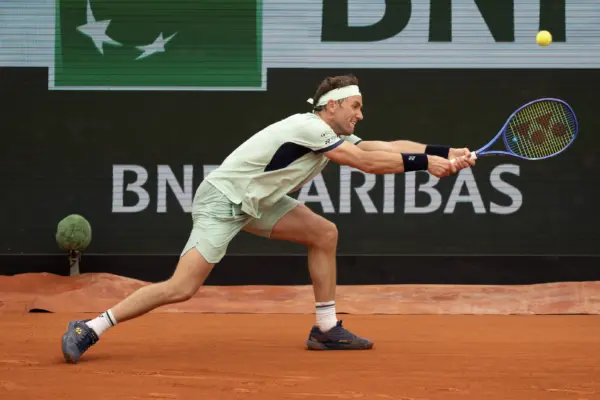
On the face of it, it might seem a minor error but this would have been forgivable if it were an ATP 250 or even a 500 event. This was a Masters 1000 event. One of only nine. And in the final of the most anticipated match all year, one of the players, the current world number #1 at the time was not even in frame. Contrast that to the French Open where players adopt a similar stance, yet always remain in frame and it tells a story of a tournament that has failed to keep pace with an evolving sport. Ultimately, it had no bearing on the match itself, but for a sport that has grown through sheer engagement and connection, it felt like a huge blunder.
The real concern however as pointed out earlier is whether this obvious flaw was even noticed and then even if it was, whether it was even considered a problem worth correcting. Unfortunately, like in Miami, we’d have to wait for another year, when the tournament comes round again to get any real indication of what or if anything has been done to combat these issues. For now, the evidence points to a sector that’s failing to keep pace with a sport that is growing rapidly all around it.
Maon photo credit: Matthias Hauer/GEPA via USA TODAY Sports