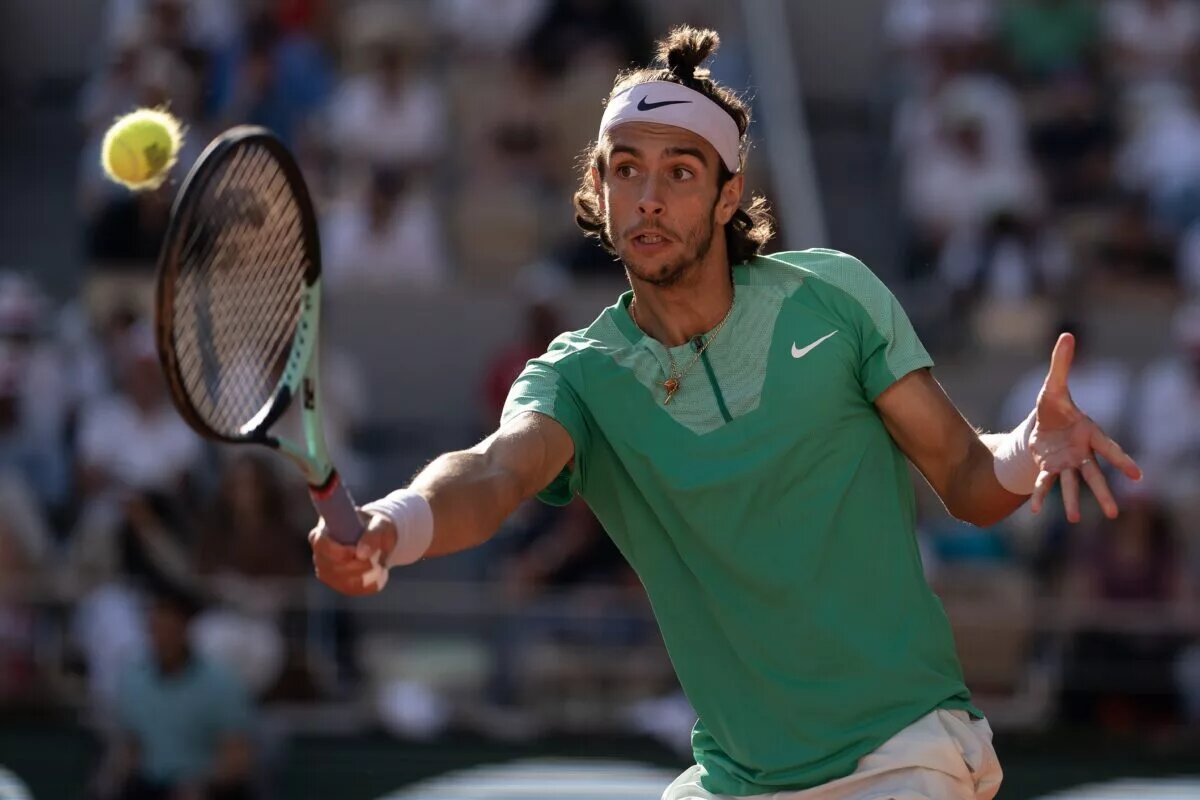

There is an easy shorthand for the men’s game in 2025 and into 2026, and it runs something like this: Jannik Sinner and Car,os Alcaraz, then everyone else. On hard courts that framing is broadly accurate. But on clay, that gap between the top two and the chasing pack is narrower than the narrative suggests, and one player in particular has done enough over the last eighteen months to stake a legitimate claim to a specific and significant title. Lorenzo Musetti is the third best clay court player in men’s tennis right now.
Is Lorenzo Musetti poised for a clay-court breakthrough?
Built for the Dirt
Start with the style, because it explains almost everything else. Musetti is noted for the variety in his game, including his use of the defensive backhand slice, drop shots and, at times, serving and volleying. He is also on record that his favourite surface is clay. That is not a surprise. Clay is the one surface where variety is not merely decorative but structurally necessary. The slower conditions give the builder time to build, the drop shot artist room to manoeuvre, and the one-handed backhand player the time to prepare their stroke properly. On hard courts, Musetti’s passive counter-punching game can be a liability. On clay, it becomes a weapon.
He is primarily a counter-punching player from the baseline who has, in recent years, worked his forehand into a more aggressive tool. The result is a player who can absorb pace, redirect it with angles, and then suddenly shift into attack with the same fluency. The one-handed backhand, now the top-ranked such stroke in the game ahead of Stefanos Tsitsipas and Grigor Dimitrov, is particularly lethal on clay where the higher bounce actually suits its preparation window. When Musetti is rolling, he is the sort of player who makes the clay court feel like his personal puzzle, drawing opponents into positions they did not agree to be in.
The Evidence Has Been Building for Years
The results did not appear from nowhere. As far back as his debut at Roland Garros, Musetti was signalling what the surface could bring out in him. He reached the fourth round at the French Open on his Grand Slam championship debut, only the sixth player since 2000 to do so. He was nineteen years old and had a first-set lead against Novak Djokovic before retiring in the fifth.
What followed was a long and occasionally frustrating plateau, punctuated by flashes of brilliance mostly on clay. He beat Djokovic in Monte Carlo in 2023. He reached a clay final in Hamburg in 2022, where he beat Alcaraz to win his first tour title. Then 2024 arrived and something shifted. At the Paris Olympics, played on the Roland Garros clay, Musetti reached the bronze medal match by defeating home favourite Gael Monfils, Mariano Navone, Taylor Fritz, and defending Olympic champion Alexander Zverev before falling to Djokovic in the semifinals. He beat Felix AugerAliassime to reach a podium and became, in doing so, the first Italian to win a medal in men’s singles tennis in 100 years. On clay. On the biggest clay stage outside Roland Garros itself.
Maturity Arrived, and It Changed Everything
The transformation from talented and volatile to genuinely elite has a fairly identifiable cause. Musetti has revealed that the birth of his first child changed his mentality around tennis and inspired him to play better and train harder. He credits reaching the Wimbledon semi-finals and the Olympic bronze medal to the same inspiration. The wild unforced errors that used to punctuate his best performances became rarer. The mental collapses that once defined his losses were replaced by recoveries.
In 2025, the ATP described Musetti as playing with a “new-found grit and resilience,” a phrase that would have been unthinkable for a player who once had a two-set lead against Djokovic at the French Open as a teenager and retired mid-match. He put it plainly himself: “I think now I approach things in a more professional way. Not just on the court, on the match, but in the daily routine.” The results in 2025 did not emerge from a talent suddenly discovered. They emerged from a talent finally matched by the discipline to deploy it consistently.
The Numbers Make the Case
This is where the argument stops being impressionistic and starts being concrete. Over his ATP-level career, Musetti holds a win rate of 66 % on clay, compared to 53.1% on hard. In the last 52 weeks entering the 2025 clay season, that clay figure rose to 81.8%. That is not a clay-comfortable player. That is a clay specialist performing at a level that very few players on the tour can match.
In 2025 alone, Musetti reached the semi-final stage at all four of the biggest clay court tournaments: Masters events in Monte Carlo, Madrid, and Rome, and then the French Open semifinals. Since the formation of the ATP Tour in 1990, he is only the sixth player to achieve that in a single season. Four of the other five on that list are Grand Slam champions, and three of them, Sergi Bruguera, Nadal, and Djokovic, have won in Paris. The company that statistic puts him in is not that of a good clay court player. It is the company of the greatest clay court players in the history of the sport.
Compare that to the players most commonly cited as the other contenders for that third spot. Djokovic, despite his record, went out in the second round of Monte Carlo 2025 and has been visibly less dominant on the surface in recent years. Tsitsipas, once the obvious heir apparent on clay, fell out of the top 10 after his quarterfinal exit at Monte Carlo in 2025, and touched his lowest ranking since 2018 in the meantime. Zverev is a dangerous clay court player, and one who comes pretty close to Musetti in terms of ability on the red dirt but his 2025 wasn’t as impressive across the board
The Obvious
The conversation around Musetti has lagged behind the reality of his results, in part because the Italian game is so thoroughly dominated by the Sinner narrative that there is little room left for anyone else, and in part because Musetti himself spent several years being talented in a way that was easy to dismiss. That period is over. As the Roland Garros commentary put it last year, his combination of creativity and consistency, combined with elite attacking power, places him among the top three or four clay courters in men’s tennis. With Sinner and Alcaraz in their own bracket, that means third. It might actually mean a closer third than the surface-level narrative gives him credit for. As the clay season opens again at Monte Carlo, the argument is not whether Musetti belongs in the conversation. He is the conversation.
Main photo credit: Susan Mullane-USA TODAY Sports