

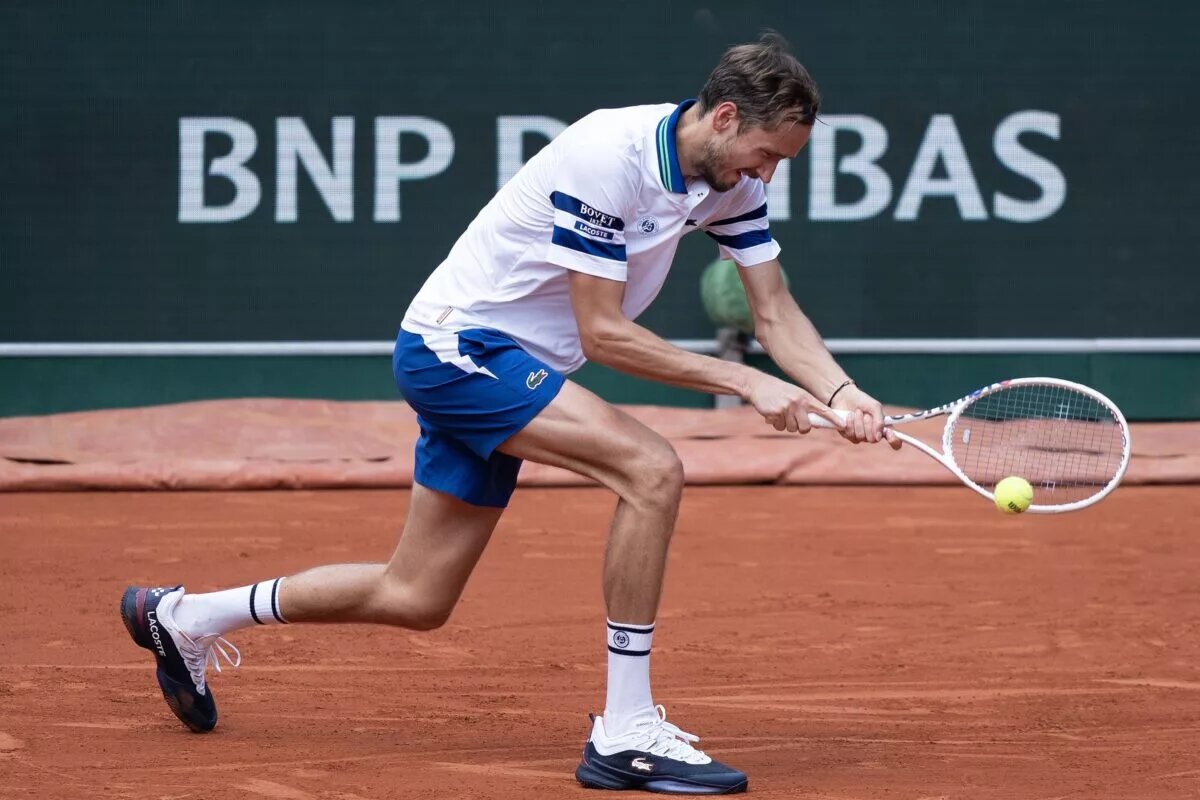

Daniil Medvedev on clay has never been a straightforward story, and Tuesday’s first-round exit at Roland Garros against Adam Walton, his seventh first-round loss in ten appearances at the tournament, leaving him with a 10-10 record at the event, reopens a question that does not have a simple answer.
The standard reading is that Medvedev simply does not suit clay. His flat groundstrokes, his aggressive baseline positioning, and his preference for pace; none of it fits a surface that punishes all three. That reading is not wrong, but it may be incomplete. Because, if you look at where Medvedev has actually worked on clay, a more specific pattern starts to emerge.
It is not just about the surface. It is about the bounce.
Medvedev Bounced in the First Round, Again
The Physics of Medvedev on Clay
To understand why this matters, you need to understand what Medvedev’s game actually does and what clay does to it. As coach Patrick Mouratoglou has explained, when Medvedev plays his flat shots on clay, the ball does not carry the same quality; it bounces higher and slower, making it easier for opponents to attack. His backhand, in particular, the cornerstone of his game, suffers significantly on the surface.
On a fast hard court, his flat ball skids through the bounce and stays low, rushing the opponent. On dry, lively clay under a midday Paris sun, that same ball sits up like an invitation. The opponent has time. Medvedev loses his primary weapon not because he hits it differently, but because the surface strips it of its effect.
Now consider what changes when the conditions are damp, or when the match is played late in the evening. Clay courts produce greater variations in how flat shots behave, with friction and bounce height both changing with surface conditions. Wet or cool clay plays faster and lower. The ball does not sit up in the same way. Evening sessions at Roland Garros, particularly on the night schedule under the Chatrier roof, can play closer to a medium hard court than to the slow, high-bouncing clay of a hot afternoon. That is a fundamentally different game, one that suits Medvedev considerably better.
This is not purely theoretical. Medvedev’s best clay-court result in recent years came in Rome, a tournament on the ATP calendar notorious for being interrupted by rain and played partly in cool, damp conditions that suppress the bounce. In 2023, he won the clay-court Masters 1000 title in Rome, a tournament where he had never previously won a match. That breakthrough did not happen in Madrid, where the altitude already speeds up the surface, or in Monte Carlo, where he was bagelled 6-0, 6-0 by Berrettini this year in a daytime match.
He smashed his racket six times during that Monte Carlo defeat as he was a player entirely stripped of his tools in ideal clay conditions for his opponent. It happened in Rome, where the weather intervenes, where the courts play heavier, and the bounce stays down.
What This Means at Roland Garros
The argument, then, is not that Medvedev cannot play on clay. It is that Medvedev on clay is highly condition-dependent in a way that most players are not, and that Roland Garros, with its sun-baked red dirt in late May, consistently presents him with the worst version of that surface for his game.
This year, he lost to Adam Walton in punishing Paris heat, a day session, bright conditions, the ball bouncing high and staying there. It fits the pattern precisely.
His flat game and defensive court positioning are more exposed at Roland Garros than anywhere else, and the theory here is that the exposure is uneven. Give Medvedev a night match in cool air after an afternoon shower, and you are giving him a version of the court he can actually manipulate. Give him Court Philippe-Chatrier at 1pm in 30-degree heat, and you are presenting him with everything his game is least equipped to handle.
He reached the quarterfinals at Roland Garros in 2021, his best result at the tournament. Worth checking how many of those matches were played in warmer daytime conditions versus cooler evening sessions.
Where to Go
This is where the speculative nature of this theory must be acknowledged honestly. The data required to prove it rigorously, match-by-match session times, court temperatures, bounce height measurements, Medvedev’s win percentages split by day versus night at Roland Garros specifically, is not publicly assembled in any comprehensive way.
What exists is a visible pattern of outcomes: good results in Rome where it rains, a breakthrough in conditions that suppress the bounce, and a string of Roland Garros exits that cluster overwhelmingly in the early rounds, where day sessions are most common, and conditions are most hostile to his game.
The conclusion it points toward is this: Medvedev on clay is not simply bad on clay. He is bad on a specific version of clay, the hot, dry, high-bouncing afternoon version that Roland Garros serves up more reliably than anywhere else on the calendar. Change the conditions and you may, just may, be watching a different player. The surface is the same. The game is entirely different.
He said after Tuesday’s exit that he knows he can play well at Roland Garros, and that first rounds are usually tougher for him. He is not wrong on the second point. But the real variable may not be the round, it may be the time of day on the order of play sheet, and whether Paris has remembered to rain.
Main Photo Credit: Susan Mullane – USA TODAY Sports