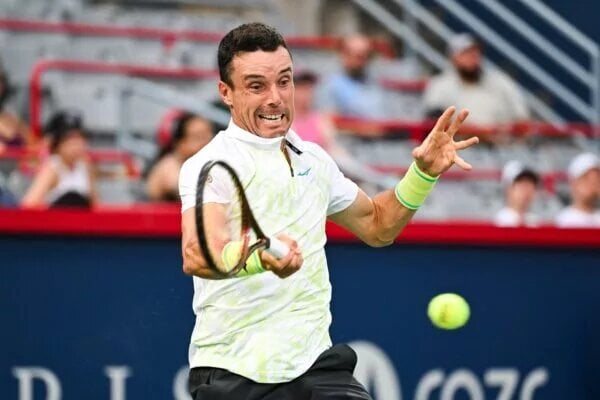



Near the beginning of the last season, during an ATP interview, Lorenzo Musetti said: “I think my game is a bit different from most others because of my one-handed backhand, and I really like to mix things up.”
He continued: “Especially on clay, I can vary my game a lot. The modern game is more about the serve and the first shot after it, or the serve and the return. But that’s not how I play.”
The last younger player with a one-handed backhand to crack the world’s top ten was Stefanos Tsitsipas. Musetti currently sits at number eight and has been there for some time now. Tsitsipas has since fallen out of that elite tier, partly because his one-handed backhand never evolved enough to keep pace with the modern game. We may well have seen the best tennis of his career already. The crucial distinction is that Tsitsipas was never a typical one-handed backhand player. He lacked variation and finesse, relying almost entirely on his serve and forehand.
That’s why Musetti draws comparisons to a young Dominic Thiem instead. The similarities aren’t perfect. They don’t bring the same intensity to the court, and Musetti naturally has more variety in his arsenal. But the Italian, perhaps contrary to what his graceful style suggests, also has to grind and battle for his victories. The fact that he’s learned how to do that is hugely important.
Musetti has matured considerably. He’s evolved from a player of tantalizing potential into a genuine elite performer. For nearly a year and a half now, he’s been playing at a consistently high level. During last season’s clay swing, he was arguably the second or third best player in the world. He reached the Monte Carlo Masters final, where he took the opening set against Carlos Alcaraz before losing the next two while battling an injury. He also made the semifinals in Madrid and Rome, and at Roland Garros, where he again went up a set on Alcaraz before injury forced him to retire.
Musetti has clearly figured some things out.
The Fighter Emerges
Above all, he’s accepted that he can’t play perfectly. He no longer lets his frustration show when the ball isn’t coming off his strings quite right. He’s learned how to fight, how to grind, how to dig in when conditions aren’t ideal. That’s become a defining reason for his rise to the top level. The complaints and sulking that used to appear when things felt off have largely disappeared. He’s become a fighter.
That realization is invaluable, and nobody can take it away from him. The Italian artist, the magician, has acquired a slightly ugly edge to his game. It’s one of the main reasons he’s reached the elite.
Winning Ugly
The numbers confirm that Musetti wins in an unconventional way.
His serve and forehand aren’t overwhelming weapons. Last season, only Alex de Minaur had a lower ace percentage among the top ten. Musetti was at 5.9 percent. De Minaur, however, wins more points on his first serve. Musetti ranks last in that category within the top ten at 71.6 percent compared to the Australian’s 73.4. Excluding aces, just 14 percent of his points come from winners. In the top ten, only de Minaur and Alexander Zverev rank lower. Along with Novak Djokovic, they also produce a lower percentage of forehand winners per point. The Italian has to work harder than most for his victories.
Only 42.2 percent of his points come from either his serve or the first shot that follows it. Once again, only de Minaur ranks lower. By comparison, Jannik Sinner sits at 56.9 percent, while Alcaraz is at 53.2. Another revealing statistic: opponents commit unforced errors on 21.8 percent of points against him. Only de Minaur ranks higher. Nobody frustrates opponents more.
Musetti is genuinely a different kind of player. But that doesn’t necessarily mean he always plays beautifully. He’s added an element of ugliness to his tennis, and it’s a major reason he’s become a top-level player. Over the past year and a half, he’s reached six Tour finals. Tragically, he’s lost all six, which now represents a psychological barrier he still needs to break through. In 2024, he also made the Wimbledon semifinals and won bronze at the Paris Olympics. At one point last season, he climbed as high as number six in the world.
He’s begun unlocking his immense potential and has shown clear signs of maturity. But the pressing issue is that he must continue evolving to keep pace with modern tennis, especially if he wants to compete with Sinner and Alcaraz. That’s clearly the biggest challenge in the sport right now.
The Evolution Required
Ultimately, Musetti can’t exist long-term in his current form.
He’s not a classic grinder limited by technical shortcomings that prevent him from being more aggressive. He’s an artist, a magician, capable of finishing points in countless ways. He must preserve what he already has, certainly, but he also needs to keep evolving if he wants to rival Sinner and Alcaraz. It’s already become clear that his current style poses physical challenges, particularly in the latter stages of tournaments.
In practical terms, that means adding another layer of aggression and efficiency while mixing things up even more. Thiem had to make that same adjustment. Musetti can do it because he’s not a limited grinder, even if that label is relative in modern tennis. He’s an artist who can end points in many different ways. His serve, for instance, can improve. He has both the physical and technical tools. At 185 centimeters tall, he can generate more power from his legs, and he has plenty of finesse in his hands.
The encouraging sign is that Musetti himself understands all of this. He recently added José Perlas to his team, a coach who has worked with many top-ten players. One of the main goals for the new season is winning more free points.
That journey begins in just a few days at the tournament in Hong Kong, and it will be fascinating to see whether Musetti can push his limits even further. One thing is certain: tennis needs him. He’s a truly unique player. Even when he plays what is, in principle, ugly tennis, he somehow makes it look beautiful.
Main photo credit: John E. Sokolowski-Imagn Images