
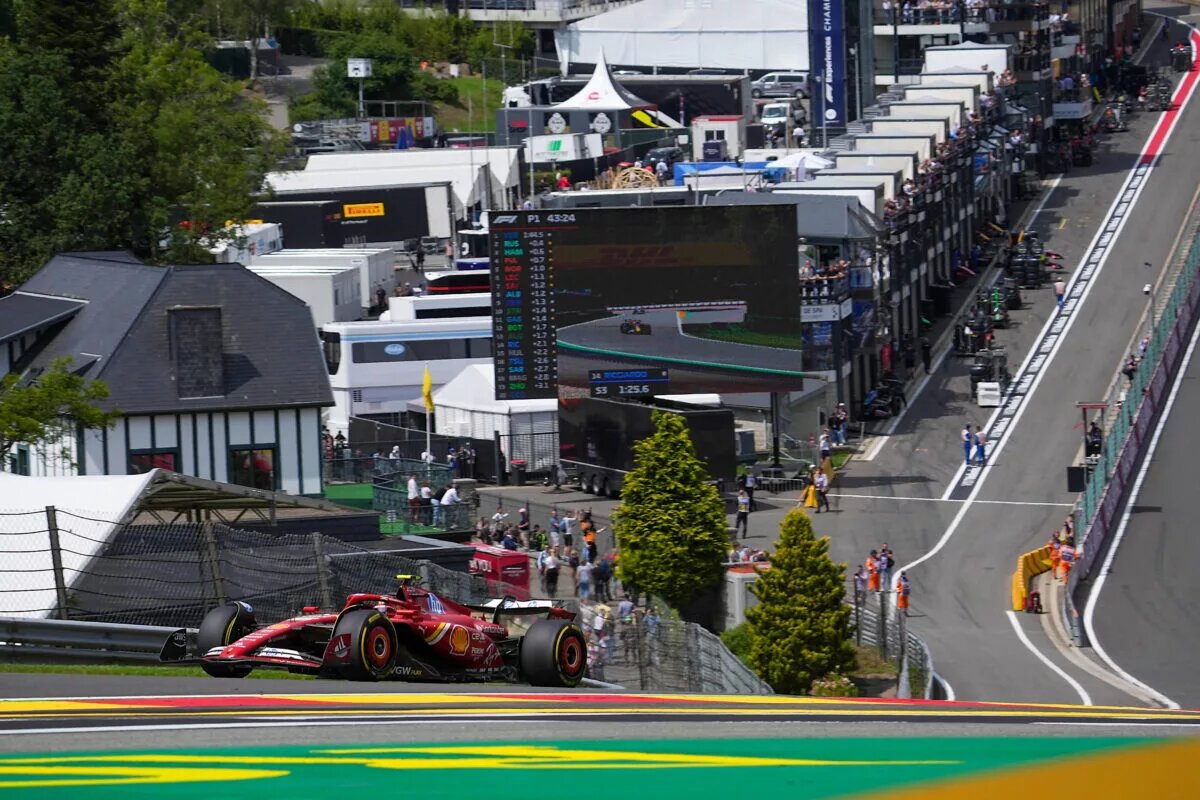

Round 13 of the 2025 F1 season takes us to the Belgian Grand Prix.
Everything You Need to Know About the Belgian Grand Prix
The Belgian Grand Prix dates back to 1925, with its most recent outing set for July 25 and 27. FP1 will open the 2025 weekend, with Sprint qualifying following that same afternoon.

Origins at Spa-Francorchamps and Bois de la Cambre
The Belgian Grand Prix was first held in 1925, staged at the original 9-mile Spa-Francorchamps circuit in the Ardennes. Antonio Ascari won the inaugural race in a works Alfa Romeo. He was killed at the French Grand Prix mere weeks later.
The Grand Prix returned in 1930 with a modified circuit, including a bypass of the Malmedy chicane. Louis Chiron claimed victory that year. The following decade saw drivers such as Tazio Nuvolari and Rudolf Caracciola dominate, while the 1939 race introduced the Raidillon corner.
World War II brought racing to a halt. It was not until 1946 that Grand Prix racing returned to Belgium, this time in Brussels’ Bois de la Cambre park. Frenchman Eugène Chaboud took the win in a Delage.
READ MORE: Zak Brown: “Clean” Norris and Piastri Can Handle Title Fight
The Evolution of Spa
By the early 1950s, Spa had evolved into one of the world’s fastest circuits. Only La Source remained a slow corner thanks to the new 8.7-mile circuit.
The invention of the Formula One World Championship in 1950 saw Juan Manuel Fangio and Nino Farina dominate the Belgian Grand Prix in their Alfa Romeos. Fangio claimed the first Spa victory of the F1 era, while Farina triumphed the following year.
Alberto Ascari took a commanding win in 1953, with his Ferrari outlasting the Maseratis.
Rain played a role in 1956, when Stirling Moss lost a wheel at Raidillon but managed to continue in his teammate Cesare Perdisa’s car to finish in third place. Peter Collins claimed victory after Juan Manuel Fangio’s Ferrari succumbed to gearbox failure.
The late 1950s saw Spa’s reputation intensify. Drivers feared the circuit’s lack of margin for error. Cars frequently sped off into telegraph poles, stone walls, or trees.
Tragedy struck in 1960. During practice, Stirling Moss crashed at Burnenville, suffering serious injuries. Mike Taylor’s career ended after his Lotus crashed at Stavelot due to a steering failure. The Belgian Grand Prix itself claimed lives.
Chris Bristow was killed in an accident at Malmedy, and just five laps later, Alan Stacey was fatally struck by a bird at 140 mph, crashing off the Masta straight.
Jack Brabham won the race, but the weekend caused emotional damage. Jim Clark, who scored his first F1 points there, famously hated the circuit thereafter.
Anger in the 1960s
Despite the dangers, the Belgian Grand Prix continued. Ferrari dominated in 1961 with a 1-2-3-4 finish, while Clark won the next four editions.
In 1966, engine regulations changed, doubling power output. Jackie Stewart’s crash at the Masta Kink, where he was trapped in his fuel-soaked BRM for nearly half an hour, inspired his campaigning for greater driver safety.
Dan Gurney won in his Eagle in 1967, the constructor’s only F1 victory. The following year, wings made their F1 debut, and Bruce McLaren secured his team’s maiden victory.
However, the race was overshadowed by another serious crash. Brian Redman suffered severe injuries after colliding with a parked car.
By 1969, drivers had had enough. The Grand Prix Drivers’ Association asked for safety improvements, which were rejected by circuit owners. The race was cancelled.
Although a final event was held in 1970, won by Pedro Rodriguez, it was clear that Spa was no longer suitable for F1 in its original form.
A Brief Period at Zolder and Nivelles
In the early 1970s, the Belgian Grand Prix rotated between Zolder and the modern Nivelles circuit. Emerson Fittipaldi won both events at Nivelles in 1972 and 1974, but the uninspiring layout and financial issues led to it being removed from the calendar.
Zolder hosted the bulk of the races from 1973 to 1984. Memorable moments included Niki Lauda’s back-to-back wins in 1975 and 1976, as well as the death of Gilles Villeneuve during qualifying in 1982.
YOU MAY ALSO LIKE: Formula E in Berlin: Oliver Rowland Wins the Drivers’ Championship as Jaguar Dominates
Return to a Reimagined Spa
In 1979, Spa-Francorchamps was revised and shortened to just over 4.3 miles to meet rising safety standards.
F1 returned to Spa for the Belgian Grand Prix in 1983, with Alain Prost taking victory.
Ayrton Senna then went on to win at Spa five times. His 1985 win came after the race had to be postponed due to the newly laid asphalt breaking up in the heat.
The 1990 Belgian Grand Prix was restarted twice, first after a pile-up at the La Source hairpin, then again when Paolo Barilla crashed at Eau Rouge. In 1992, Michael Schumacher claimed his maiden F1 victory for Benetton, a year after debuting at Spa.
In 1993, Damon Hill battled both Senna and Schumacher to clinch a hard-fought win.
Following the deaths of Senna and Roland Ratzenberger at Imola in 1994, Spa temporarily added a chicane at the foot of Eau Rouge. By 19995, the chicane was removed, and Schumacher began a dominant run, winning three consecutive Belgian Grands Prix.
His dominance at Spa continued into the 2000s. In 2001, he surpassed Prost’s record with his 52nd career win at the circuit. In 2004, he clinched his seventh World Championship title at Spa.
Present Day
In 2003, the Belgian Grand Prix faced disruption and was omitted from the calendar due to Belgian tobacco advertising laws. A further cancellation followed in 2006 when local authorities failed to complete essential upgrades.
The event returned in 2007 with Kimi Räikkönen taking victory, his third in succession at Spa.
In 2008, rain once again played havoc. Lewis Hamilton overtook Räikkönen twice in the closing laps on a wet track, eventually winning after the Finn crashed out. However, a post-race penalty for cutting the Bus Stop chicane demoted Hamilton to third, handing victory to Felipe Massa.
The 2021 race had no green-flag racing due to torrential rain. Two laps were completed behind the safety car before it was red-flagged, and Max Verstappen was declared the winner. Backlash over the decision to award half points prompted the FIA to revise its points system for shortened races in 2022.
In January 2025, the Belgian Grand Prix was secured in 2026-2027, 2029, and 2031.
Circuit de Spa-Francorchamps
| Circuit Information | Details |
|---|---|
| Circuit Length | 7.004 km |
| First Grand Prix | 1950 |
| Number of Laps | 44 |
| Race Distance | 308.052 km |
| Fastest Lap | 1:44.701 – Sergio Perez (2024) |
READ NEXT: Revisiting Pato O’Ward’s Career Milestones
Main Photo
- Credit: IMAGO / ABACAPRESS
- Recording Date: 07/28/2024