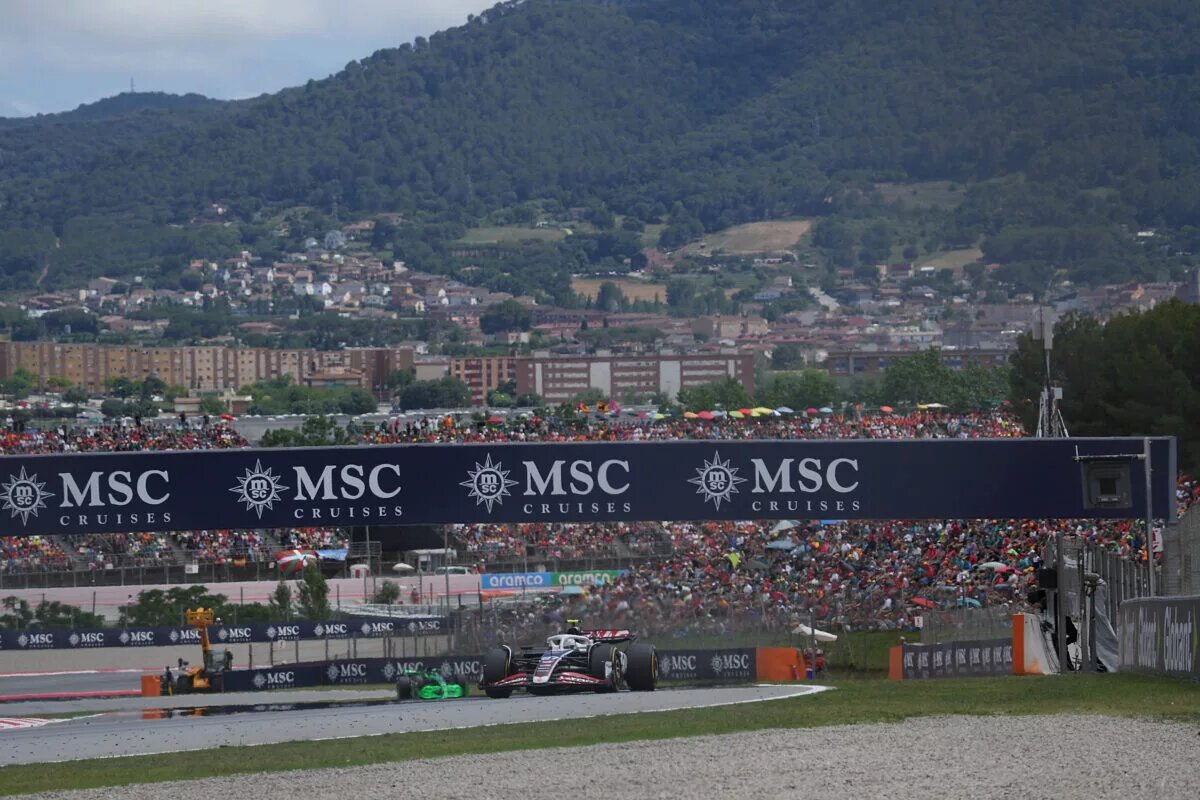

Round 9 of the 2025 F1 season takes us to the Spanish Grand Prix.
Everything You Need to Know About the Spanish Grand Prix
The Spanish Grand Prix has long held a significant place in motorsport. As one of the oldest racing events in the world, it marked its centenary in 2013.
Always an incredible atmosphere at the #SpanishGP ❤️💛#F1 pic.twitter.com/dKwxA8Nsy6
— Formula 1 (@F1) May 27, 2025
The Pedralbes Years
Spain re-entered the international racing scene in 1951, joining the F1 World Championship with a race held at the wide, tree-lined streets of the Pedralbes circuit in Barcelona.
That year proved historic, as Argentina’s Juan Manuel Fangio clinched his first world title, driving an Alfa Romeo and taking advantage of Ferrari’s tyre issues.
Plans were made to run the event in 1952 and 1953, but financial difficulties prevented this. The race returned in 1954, where Briton Mike Hawthorn ended Mercedes’ dominance by winning for Ferrari.
However, tragedy elsewhere halted Pedralbes’ future. Following the 1955 Le Mans disaster, which killed over 80 spectators, strict new safety regulations were introduced. The Spanish Grand Prix was cancelled that year, never to return to Pedralbes. The circuit, too dangerous for modern racing, faded into history.
Jarama and Montjuïc’s Shared Hosting Duties
By the late 1960s, Spain was eager to reclaim its place in F1. A new permanent circuit was built at Jarama, just north of Madrid, while the Montjuïc Park circuit in Barcelona was updated to meet modern safety standards.
Jarama hosted a non-championship F1 race in 1967, won by Jim Clark, setting the stage for an official return in 1968.
From 1969, the Spanish Grand Prix alternated annually between the two circuits: Jarama in even-numbered years, Montjuïc in odd. Jarama was slow and tight, Montjuïc fast and flowing.
Montjuïc produced several memorable races. Jackie Stewart took victories in 1969 and 1971, while Niki Lauda claimed his first career win in 1974.
However, by 1975, drivers raised serious safety concerns about loose barriers. Organisers reacted poorly, even threatening to lock cars in their garages. Most teams reluctantly started the race, but Emerson Fittipaldi withdrew in protest after just one lap.
On lap 26, Rolf Stommelen’s rear wing failed, launching his car into the crowd. Four spectators died. The race was red-flagged three laps later, and Jochen Mass was declared the winner. Only half points were awarded. Montjuïc never hosted an F1 race again.
READ NEXT: Verstappen, Red Bull Reveals Hopes for Spain Technical Directive
Jarama’s Solo Years and Eventual Decline
After Montjuïc’s tragedy, Jarama became the Spanish Grand Prix’s sole venue. Though safer, the circuit’s narrow layout made overtaking difficult. In 1976, James Hunt won the race but was controversially disqualified for having a car that was too wide. A successful appeal restored his points.
Mario Andretti dominated in his innovative ground-effect Lotus in the late 1970s. Unfortunately, Jarama’s shortcomings, such as its tight corners, summer heat, and dwindling crowds, led to its cancellation in 1982. The Grand Prix would return four years later at a new home.
Jerez
In the mid-1980s, hopes to stage a race in the coastal town of Fuengirola fell through. Instead, the mayor of Jerez championed a new permanent circuit to promote tourism and the local wine industry. The Circuito Permanente de Jerez debuted in 1986. Ayrton Senna beat Nigel Mansell by just 0.014 seconds.
Senna and Mansell returned as winners in later years, while the final Spanish Grand Prix at Jerez in 1990 ended with a Ferrari one-two, led by Alain Prost. That weekend also saw a terrifying accident for Martin Donnelly, who was thrown from his car in a high-speed crash and never raced in F1 again.
Though popular with teams and drivers, Jerez’s remote location struggled to attract large audiences. It would later host the European Grand Prix.
YOU MAY ALSO LIKE: Aix Racing’s Struggles to Find Pace on Monaco’s Streets
Circuit de Barcelona-Catalunya
With support from the Spanish government, a modern track was constructed in Montmeló, near Barcelona. The Circuit de Barcelona-Catalunya became the Grand Prix’s permanent home in 1991. Its 1992 edition was heavily promoted as part of that year’s Olympic Games.
Williams dominated the early races, but the circuit is best remembered for Michael Schumacher’s masterclass in the rain in 1996, which was also his first victory for Ferrari.
The 2000s brought a resurgence in Spanish interest thanks to Fernando Alonso. He stood on the podium several times, finally winning his home Grand Prix from pole in 2006. He repeated the feat in 2013, making him the only Spaniard besides Carlos de Salamanca (1913) to win a Spanish Grand Prix.
Between 2001 and 2019, 15 of the 19 races at the circuit were won from pole position, highlighting the importance of qualifying. In 2020, the COVID-19 pandemic delayed the race to August. Lewis Hamilton emerged victorious after executing a clever two-stop strategy to pass Max Verstappen.
Some incredible storylines and results in this period 💪#F1 #SpanishGP pic.twitter.com/XnjKSFqFDs
— Formula 1 (@F1) May 28, 2025
The layout was slightly altered in 2023, adopting the faster MotoGP configuration to improve overtaking and race flow.
Madrid’s Street Circuit
The future of the Spanish Grand Prix will shift from Catalonia to the capital. Starting in 2026, F1 will race on a brand-new street circuit near the IFEMA exhibition centre in Madrid, nicknamed ‘Madring.’ The move sees the race return to Spain’s central region.
READ NEXT: Ferrari Will Only Bring Minor Update for Spanish GP
Main Photo
Credit: IMAGO / DeFodi
Recording Date: 23.06.2024