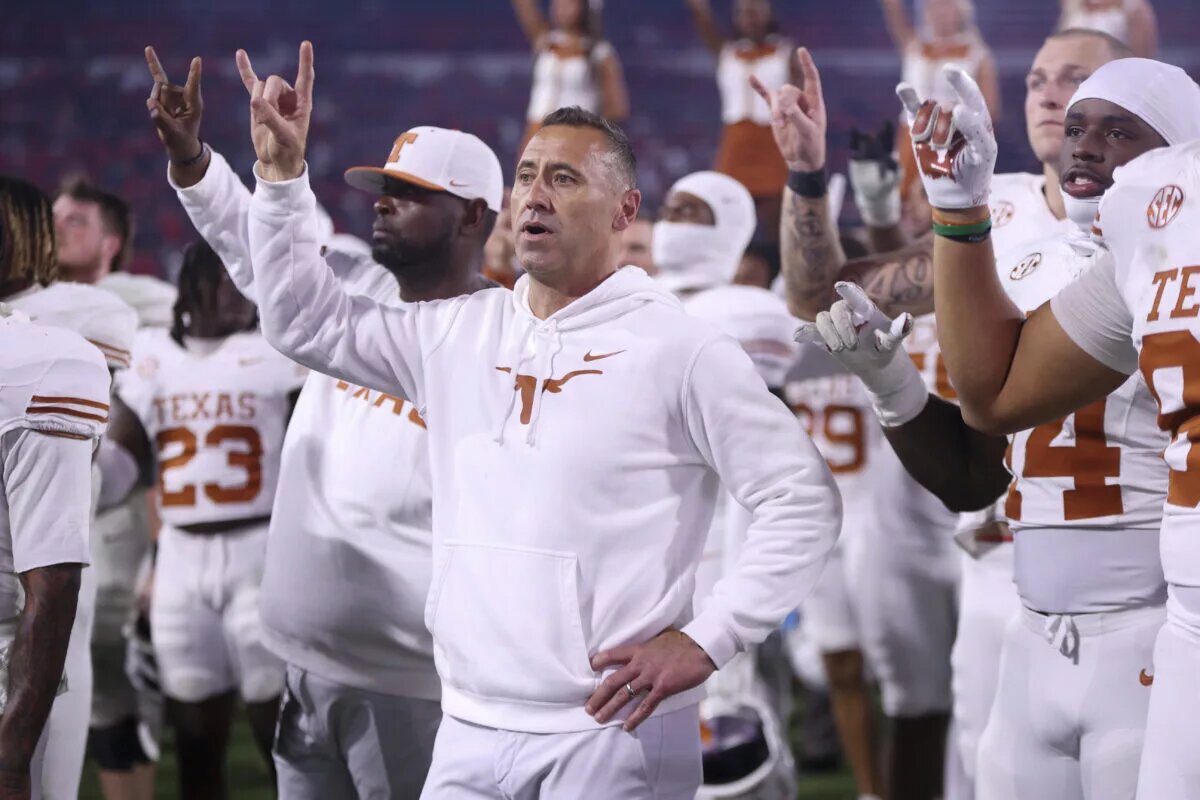

In a recent press interaction ahead of the Cheez-It Citrus Bowl, Texas Longhorns head coach Steve Sarkisian offered an intriguing preview of his team’s New Year’s Eve clash against the Michigan Wolverines.
While expressing lingering disappointment over the Longhorns’ narrow exclusion from the expanded 12-team College Football Playoff, Sarkisian boldly suggested that the December 31 matchup could draw higher television viewership than several games in the playoff itself.
The game, set for a 3:00 p.m. ET kickoff at Camping World Stadium in Orlando, Florida, and broadcast live on ABC, pits two storied programs against each other in what promises to be one of the most compelling non-playoff bowl games of the season.
Sark on significance of Texas-Michigan
Sarkisian highlighted the Citrus Bowl’s longstanding reputation for featuring powerhouse brands, noting, “One thing that the Citrus Bowl has been able to do over time is look at the brands, look at the iconic brands that have come and competed in this game year in and year out. And this year’s no different. They’re getting Texas versus Michigan… What they’ve been able to hit home runs on is viewership.”
He added that he “wouldn’t be surprised” if the game’s ratings surpassed those of multiple CFP contests, expressing genuine excitement about the potential audience numbers.
Sarkisian’s confidence appears well-founded when examining recent trends in college football viewership.
Although the College Football Playoff dominated the top-watched games in previous seasons, the expanded 12-team format has introduced variability, particularly in first-round matchups involving mismatched teams or Group of Five programs.
For instance, certain lower-profile first-round games—like blowouts featuring teams such as Ole Miss against Tulane (around 6.2 million viewers) or Oregon versus James Madison (approximately 4.4 million)—posted relatively modest numbers, especially when aired on cable networks like TNT and competing against NFL programming.
In contrast, a high-profile non-playoff bowl like the Citrus Bowl benefits from several advantages. Airing on over-the-air network television via ABC provides broader accessibility compared to the majority of CFP games, which are primarily on cable channels like ESPN or TNT.
Only a limited number of playoff games land on network TV.
Why Sark could be right
Additionally, the Texas-Michigan showdown carries immense brand appeal: these are two blue-blood programs with massive national followings, recent history (including Texas’ victory over Michigan earlier in the 2024 season), and a rematch vibe that resonates with fans.
The quarterback duel adds another layer of intrigue. Texas’ Arch Manning, the highly touted signal-caller from the famed Manning family, has shown flashes of brilliance in his starting role, compiling nearly 3,000 passing yards, 24 touchdowns, and solid rushing ability.
Opposite him is Michigan’s Bryce Underwood, a true freshman phenom and former No. 1 overall recruit, who has navigated a challenging debut season but demonstrated elite potential with his arm and legs.
Both young quarterbacks are expected to play despite opt-outs elsewhere on their rosters, creating a showcase for two of college football’s brightest rising stars.
Their off-field interactions during bowl week— including a viral photo of the duo enjoying a roller coaster together at a local Orlando theme park—have only amplified the hype, with some dubbing it one of the “most expensive” casual snapshots in bowl history given their combined NIL value.
Contextual factors further bolster the case for strong ratings.
The Citrus Bowl slots in on New Year’s Eve afternoon, facing limited direct competition from other bowls in its window—primarily lower-profile games like the Sun Bowl (Arizona State vs. Duke) or Las Vegas Bowl (Nebraska vs. Utah)—before transitioning into the evening CFP quarterfinal, such as the Cotton Bowl featuring Ohio State against Miami.
Without heavy NFL overlap on that day and capitalizing on holiday viewership, the game is positioned to attract casual fans drawn to the marquee names.
Of course, viewership isn’t guaranteed, and variables like game competitiveness, weather in Orlando, or emerging storylines (such as Michigan’s recent coaching transitions) could influence numbers.
Yet, historical data supports Sarkisian’s optimism: iconic brand matchups outside the playoff have occasionally outperformed lesser playoff games, especially when accessible on network TV.
Whether Sarkisian’s comments stem purely from enthusiasm for the opportunity or carry a subtle nod to the Longhorns’ perceived snub from the CFP bracket, they underscore a broader conversation in college football.
In an era of playoff expansion, transfer portal chaos, and opt-outs, traditional bowls featuring elite programs can still command significant attention.
As the Longhorns and Wolverines prepare to close out their seasons, all eyes—including those of television executives—will be on whether this Citrus Bowl delivers the viewership home run Sarkisian anticipates.