

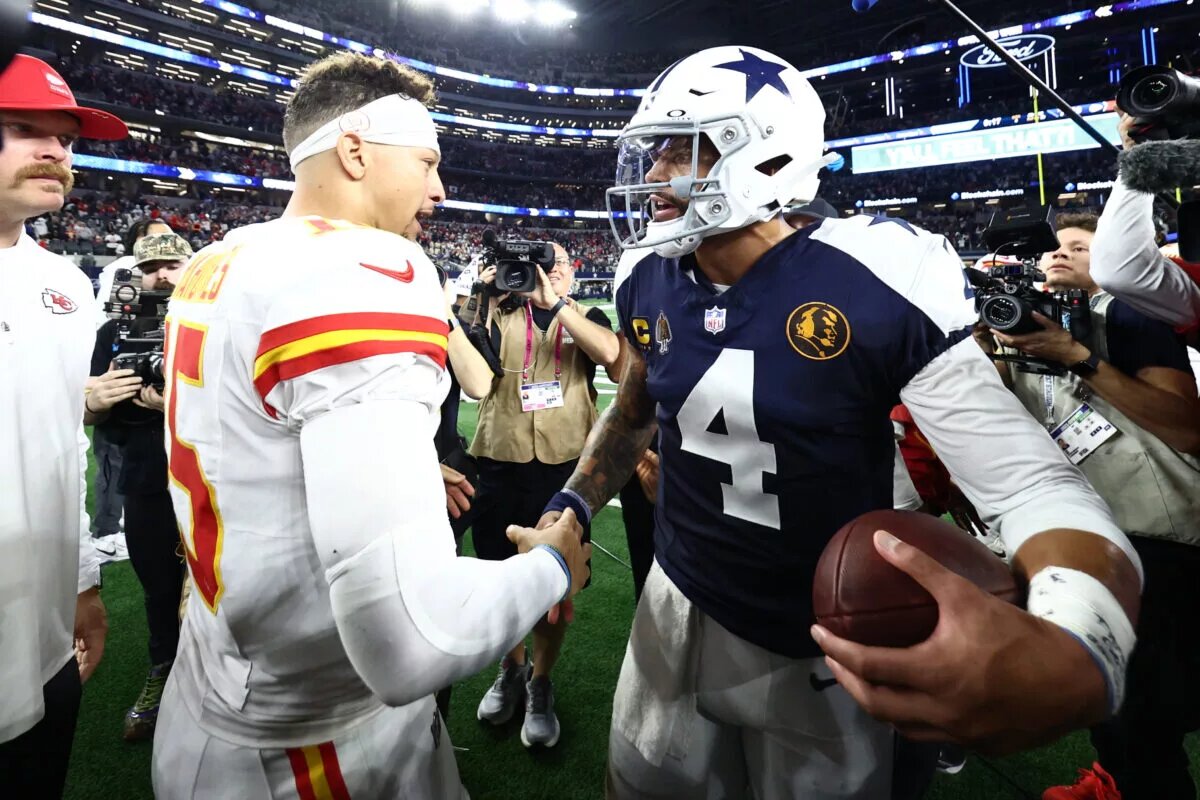

The Kansas City Chiefs, long hailed as a modern dynasty under Patrick Mahomes and Andy Reid, and the Dallas Cowboys, perpetually branded as “America’s Team,” have been the NFL’s undisputed television juggernauts for years.
These two franchises consistently deliver massive audiences, drawing in casual fans, hardcore supporters, and even detractors who tune in for the drama.
However, as the 2025 regular season winds down, both teams find themselves on the outside looking in when it comes to the postseason.
No Chiefs and Cowboys
On December 14, 2025, the Chiefs suffered a heartbreaking 16-13 loss to the Los Angeles Chargers.
Compounded by victories from the Buffalo Bills, Houston Texans, and Jacksonville Jaguars, this defeat officially eliminated Kansas City from playoff contention. It marks the first time the Chiefs have missed the playoffs since 2014, ending a remarkable 10-year streak that included multiple Super Bowl appearances and three championships.
Tragically for the franchise, the game also saw Patrick Mahomes sustain a torn ACL, casting uncertainty over his recovery timeline.
Meanwhile, the Dallas Cowboys’ playoff hopes took a severe hit during their Sunday Night Football matchup against the Minnesota Vikings.
A 34-26 home loss dropped their postseason probability to less than 1%, according to NFL Next Gen Stats and other analytics models.
While not mathematically eliminated as of mid-December, the Cowboys face an uphill battle requiring near-perfect finishes from themselves and catastrophic collapses from division rivals like the Philadelphia Eagles.
In essence, January football without the star-spangled helmets of Dallas seems all but certain.
This rare absence of both premier brands from the playoffs raises a critical question: Will the NFL experience a noticeable dip in television ratings during the postseason?
The Chiefs and Cowboys aren’t just popular teams—they’re rating machines, often elevating viewership numbers far above the league average.
It’s no exaggeration to say these teams dominate NFL television metrics.
By the numbers
On Thanksgiving 2025, their highly anticipated showdown on CBS shattered records, averaging an astonishing 57.23 million viewers.
This figure eclipsed the previous regular-season high and underscored why broadcasters clamor for games involving either franchise.
The matchup benefited from holiday timing, playoff implications for both squads at the time, and the star power of quarterbacks like Mahomes and Dak Prescott, but it also highlighted their enduring appeal.
Historically, playoff games featuring the Cowboys receive a substantial boost.
For context, their most recent postseason appearance in January 2024—a Wild Card loss to the Green Bay Packers—drew 40.2 million viewers.
That number dwarfed the average for other Wild Card games that weekend, which hovered around 29.7 million. The difference represents a roughly 10.5 million viewer drop-off, or more than 26%, when Dallas isn’t involved.
Even though the Cowboys haven’t reached an NFC Championship since 1996, their games carry a unique cultural weight, attracting viewers who might otherwise tune out.
The Chiefs, on the other hand, have been the playoff ratings kingpin in recent years.
In the 2024 postseason (leading into Super Bowl LIX), Kansas City featured in several of the most-watched games.
Their Super Bowl loss to the Philadelphia Eagles set a record with 127.7 million viewers—the largest audience ever for a Super Bowl.
Their earlier playoff contests, including the Divisional Round against the Houston Texans and the AFC Championship versus the Buffalo Bills, averaged around 45.75 million viewers each.
By contrast, comparable rounds without the Chiefs saw averages closer to 39.7 million, reflecting a 13-14% decline.
These statistics paint a clear picture: Games with the Chiefs or Cowboys command premium attention.
Their national fanbases, combined with storylines involving superstar players, rivalries, and high-stakes drama, pull in millions more than matchups featuring lesser-known or regionally popular teams.
That said, the NFL’s overall popularity remains at an all-time high, providing a buffer against potential declines.
The league has enjoyed record or near-record viewership in recent seasons, driven by expanded streaming options, international growth, and compelling narratives across multiple teams.
Emerging stars on squads like the Bills, Eagles, or rising contenders could help fill the void.
Moreover, the playoffs inherently draw heightened interest, with elimination stakes amplifying excitement regardless of the participants.
What this all means
Historical precedents offer mixed insights. In seasons where neither the Chiefs nor Cowboys advanced deep into the postseason, ratings have occasionally softened but rarely cratered.
The NFL’s broadcast partners—networks like CBS, Fox, NBC, and ESPN—have structured deals assuming sustained high viewership, and the league’s marketing machine is adept at promoting new heroes and rivalries.
Ultimately, while the absence of Kansas City and Dallas will likely result in somewhat lower numbers—perhaps a 10-15% dip in certain rounds based on past differentials—the postseason should still deliver robust audiences.
The Super Bowl, in particular, transcends individual teams, routinely setting records as a cultural event.
Fans will tune in for the spectacle, commercials, halftime show, and the crowning of a champion.
In conclusion, the NFL has reason for mild concern about a modest ratings shortfall without its two biggest draws, but the league’s unbreakable appeal ensures the playoffs will remain a television powerhouse.
The numbers may not reach the stratospheric heights possible with Mahomes chasing history or Prescott leading America’s Team, but strong viewership is all but guaranteed as the road to the Super Bowl unfolds in January.